



Rieko Kodama – Part VII: Change and new responsibilities
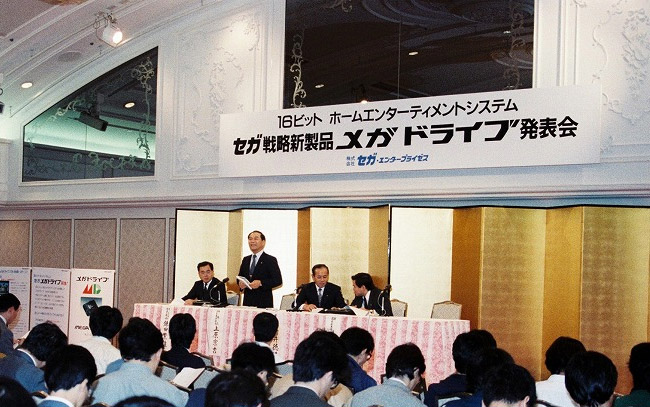
Table of contents:
Part I: Tokyo, 1984
Part II: Champion Boxing
Part III: From arcade to console (and vice versa)
Part IV: Alex Kidd in Miracle World or the birth of a Master System icon
Part V: Breaking out of the canon to go beyond it: the making of Phantasy Star
Part VI: The status of women in the Japanese video games industry
Part VII: Change and new responsibilities
Part VIII: The two Phantasy Star II
Part IX: Working conditions at Sega and in the Japanese video game industry
Part X: A mascot in the making
Part XI: On both sides of the Pacific
Part XII: Final Phantasy
Part XIII: The last Saturn games
Part XIV: Arcadia of my youth
Part XV: Entering History
Games
To be confirmed
Other video game related works
Chronology
Gallery
Sources
General sources (Interviews, liner notes, comments, etc.)
Article aussi disponible en VF
A new console in the works
Almost 3 years after the release of the Mark III, Sega was preparing a new console with the intention of bringing it to market as soon as possible in order to stay ahead of the competition in terms of technology. At the time, the company was one of the leaders in the arcade market, where most of its strengths were concentrated, but it was struggling to take market share from Nintendo in both Japan and the United States.
It was during this period that five new graphic designers were hired: two women and three men, including Yasushi Yamaguchi (Sonic 2) and Toru Yoshida (Phantasy Star II). All were assigned directly to the development of three Mega Drive games: Super Thunder Blade, Space Harrier II and Osomatsu-kun: Hachamecha Gekijō. Due to the turnover the company was experiencing, each team had only one senior graphic designer, with all of the assistant graphic designers being newcomers. While their predecessors had generally enjoyed a certain freedom of choice when it came to their assignments, Sega wanted to increase the number of staff in its consumer division, which meant making some internal policy changes (Yuji Naka had nevertheless suffered the same fate 4 years earlier, when he had hoped to be assigned to the development of arcade games). Yamaguchi and Yoshida made their debut on Super Thunder Blade, even though the former had initially chosen to work on Space Harrier II, the console’s other launch title.
While the programmers didn’t hesitate to ask Sega’s engineers to add certain functions such as zoom or rotation to the Mega Drive’s hardware, the graphic designers were also called upon to contribute:
‘I remember that back in the days of the Mega Drive, the graphic designers were involved in the color selection process to say ‘This is the type of color we want’. When the hardware was still in development, the engineers would show us tests and say ‘this color will look like this if you take out this other color’ or ‘this is what it will look like if you put green next to red’, and we’d say ‘so I want a brighter shade of green’. All the designers took part in this type of discussion several times during the making of the hardware.
In Sega’s case, the colors we used in arcade games were fundamental, and we were tasked with reproducing them on home consoles.’
Preparations for the launch of the Mega Drive coincided with a change in development tools for Sega’s graphic designers. The old Digitizer System, with which you drew using a light pen directly on a screen, was replaced by the model III. The light pen gave way to a drafting mouse that was slid across a white tablet, a tool that Nintendo was also equipping itself with at the same time. While the Digitizer System III still had two screens, a television was sometimes added, which in some cases replaced the screen dedicated to previewing. As each screen had its own rendering, some graphic designers chose to preview their work on several screens at once, while others had a preference for a particular model of screen.
Programmers were not left behind, as the PC-88 computers used until then to write code were replaced by PC-98s, which were more powerful overall.
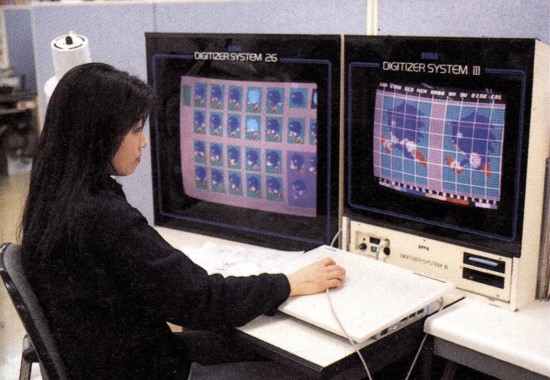
Takako Kawaguchi in front of a Digitizer System III (Sega recruitment brochure)
This was also a period of change for Kodama. One of Sega’s longest-serving graphic designers, she was appointed head of the design section within the R&D2 and given responsibility for supervising the work of the graphic designers. She took part in defining the settings of the games she worked on, becoming involved from the very beginning of the development phases (at least for the original titles), but did not cease to carry out her former duties. She was still a graphic designer and character designer and, like many of her colleagues, helped to train new recruits.
Although she continued to work on a large number of games, the switch to the Mega Drive meant an increasingly heavy workload for each title, with the result that she would no longer be able to work systematically on five or six games each year as she had been able to do until then.
Her change in status had an impact on more than just game creation, and it wasn’t long before she was put in charge of a rather special project at Sega.
Sega Players Enjoy Club
In the second half of the 80s, a number of companies set up fan clubs and began publishing newsletters for their fans, following in the footsteps of the little manuals produced by SNK and put together by its developers. Chieko Aoki, who was already known for dealing with gamers’ mail, got hold of a copy of Compile’s newsletter and decided to tell one of her superiors about it, suggesting that they make something similar. Sega already had a regular promotional brochure with Joy Joy News (1986-1988), but it was more like an impersonal catalogue. As for its telephone service – the Joy Joy Telephone – through which consumers could enquire about a release date, it was limited to a voice mailbox to which graphic designer Takako Kawaguchi lent her voice for a time. The latter, better known as ‘Choko Oneesan’ (Choko being her pseudonym and Oneesan meaning ‘big sister’), certainly had a number of fans of varying ages, but that’s not exactly what Sega’s managing director was looking for. He wanted his company to have its own fan club, and so he responded favorably to Aoki’s suggestion, giving birth to the Sega Players Enjoy Club (SPEC), a fanzine-like magazine whose size and frequency varied greatly from issue to issue, and in which the staff of Sega’s consumer branch expressed themselves.
The first issue appeared in August 1988, already illustrated by Yasushi Yamaguchi, and it was initially Kotaro Hayashida who was officially appointed editor-in-chief, before Rieko Kodama took over. As she herself admited with hindsight, her contributors – including herself – got a bit carried away with the subject and the project, which was based on voluntary work, seems to have been more of a vent than an extra workload. Many Sega employees probably produced their own fanzines when they were still students and, years later, some of them would take a day off work to come to Comiket. The company’s offices were sparsely populated during this twice-yearly event, which showcased thousands of amateur productions, ranging from fanzines to illustrations and games.
The contributions were not only open to the company’s graphic designers, but also included Miki Morimoto, whose fan club grew from issue to issue, Chieko Aoki, who ran the letters to the editor column under the pseudonym Okarun, and the composer Izuho Numata (Phantasy Star III and IV), who took to her pencil to draw some of her colleagues.
As well as rankings, technical sheets, interviews with colleagues and comic strips, several comic strips were featured in the pages of SPEC. Kodama herself signed one of these Phantasy Star-related comics, while she supervised the comic that later served as the basis for Phantasy Star IV, drawn by Toru Yoshida, who would design the game’s characters. It was also within the pages of SPEC that we found some of the first drawings relating to Sonic, illustrated by Naoto Ohshima or his colleague Tsukasa Mori.
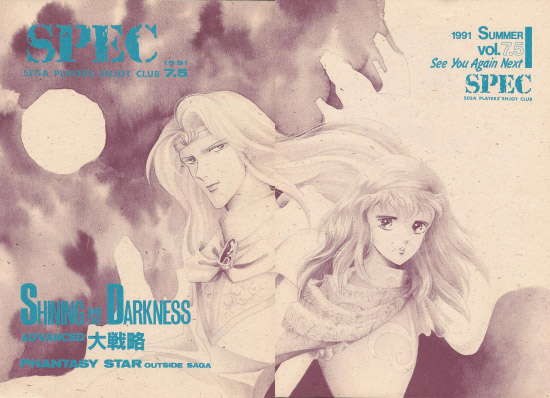
Cover of an issue of SPEC illustrated by Kodama
A total of 11 issues were produced between 1988 and 1993, while a twelfth was started but then shelved during the development of Magic Knight Rayearth, preventing Yamaguchi from continuing the comic he had begun.
Altered Beast
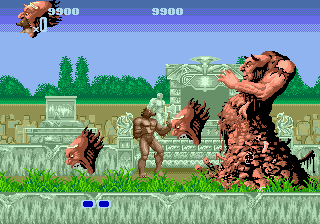
Influenced by Ray Harryhausen’s films and by Michael Jackson’s transformation into a werewolf in the ‘Thriller’ video clip, Altered Beast is a beat’em up originally released in arcades in June 1988 and whose adaptation for the Mega Drive was started even though the console’s hardware had not yet been finalised. The developers did not yet have access to all of its features, particularly those related to display: certain colors could not yet be used and the number of sprites that could be displayed on screen was not the same as that which the final version of the console would be capable of.
‘The console prototype was supposed to be about one meter by two meters. To this day, when I think of the Mega Drive, I think of that development version (laughs)’.
The team in charge of this adaptation only had 3 months to hand in their copy and Kodama, for whom this was her first Mega Drive game, was in charge of adapting the backgrounds.
‘As it had already been released in arcades, I redrew everything by looking at the original graphic data. The number of colors that could be used in the arcade version and on Mega Drive was different, so my job was to be as faithful as possible.’
While the Mega Drive doesn’t shine in terms of its range of colors or the number of colors it can display simultaneously on screen, it does have a function that enables differential scrolling. This means that the different elements in the background don’t necessarily scroll at the same speed, unlike the arcade version where each background is made up of a single layer.
‘Altered Beast was the first game for the Mega Drive and I think we were under strict orders to use all its new features’.
Although Kodama didn’t animate the characters, it’s not unlikely that she was responsible for the flame effect surrounding the main protagonist during the transformation sequence (her memory failed her when she was asked about it). It is certain, however, that it was not she who drew the bear that appears in these transformations.
Altered Beast was released in November 1988, a month after the console’s launch, making it the 3rd game to be marketed on this machine and one of its first technological showcases. Its inclusion as a bundle with the console in the USA and certain European countries contributed greatly to its fame, even though the game was not necessarily one of the console’s most popular titles.
Alex Kidd in the Enchanted Castle
One of the other games Rieko Kodama worked on in the run-up to the launch of the Mega Drive was Alex Kidd in the Enchanted Castle, the console’s only episode. In addition to unfinalised hardware and once again very tight production deadlines, the developers had to contend with another factor: the size of the cartridge, limited to 2 megabits. Kotaro Hayashida indicated that this was due to the desire to sell the game at a lower than average price, but it’s not impossible that the ROM shortage suffered by the entire industry in 1988 was the main reason. Osomatsu-kun: Hachamecha Gekijō itself saw its cartridge size reduced during development. However, this may also have been due to a desire to position Alex Kidd as a title aimed primarily at a younger audience, generally less affluent than teenagers and young adults.
While the Japanese title of this 16-bit episode – for a long time the last in the series to be released in Japan – mentions a castle in the sky, Alex Kidd in the Enchanted Castle doesn’t exactly have the aesthetic mastery of Hayao Miyazaki’s film. Barely more detailed than the first episode released on Mark III, it fails to turn the simplicity of its graphics to its advantage, producing a disappointing result overall, but one that Kodama nonetheless remembered fondly.
‘The game console was still in development so we couldn’t make full use of color and we couldn’t make full use of characters either. Luckily, I had a female supervisor who encouraged me. It ended up being an incredible experience and we were able to make a great game.‘
Although she indicated in the mid-2000s that she had designed all the game’s backgrounds, Kodama gave a different version of events in later interviews, indicating that she had only designed part of them. This uncertainty, contributed to by the absence of credits in the game, leaves another point in doubt. The book ‘Sega TV Game Genga Gallery’ published in 1994 states that the game’s box art was not created by external illustrators, as was the case for previous Mega Drive games, but by two in-house graphic designers: the person in charge of the game’s characters (probably Yoko Kobayashi) and the person in charge of the backgrounds. Thus, it’s not certain that Kodama was responsible for drawing the background for this illustration, which is exclusive to the Japanese version.
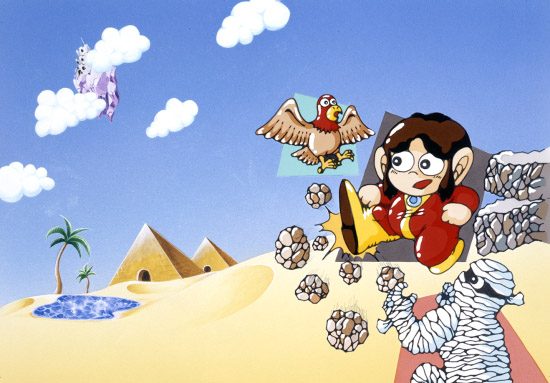
Box art for the Japanese version of Alex Kidd in the Enchanted Castle
The game was presented at the same time as the Mega Drive at a press conference held in September 1988, 2 months before the console’s release. For its launch, Sega’s 16bit was to have been accompanied by Space Harrier II, Super Thunder Blade and Altered Beast, which were also presented at the conference, but only the first two titles were released on time. Altered Beast was delayed by a month, while Alex Kidd, scheduled for November 1988, saw its release date postponed to January 1989. Yosuke Okunari indicated decades later that the developers had encountered difficulties with the console and that the debugging period had to be extended. Another factor that may have had an impact: according to Yasushi Yamaguchi, development of Space Harrier II, Super Thunder Blade, and Osomatsu-Kun did not begin immediately after the graphic designers were assigned to each team (presumably because the necessary personnel were not yet available).
Alex Kidd in the Enchanted Castle and the Mega Drive version of Altered Beast were developed over a period that Kodama modestly describes as a ‘3-month project’. During this period of intense work, which seems to have lasted a little longer than expected, she also worked on a third game that she often avoided naming: the Mark III version of Phantasy Star II.
—-Chronological point #2—-
Due to the lack of information about Yoko Kobayashi, it’s not clear why Kodama became head of the graphic design section when her colleague with more seniority than her was presumably still working at Sega (Kodama has made it clear that it was because she was the longest-serving graphic designer that she was appointed head). It’s not impossible that Kobayashi stopped working for a while around 1988 and then returned briefly, allowing Kodama to move up the ranks in the interim.
Page 1 2 3 4 5 6 7 8 9 10 11 12 13 14 15 Sources
———-Support me———-
VGDensetsu is the equivalent of a full-time job for me – I spend an average of 30 to 40 hours a week on it. You can help me continue my work by supporting me financially via Patreon (monthly payment with the possibility of a one-off payment by unsubscribing after an initial payment) or via Ko-fi (one-off payment), or simply by talking about my work to those around you.