



Rieko Kodama – Part XIV: Arcadia of my youth
Table of contents:
Part I: Tokyo, 1984
Part II: Champion Boxing
Part III: From arcade to console (and vice versa)
Part IV: Alex Kidd in Miracle World or the birth of a Master System icon
Part V: Breaking out of the canon to go beyond it: the making of Phantasy Star
Part VI: The status of women in the Japanese video games industry
Part VII: Change and new responsibilities
Part VIII: The two Phantasy Star II
Part IX: Working conditions at Sega and in the Japanese video game industry
Part X: A mascot in the making
Part XI: On both sides of the Pacific
Part XII: Final Phantasy
Part XIII: The last Saturn games
Part XIV: Arcadia of my youth
Part XV: Entering History
Games
To be confirmed
Other video game related works
Chronology
Gallery
Sources
General sources (Interviews, liner notes, comments, etc.)
Article aussi disponible en VF
New Saturn RPG
From the adaptation of Virtua Fighter 3 to Sonic Adventures and Shenmue, the Dreamcast is not short of titles originally intended for release on Saturn, in a form more or less different from their revail version. Among these is Eternal Arcadia, also known as Skies of Arcadia in the West and Project Ares to some Sega employees.
Despite all the ranks she had climbed throughout her career, Kodama had almost always worked on projects that had begun before she was assigned to the various development teams involved, and Skies of Arcadia was no exception to this phenomenon.
‘The whole conversation about a new original RPG, that conversation was actually initiated by the previous producer, not me. For financial reasons, it was decided to start off with a small team of 5-6 people, who would first come up with a good direction for the game, and figure out what direction we were going in.‘
The name of the producer who preceded Kodama and initiated the project was not revealed. They were not the only notable member of the development team to leave the project without being named.
Work on Project Ares began on Saturn at a time when the Dreamcast console project had not yet been officially announced within Sega; the developers themselves were not kept in the loop by the engineers. The small team in charge of the game’s pre-production already had in mind the idea of making it a fully 3D RPG, but had not yet incorporated the concept of air pirates. There was even talk at one stage of making a game set on land, with battles taking place on top of trains.
However, while research had been carried out into the characters and backgrounds, it seems that the work of the graphic designers and programmers had not yet begun at this stage of development.
‘We hadn’t gotten very far. We had drawn some concept artstarted working on the story and setting, but there was nothing playable yet.’
Over and above the technical constraints imposed by the Saturn in terms of 3D environments, the project stalled in several respects, until Shuntarō Tanaka took over as director. He joined Sega during the development of Phantasy Star IV and was assigned to the same department as the team in charge of the game, even though he did not work on it. He did, however, hold the position of planner on several titles, including the RPG Blue Seed and the first two Sakura Taisen on Saturn. After telling his superior that he wasn’t very motivated by the idea of working on the third episode in this series, the latter told him that another RPG was in development for Saturn.
Tanaka indicated that the Project Ares team was not satisfied with a number of points, including the combat system, the story and the game’s setting. So he asked his colleagues to let him rework a large part of the project. Together, they agreed that the game should be an adventure set in a world of floating islands, a concept that would be retained when the project moved to Dreamcast.
Spiral Zone
Towards the end of 1997, Sega officially announced its new console internally and accompanied this announcement with a request to the Project Ares team: to release the game for the launch of the Dreamcast at the end of 1998. In other words, the team, which still consisted of only a handful of members, only had a year to form, familiarise themselves with this new console and develop a large-scale RPG. What’s more, the developers were instructed to exploit all the console’s capabilities and get the most out of it, which meant using the VMU, a hybrid between a memory card and a handheld console, for which a dedicated mini-game was developed. The modem was also used as part of a system for collecting animal species that could be used to upgrade weapons. Added to this are transparency effects (difficult to achieve on Sega’s previous console) and adaptive music, all of which add to the developers’ workload.
As a producer, Kodama was no longer as involved in day-to-day development as she had been on previous titles, and instead supervised all the work on the game once the foundations had been laid.
‘I don’t think I had looked at the storyboad much, but I helped craft the story, world, and gave my input about how I thought things should be. Also, once a section was completed to a certain extend, I’d play through it and give my input.‘
What’s more, her position meant that she wasn’t exclusively devoted to Eternal Arcadia during its development. Deep Fear was still in progress when work began on this RPG, and Kodama was also producer on Atsumare! Guru Guru Onsen, the first instalment in a series of party games offering online play, which preceded ChuChu Rocket by a few weeks in this regard.
She was not, however, detached from development of Eternal Arcadia, and saw it as a way of fulfilling her childhood dream of exploring temples and pyramids and travelling to the end of the world.
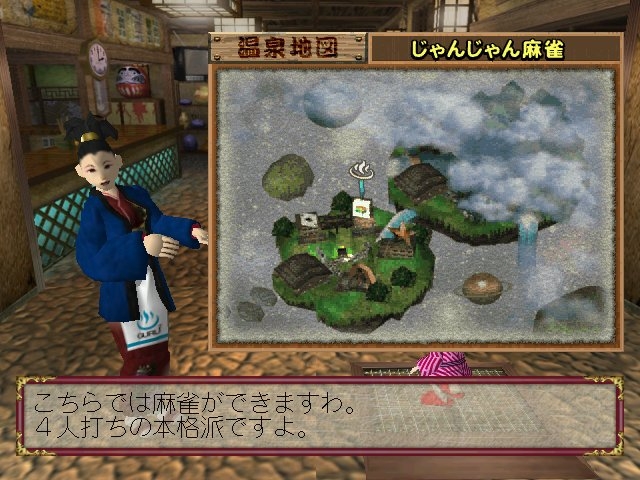
Atsumare! Guru Guru Onsen
Intertwined inspirations
Although Tanaka was the main architect of the world of Arcadia, he didn’t hesitate to solicit ideas from other members of the team to define the various locations to be explored. Inspired by Dragon Quest III, most of the game’s regions are more or less taken from our own world, ranging from fantasy versions of ancient Egypt to pre-Columbian civilisations, the Orient and medieval Japan. In addition to these settings aimed at recreating the Age of Discovery, there are a number of regions that lean towards steampunk or even science fiction, revealing some of the developers’ sources of inspiration. Apart from Captain Harlock, a manga by Leiji Matsumoto in which a space pirate wearing an eye patch travels aboard the Arcadia, and Robert Louis Stevenson’s classic Treasure Island, the influence Tanaka cited most openly was Laputa, a film by Hayao Miyazaki that openly references Gulliver’s Travels (and which also had Stevenson’s novel among its references). It features flying islands, steampunk elements, flying ships, a female character who falls from the sky and an empire that hunts down the main characters.
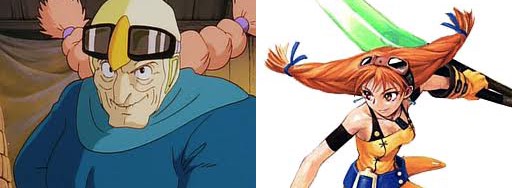
Two generations of air pirates
But the script written by Miyazaki also formed the basis for the series Nadia: The Secret of Blue Water, which features more or less the same elements as those mentioned above, with the addition of an antagonist belonging to the same people as the heroine. The Nadia series itself probably served as inspiration for Grandia, one of the flagship RPGs for the Saturn released in 1997 and which, by virtue of its shared inspirations, has even more similarities with Eternal Arcadia than with the aforementioned works (so much so that one might wonder whether Grandia wasn’t used as a model for Sega’s game). /!\ Spoilers /! \ In addition to the aforementioned elements carried over from one work to another, the cast of characters running through the story is very similar, with the Germanic-sounding army giving way to one with more Hispanic names, while the protagonists discover that the end of the world is a wall they can cross (and, by extension, that their planet is round) ; the antagonist, who belongs to the same people as one of the heroines, turns against his army towards the end; one of the antagonists, in love with her superior, sacrifices herself, and so on. /!\ End of spoilers /!\
Unresolved conflict
Despite all the similarities in the storylines and the sense of adventure shared by the two titles, they differ in terms of both their setting and the appearance of their characters. The latter task was originally entrusted to Shinichi Morioka, a former SNK designer whose work includes some of the characters from The King of Fighters series. His designs, with their darker, more serious style, were used to illustrate the first Skies of Arcadia previews, but a conflict seems to have broken out internally, which may be the reason for his departure.
“We had this stormy discussion over the visual character design of Vyse, which caused the team to split into two. Just to make decisions over the hair style, or trouser color (white versus black); the heated discussion took place and continued until the morning, even involving the president of the company at that time!“
The spiky hairstyle seen in Morioka’s illustrations was replaced by a style closer to the one worn by Vyse in some of the early concept art.
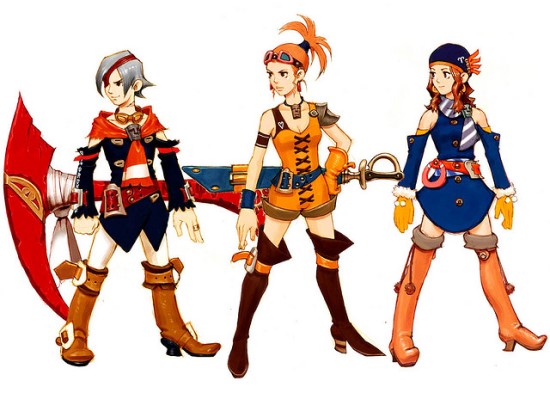
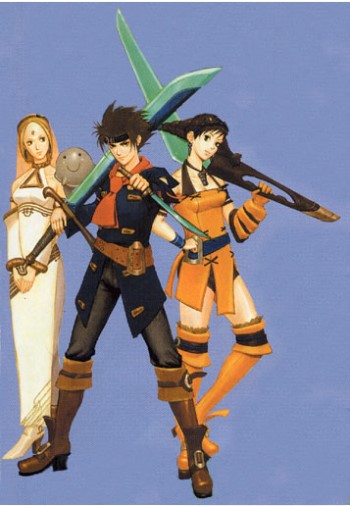
Top: Concept art by Shinichi Morioka.
Bottom: Character illustration drawn by Morioka, which was used at the beginning of the game’s promotion.
Morioka handed over the reins to freelance artist Itsuki Hoshi and was not credited in the game. It would be years before he posted his illustrations and concept art on his Flickr page, in what appears to be one of his last works related to video games. As for Hoshi, she was tasked with drawing a manga adaptation of the game, something Kodama had been keen to do since the beginning of the project.
Sega’s developers were also asked to contribute to some of the designs, and an internal competition was launched to define the appearance of the Loopers, the game’s most basic enemy. As for Atsushi Seimiya, one of the game’s directors, he was responsible for part of the mecha design (spaceships, robots).
Another point on which Sega sought to distinguish itself from the competition concerned cinematics. They were used extensively to promote a number of games from the second half of the 90s, but some gamers were suspicious of them, deploring the fact that the cutscenes used in some TV commercials did not really reflect the content of the games in question. So it was decided to use the game’s engine to show the dialogues and scripted sequences in Skies of Arcadia.
Development was completed after almost 3 years’ work, and the game was released in Japan on October 5, 2000, following a final delay that meant it narrowly missed the summer release window and a crunch phase during which Kodama and her team worked tirelessly to track down bugs. Shortly afterwards, while promoting the American version of the game, the producer admitted that she had come out of this phase in a state of both physical and mental exhaustion.
During those three years, the department responsible for the game changed its name several times, a sign that Sega has undergone restructuring in the meantime. Sega CS2 became R&D 7 in 1999 before becoming Overworks in 2000, when the company decided to give its various development departments their independence.
After the Dreamcast
As luck would have it, Eternal Arcadia was released a few months after Grandia II on the same console, quickly making the two titles the Dreamcast’s leading RPGs. However, the console’s mixed success and the announcement of its premature discontinuation shortly afterwards prompted their respective publishers to consider adapting them for other platforms.
While rumors circulated about a possible PS2 adaptation, Sega finally set its sights on GameCube.
‘I went to Nintendo to explain the project to them. I went to their headquarters in Kyoto and I was really impressed (laughs). I’d spent my whole life at Sega and I never imagined the day would come when I’d go to Nintendo!’
‘It was a very strange feeling. What we had done in Sega’s boardroom, we were now doing in Nintendo’s.’
Despite being generally more powerful than the Dreamcast, the GameCube does not offer exactly the same functionality, forcing the team in charge of this adaptation to program what was previously handled natively by the original console. Small changes and additions were made for this ‘Legends’ version, which was released almost 2 years after the original.
Kodama was subsequently asked several times about a sequel to this game, which was one of her favourites, and in 2004 and 2008 gave answers similar to those given for Phantasy Star 5:
‘We’ve had some plans, but the other team members are busy with games like Sakura Taisen right now, so it’s on hold for the time being. But I think another game in the setting, with the sky pirates, would be great.‘
‘The game was well accepted in both Japan and the United States, and was in fact more popular in the United States than Japan. It makes me very happy and I would love to make a sequel.’
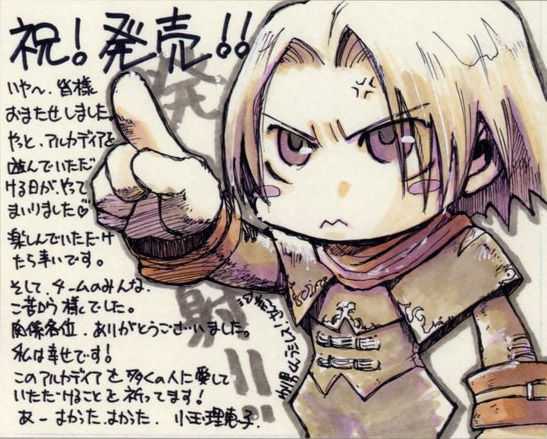
Drawing made by Kodama for the Eternal Arcadia Visual Book
Page 1 2 3 4 5 6 7 8 9 10 11 12 13 14 15 Sources
———-Support me———-
VGDensetsu is the equivalent of a full-time job for me – I spend an average of 30 to 40 hours a week on it. You can help me continue my work by supporting me financially via Patreon (monthly payment with the possibility of a one-off payment by unsubscribing after an initial payment) or via Ko-fi (one-off payment), or simply by talking about my work to those around you.