



Ayano Koshiro – Part 4: The birth of Ancient
Table of contents:
Part 1: A family of artists
Part 2: The Falcom years
Part 3: Transition to freelancing and amateur games
Part 4: The birth of Ancient
Part 5: The end of the 16-bit era
Part 6: Entering the era of 3D graphics
Part 7: Struggling projects
Part 8: Gradual departure from development
Sources
Games
Gallery
Article aussi disponible en VF
Sonic the Hedgehog
In 1989, following the success of the first Shinobi and its adaptation on a wide range of machines, Sega decided to launch a sequel on Mega Drive, known in the West as The Revenge of Shinobi. Series born in arcades and continued on consoles were not uncommon at the time, with Fantasy Zone and Space Harrier, for example, meeting the same fate. Although development of the game, carried out in-house at Sega, was already well advanced, the recent release of its new console and the need to continue supplying the Master System’s game library and producing arcade games meant that hands were running out. Yuzo Koshiro was contacted through a new recruit, a former editor of Beep! magazine who would later produce the arcade version of Moonwalker – Roppyaku Tsurumi. The composer had already built up a number of relationships with people in the industry and enjoyed a certain reputation. Tsurumi, who was friends with producer Noriyoshi Oba, invited Koshiro to meet him, marking the beginning of a long working relationship between the two men.
As for the sequence of events, although the chronology is not completely clear due to variations in the different accounts provided by Yuzo Koshiro, we do know that Ancient was founded on April 1, 1990, probably after discussions with Sega during which he was asked if he knew of any companies capable of developing Game Gear games (a console that would not be released until October 1990). The composer thought that he already knew a few programmers and graphic designers, so he felt that he could develop games with some of them. He replied to Sega in the affirmative, indicating that he knew some qualified people and exaggerating a little in order to obtain proposals for game development.
Once he had given his answer, Sega told him that it was necessary to form a company in order for their collaboration to take place. And so Ancient was born, the literal translation of Koshiro into English, with Yuzo and Ayano’s mother, Tomo Koshiro (born on March 5, 1939 and still active on Instagram), as president. However, the studio was unable to accept projects straight away, as Ayano and her brother were already busy working on Actraiser.
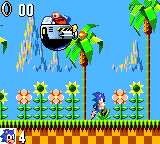
The following year, producer Tomio Tamaki asked Yuzo to work on an adaptation of Sonic the Hedgehog for Game Gear. Originally released on the Mega Drive, this unheralded title made its character the de facto mascot of Sega (the competition organised internally by Sega to choose a new mascot was halted before completion) and producing an adaptation for its new portable console made sense.
We may well question the relevance of entrusting such a title to a company that had just been set up but, as Masaharu Yoshii, formerly in charge of Sega’s consumer division, pointed out decades later, most of the Game Gear games produced by Sega were in fact developed by other companies. It’s likely that Sega didn’t have enough in-house teams to develop for its 8-bit console and preferred to concentrate on the Mega Drive, which required more resources and was aimed at an older and perhaps more demanding audience than Game Gear. What’s more, it’s not impossible that the Japanese branch of Sega underestimated the impact its hedgehog would have outside its home market. There’s only a 5-6 month gap between the releases of the Mega Drive and Game Gear versions, which implies that development pesumably began before the success of the 16-bit version was confirmed and probably before it went on sale. Finally, even if the quality wasn’t there, the game would still have benefited from the notoriety of the Mega Drive version, which would have enabled it to sell out on its own.
Just after working on the first Streets of Rage, Yuzo Koshiro took charge of Sonic’s soundtrack, using some of the compositions from the original version while creating new ones on his PC-88. He also called on programmer Shinobu Hayashi, who also acted as game planner, while Ayano designed a large part of the graphics and worked on the level design. It was she who animated Sonic and determined the appearance of each of the game’s zones, some of which were taken from the Mega Drive version. A fourth person joined the trio already at work on The Scheme: Takefuni Yunoue, a former high school friend of Yuzo’s, who assisted Ayano with the graphics.
The composer found development difficult, not least because of the small size of the team, which was not in close communication with Sega (a phenomenon also experienced by Treasure). The graphic designers worked on X68000 computers with graphics software designed in-house for the occasion, and one of the main difficulties Ayano encountered was the Game Gear’s low resolution (160 × 144), much lower than the machines she had worked on previously. On the other hand, she took advantage of the console’s wider color palette – 4096 compared to 512 on the Mega Drive – to create more vividly colored graphics than those on the 16-bit version.
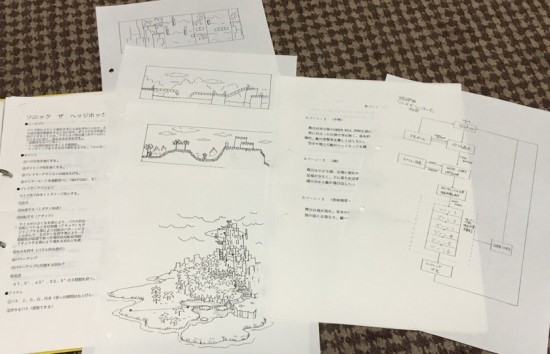
proposal
Once development of the game was complete, Sega asked Ancient to adapt it for the Master System, a machine that was no longer being sold in Japan and was living out its last days in the USA, while continuing its career in other parts of the world such as Europe and South America. The conversion was carried out quickly, given the similarities between the two machines (starting with a Z80 processor), even if adjustments had to be made here and there. This was particularly true of Sonic’s sprite, which was completely redesigned to fit a higher resolution and a larger game window.
Both versions were released at the end of 1991 and were a great success, giving Ancient the means to fund the construction of new premises. However, there was one notable omission from the game’s title screen: in addition to the fact that Yuzo Koshiro’s name did not appear on it, Ancient’s name was nowhere to be seen, even though it was present in the ROM alongside Sega’s name and could be seen in some previews published before the game was released. Thus, Ancient’s first didn’t bear the Ancient name, even though the developers were credited in their own name in the end credits.
Lunar: The Silver Star
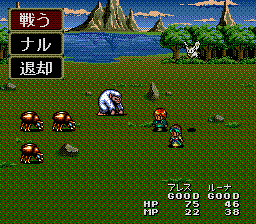
In the summer of 1991, Sega presented some of the first games for the Mega-CD, the Mega Drive’s CD-ROM drive. Sega’s 16-bit games did not shine in terms of quantity of RPGs and Lunar: The Silver Star was designed to become one of its main representatives. Like Tengai Makyō on the PC Engine CD, it was a relatively large production involving dozens of people, something that was not yet the norm in the industry.
Lunar was born from the coming together of several studios and talents, starting with Game Arts, which set its sights on the Mega-CD to explore the full potential of the CD-ROM. Until then, this company, which had specialised in computer games, had only made rare forays into console games, and Lunar was a project that could potentially fulfil its ambitions. To develop what was to become the first episode in a series, it joined forces with another company called Studio Alex. At the head of the latter was Kazunari Tomi, who had left Falcom some time earlier with some of his colleagues.
At the same time as Lunar, Game Arts was working on Alisia Dragoon, an action-oriented Mega Drive game for which it collaborated with Gainax. Primarily known as an animation studio, Gainax began producing computer games in the late 80s, putting the talents of its animators to work in an activity that was ultimately more profitable than anything the studio had ever produced in the animation field. Among the artists hired by Gainax was animator and character designer Toshiyuki Kubooka, who worked on Gunbuster and Nadia and the Secret of Blue Water. While he was employed at Gainax, his colleague, scriptwriter Kei Shigema, promised to make a game with him one day.
Shigema wrote the script for Lunar, while Kubooka designed the characters, drew the cinematics and produced the game’s illustrations. The cast included at least three Falcom veterans in addition to Tomi: graphic designers Takahiro Ōura and Yoshimi Satō, who had already worked on Ys (which probably explains Adol’s cameo appearance), and Ayano Koshiro, who was called in by Tomi to design the game’s monsters. She studied the bestiary of titles such as Golden Axe and Daimakaimura / Ghouls ‘n Ghosts before setting to work, and went on to draw almost 90 monsters. As for the animation, she animated some of them herself, then trained the novice graphic designers so that they could animate the rest of the bestiary.
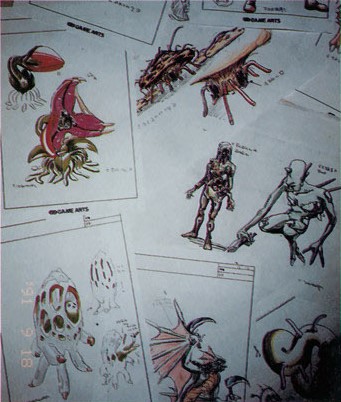
Some of the monsters designed for the game
Lunar: The Silver Star was released in Japan in June 1992 and became one of the best-selling Mega-CD games on that market. As for Ayano Koshiro, she probably didn’t wait for development to be completed before tackling other projects.
Gage
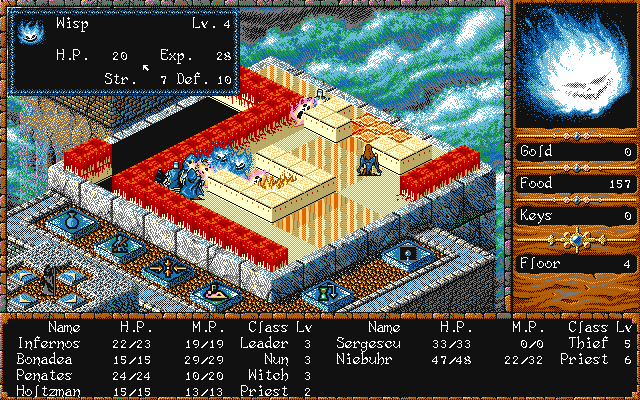
A strategy game released on PC-98 in September 1992, Gage was the fruit of one of the many collaborations between Yuzo Koshiro and Mikito Ichikawa, a programmer slightly younger than the composer but with whom he shared many similarities.
The two men met at Dempa Shimbunsha, where Koshiro wrote for the magazine and Ichikawa developed games. When Ichikawa, still in his school uniform, needed music for one of his games – The Curse of Mars, released on Sharp X1 in 1988 – he asked the composer to do it. Koshiro, who recognised his uniform from having attended the same high school a few years earlier, accepted the offer. In the years that followed, Ichikawa regularly called on the composer to create music for games produced by the company he had founded: MNM.
On Gage, Koshiro was not the only Ancient employee to be credited, as he was assisted on the music by Ayako Yoda and Motohiro Kawashima (whose mother was also a piano teacher) and accompanied by his sister Ayano on the graphics.
Development of Gage began at the end of 1991 and, for Ichikawa and his company, ran in parallel with that of another game on which he was working with Kawashima and the Koshiros: Streets of Rage 2.
Streets of Rage 2
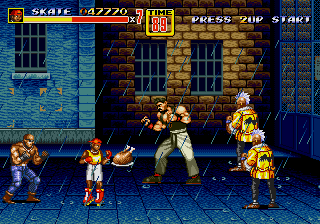
“SoR1 not a hit in Japan. SOJ (Sega of Japan) didn’t want to make SoR2. Took a LOT of convincing.” It was with these words, telegraphed on Twitter in 2015, that former Sega of America marketing director Al Nilsen described the situation in which the Streets of Rage series found itself after the release of the first opus. While we don’t have any sales figures for this episode, we do know that a certain amount of time elapsed between its release in the summer of 1991 and the start of work on its sequel, development of which probably began around February 1992. What’s more, unlike the original, Streets of Rage 2 was mostly made by developers outside Sega, with Ancient Studio in charge of the project. However, according to Yuzo, the president of SOJ – Hayao Nakayama – didn’t consider the project to be of secondary importance – quite the contrary.
While Streets of Rage 1 clearly drew its inspiration from Final Fight, Streets of Rage 2 is based more on a game from a genre other than beat’em up, namely Street Fighter II. Since its arcade release in March 1991, much of the video game industry tried to replicate its success, often with a similar formula. But when Nakayama invited Yuzo into his office to explain how he envisaged a sequel to Streets of Rage, he demanded that the composer surpass Street Fighter II and, to do so, had a cabinet of the game delivered to Ancient’s offices. The Koshiros were already big fans of Capcom’s game, with Yuzo spending many hours playing with his former editor-in-chief Akira Yamashita. He even went so far as to buy his own Street Fighter II Champion Edition cabinet later on, after returning the one lent to him by Sega.
While it’s difficult to transpose the mechanics of a one-on-one fighting game into a beat’em up, the Koshiros have tried to adapt many of the elements of Street Fighter II in Streets of Rage 2. This is reflected in the feel of the game, the essence of the combos, the diversity of the characters, including a wrestler reminiscent of Zangief in many ways, and the special moves that were absent from the first opus. A battle mode was also introduced, albeit with fewer characters than initially envisaged. Shiva, the game’s penultimate boss, had to wait until Streets of Rage 3 before he was released from his status as a mere NPC. The idea of a battle mode, already sketched out in the story modes of Double Dragon (1987) and Streets of Rage 1 (1991), in which the two players faced each other at the end of the game, was taken up again and enriched years later in Guardian Heroes (1996), a game produced by Sega and developed by Treasure.
The development of Streets of Rage 2 began as a small team, with a period of field research for Ayano. She and her brother were in charge of game design (the latter proposed a fencer character, a sport he himself had practised), but not being an expert in martial arts, she decided to go to a bookshop to acquire documentation on the subject. She also went to a boxing club to build up her own visual references before moving on to the graphics stage.
From the start of development, the Ancient team knew that they would have to work with a cartridge 4 times larger than the first episode, which for Ayano meant drawing bigger sprites. But this came with a constraint: the game had to be completed in 7 or 8 months in order to be on US shelves by Christmas 1992.
Kataru Uchimura, who later joined Ancient, was called in as a back-up planner. Although his role was to flesh out the design document drawn up by the Koshiros at the start of production, it was not adhered to to the letter, with the various members of the team not hesitating to put forward their ideas and test them on the fly throughout development.
Ayano designed all the characters and a large part of their move sets. She also animated the 4 playable characters, some of the bosses (Shiva, Jet, Boxer, Robot), most of the enemies and even drew a handful of backgrounds, all on an X68000. As the Mega Drive has rectangular pixels, she had to take this into account when drawing the sprites and backgrounds, using a television screen to preview the game’s graphics more faithfully than on an X68000 screen. The characteristic blurriness of the television screens of the early 90s and the pixels which, depending on the colour, appeared smaller or larger on these same screens were all elements that she had to take into account when working.
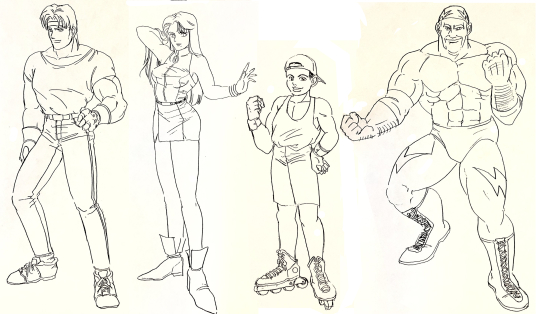
The 4 main characters
For the other characters and backgrounds, production deadlines did not allow her to do everything, so it was decided to call in outside help. In addition to the few developers sent by Sega (including Atsushi Seimiya, the only graphic designer to be credited on the first three episodes of the series), there were 4 people who worked or had worked at Winds. Satoshi Nakai, who had designed most of the graphics for Gynoug, took charge of several backgrounds, including those for level 5 (the boat). His colleague Kouichirow Kobayashi also drew backgrounds, while Tomoharu Saitō animated the game’s first boss, Barbon, and brought in his former colleague Hitoshi Ariga to work on an alternate version of the same boss. Having recently gone freelance so that he could draw manga on the side, Ariga was just 19 when he joined the team. He and Saitō were already busy working on another game in parallel – Ranma ½: Bakuretsu Rantōhen -, but Yuzo nevertheless asked Ariga to work on another boss, then another, then a fourth. In the end, Ariga took on Jack, the mid-boss of the first level, Abadede, the wrestler in the fourth level, and Mister X, the big bad of the story, in addition to the alternate version of Barbon. While he freely adapted Abadede and Mister X based on their counterparts in the first episode of the series, the character of Jack was born from a sketch drawn by Ayano.
After being trained by Saitō – his former superior – Ariga was taught by Ayano, two years his senior. Although he considered her to be just as strict as Saitō, he learned a great deal from her, particularly in terms of coloring. In particular, she asked him to redo the coloring of Jack, which was a little too monochromatic in his first version. The two of them shared the design of the ending illustrations, while Ayano drew one of the two opening illustrations (the one showing Mister X reigning over the city, the other illustration being taken directly from the ending of the previous episode). As for the portraits on the character select screen, we know that Nakai drew Sammy’s, who was renamed Skate in the West. Regarding the other bosses, enemies and backgrounds, they were all created under the supervision of Ayano, the game’s art director. As she was rarely satisfied with the initial renderings, she often had to ask for a particular enemy or a particular section of background to be redone, when she didn’t make the changes herself.
The amount of work put in by Ayano Koshiro is all the more impressive when you see the final result, with its relatively large, detailed sprites and highly detailed backgrounds. Despite being released in the middle of the console’s lifespan, Streets of Rage 2 is still one of its most visually accomplished titles, starting with its first level, which was completed last and which features a host of visual effects (pseudo-transparency, rain, non-linear scrolling).
The game is teeming with references reflecting the tastes of the members of the development team, and the Koshiros readily admitted to incorporating elements from contemporary manga into the production of their title. For example, the underground arena beneath the Level 4 stadium is a reference to Baki, which also served as a source of inspiration for the character of Shiva (and for several Capcom and SNK games). Enemies are named by family, each with its own theme: weather conditions (Fog, Hail, Frost, Mist), birds (Eagle, Raven, Condor, Falcon, Bantam), fighter planes (Jet, Mach, Stealth, Griphis), chemical elements (Particle, Molecule, Isotope, Uranium), colors (Y.Signal, R.Signal, B.Signal). References to manga and animation series include Berserk (Caska, Griffith, Vehelits / Behelit, Donovan, Ganbeeno (eventually renamed Galsia), Shiva, Dante and Garuda), Densetsu Kyojin Ideon (Abadede, Zamza), Hokuto no Ken (Suicho, Dante, Heart, Souther, Wayne) and Jojo’s Bizarre Adventure (Joseph, Jonathan, L.Lisa (Lisa Lisa), Sug Q (Suzi Q)). Other references include the ninjas, named after actors who have appeared in films featuring sword or hand-to-hand combat (Toshiro Mifune, Sonny Chiba, Sho Kosugi), and Jack’s family, a reference to Soybean Candy (Jack, Beano and Soya).
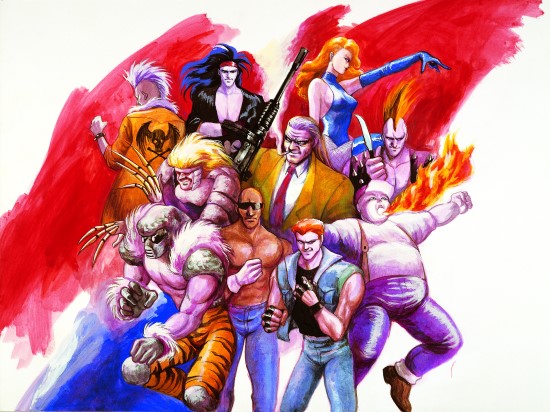
Manual illustration by Ayano Koshiro – one of her rare works as an illustrator for a video game.
Sega of America didn’t have many objections to the design, but did provide documentation (magazines, etc.) so that the game would be more in line with what some people in their marketing department considered to be the tastes of American children, particularly when it came to the character of Skate, an Afro-descendant kid in roller skates. One of the main requests made beforehand was to give Blaze a different costume from the one she wears in the first episode. The game’s female character underwent another modification during development, with Sega’s American branch requesting that her crotch no longer be visible during her jump kick. In fact, the animation of this move differs between the Japanese and Western versions.
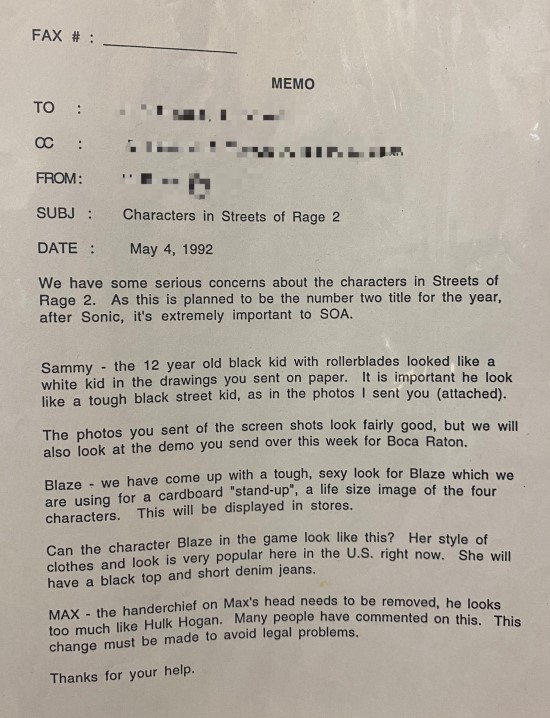
Document sent by Sega of America and dated May 4th, 1992. Work on the game’s graphics had already begun at this point. Development was due to finish around September, with the remaining 3 months until Christmas to be used for cartridge production.
As for the game’s sound, Mikito Ichikawa’s company produced a sound engine for Yuzo Koshiro, who continued his work of importing Western dance sounds, while his colleague Motohiro Kawashima added his own touch to two of the game’s tracks. The sound effects are exaggerated and contribute greatly to the feeling of safisfaction that the player feels with each blow inflicted. As for the digitised voices, they were all recorded by Yuzo Koshiro with his own voice, then modulated as required (particularly for Blaze).
The game was released on time in the United States, a few days before Christmas, then in January in Japan and finally in Europe, with a few differences here and there.
It was sufficiently successful that Sega decided to start work on a sequel in the following months, but this was made in-house with part of the team from the first episode, much to the displeasure of the Koshiros. While Yuzo wanted to develop this third opus within his studio, Sega only turned to Ancient for the musical part, for which the Koshiro-Kawashima duo returned.
Although no reason was given, it is possible that Sega realised the value of its licence and therefore felt that it needed to be developed in-house. Several third-party companies that had developed titles exclusive to the Mega Drive noticed a change in Sega’s internal policy at this time. Companies such as Climax and Sonic Software Planning / Camelot reported years later that they felt Sega’s producers were now less inclined to the idea of producing games developed outside their premises (apart from sub-contracting). It has to be said that the company’s payroll had grown considerably in the space of a few years, reducing the need to call on outside companies. What’s more, major industry players who had previously been reluctant to produce games for the Mega Drive (Capcom, Konami) were now keen to work with Sega, attracted by the machine’s success in the West and the potential sales that this implied.
However, Ayano Koshiro’s next project was a Sega-related production, involving one of its flagship licences.
———-Support me———-
VGDensetsu is the equivalent of a full-time job for me – I spend an average of 30 to 40 hours a week on it. You can help me continue my work by supporting me financially via Patreon (monthly payment with the possibility of a one-off payment by unsubscribing after an initial payment) or via Ko-fi (one-off payment), or simply by talking about my work to those around you.