



Ayano Koshiro – Part 8: Gradual departure from development
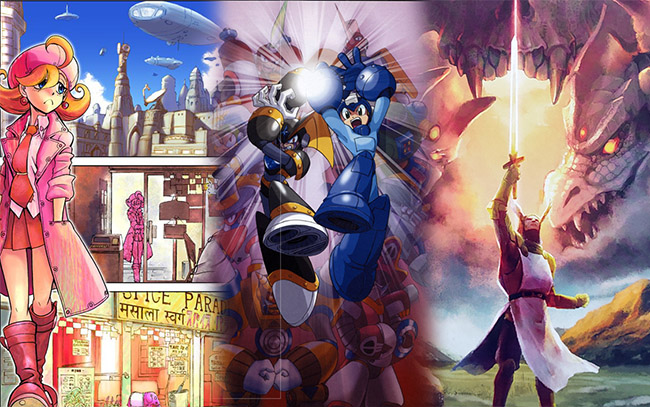
Table of contents:
Part 1: A family of artists
Part 2: The Falcom years
Part 3: Transition to freelancing and amateur games
Part 4: The birth of Ancient
Part 5: The end of the 16-bit era
Part 6: Entering the era of 3D graphics
Part 7: Struggling projects
Part 8: Gradual departure from development
Sources
Games
Gallery
Article aussi disponible en VF
Mangas and illustrations
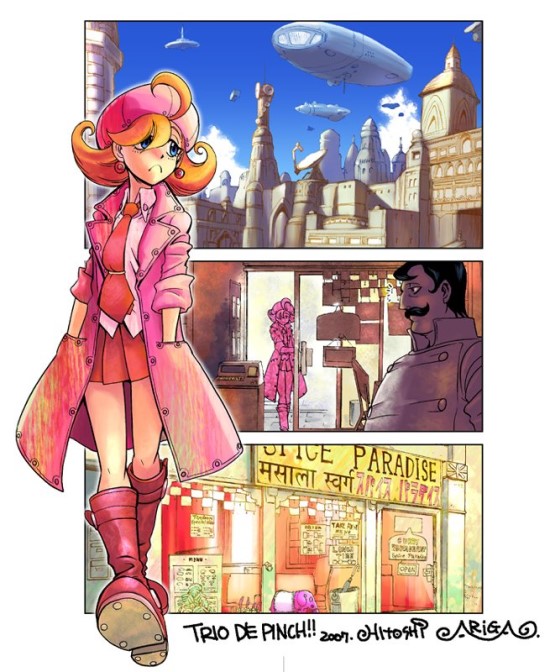
Kaiju no Shima: Amazing Island was released in 2004 in Japan and then in the USA; to date, it is the last known game on which Ayano worked as art director and character designer. Although she has not left the video game industry, her professional life has not revolved solely around video games since she met Ariga. As well as collaborating on some of the illustrations for Story of Thor and Vatlva, she colored the box art for the Super Famicom game Rockman & Forte (1998), drawn by her husband. She held the same position on the color pages of the mangas The Big O (1999-2001), Trio de Pinch! (2006), Yōkai-tori mo no chō (2013 – 2023) and generally on most of the pages and cover illustrations for Ariga’s works, as well as on the Pokémon card illustrations he has been drawing since the early 2010s. Nevertheless, he sometimes asks her to limit herself to simple adjustments to his own colourisations, notably on the new editions of Mega Man Megamix Volumes 1 and 2. Ayano also used her 3D training to model the eponymous robot from The Big O, at the request of Ariga, who used it as a reference to present his project to his publisher at the end of the 90s.

Box art for Rockman & Forte
In recent years, she has occasionally colored cover illustrations designed by Ariga for some OSTs, first for the Shovel Knight series (Specter of Torment, King of Cards and possibly other episodes for which she is not credited) and then for a game that has long eluded her: Streets of Rage 4. We can imagine that seeing the release of a title she’s been trying to develop with her studio for years and then being entrusted with work on its OST (in which her brother took part) must not have left her unmoved.
It’s worth noting that, 20 years earlier, she had already collaborated on a re-release of the OST for the second episode, illustrated by Ariga and for which she held the post of art director.

Cover of the Shovel Knight: Specter of Torment OST
The PSP years
From the second half of the 2000s onwards, Ayano no longer systematically worked on all the games developed by Ancient. The fact that she gave birth to two children in the years following the release of Kaiju no Shima may have something to do with this intermittence. She is nevertheless credited as a special effects artist on Katekyo Hitman REBORN! Battle Arena and its sequel, two PSP titles illustrated by Ariga and released in 2008 and 2009 respectively. She also took part in creating the map for Fairy Tail: Zelef Kakusei, another PSP game released in 2012.
At the time, Ancient was producing an increasing number of adaptations of anime series, themselves adapted from manga, but these productions were drowned out by the mass of titles released each year and were known in the West only to a few fans of the series in question. In addition to the PSP games mentioned above, other examples include the PS2 adaptations of Ueki no Housoku (Ueki’s Law), Bobobo-bo Bo-bobo and Bleach, released between 2006 and 2007. Ancient played a supporting role on these latter titles, as well as on Fuzion Frenzy 2, produced by Hudson Soft in 2007. It returned to the status of main studio on the Katekyo Hitman REBORN series, notably on the episode Kizuna no Tag Battle (2010), in which Ayano did not take part.
Mamotte Kishi / Protect Me Knight
2010 saw the birth of Mamotte Kishi, a new licence developed within Ancient and renamed Protect Me Knight in the West. The project was initiated by Makoto Wada, a.k.a Karu_gamo, a graphic designer who learned to program in 2003 and was thus able to play the role of one-man-band on this title. He was responsible for most of the graphics and programming, as well as sound effects and game direction. Released 30 years after the studio’s creation, Mamotte Kishi was a game that may have come as a bit of a surprise to some gamers. While Yuzo Koshiro was still regularly in the news for his work as a composer, the name of his studio was more reminiscent of the past, not to say the last century.
The game was designed for Xbox Live Indie Games (XBLIG), an Xbox 360-specific service specialising in digital distribution of games created by small teams or solo devs. Independent games were beginning to emerge on the international scene, and Wada was one of the first Japanese developers to go down this route. For him, digital gaming certainly didn’t offer the same sales potential as a physical release due to the reluctance of the general public at the time, but for Ancient it was an opportunity to develop a game with a much lower budget than other more traditional productions, those developed outside the so-called ‘independent’ circuit. It was around this time, moreover, that a debate was taking place on the distinction between amateur and independent games in Japan, a country where amateur games have been sold at conventions such as Comiket for decades and where some developers remained attached to this tradition. Amateur productions are often only marketed on an event-driven basis, for a very limited period of time, whereas independent games are meant to be available for sale for as long as the machine(s) on which they are developed allow(s). What’s more, amateur developers don’t necessarily seek to become professionals, even though some professionals started out making amateur games (Yuzo Koshiro and his friend Hitoshi Sakimoto are just two examples). The boundaries began to blur with the growing success of the games developed by Zun, set in a universe he himself created in the late 90s: Touhou Project. Where many amateur productions use a pre-existing universe that does not belong to them but whose sale is authorised on a time-limited basis during the Comiket (with a few exceptions), Zun owns the rights to his universe and is therefore technically not bound by this time constraint. Although his resignation from his employer – Taito – was not motivated by a desire to embark fully on a career as an independent developer (at least according to him), the sales of his games enabled him to make a living from them.
Several Ancient employees were working on Protect Me Knight, a tower defense game with a Famicom feel, using pseudonyms typical of the Nintendo 8-bit era – including Yuzo’s YK-2. The 2D graphics creation software that Wada used is barely older than the Nintendo console, as it has been in use at Ancient since 1997 and runs on Windows. Ayano was only involved in designing the main visual for the Western version, at the request of Wada. She decided to play on one of the clichés of the NES era, which was that games of Japanese origin had their cover illustration with cute characters replaced by a more adult illustration when they were marketed in the United States.
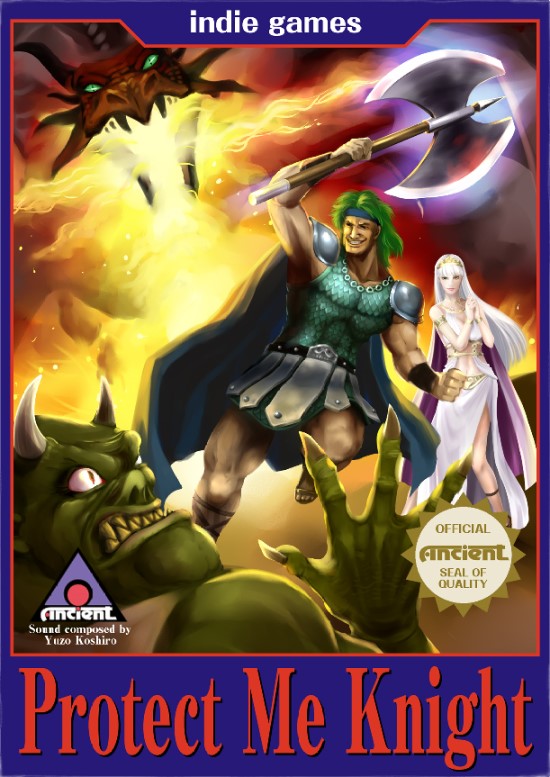
A box art similar to some NES games, right down to the Ancient logo, which mimicked the Nintendo Seal of Quality.
Protect me Knight saw a sequel on 3DS – Gotta Protectors (2014) – as well as a third episode – Gotta Protectors: Cart of Darkness (2019) – released in the West 3 years after the Japanese version. After skipping the second episode, Ayano took charge of promoting the third by creating a page dedicated to the game on Ancient’s official website, deliberately giving it a typical late 90s/early 2000s feel. She also edited the promotional video for the DLC featuring a new soundtrack, a video which seems to have been illustrated by her.
Since Gotta Protectors, Wada has not only been developing games that mimic Famicom graphics and sounds, but also games that can run on a Famicom. Examples include the free-to-play mini-game Amazon’s Running Diet (2017), a spin-off of Gotta Protectors in the form of an endless runner, and Blazing Rangers, released on NES, Famicom and PC in 2021. In 2022, an expanded version of Amazon’s Running Diet was released on NES, renamed Amazon’s Training Road, and Ayano created the box art for the game.
2025 saw the release of Earthion, a shoot ’em up originally conceived as a bonus game for a new album by Yuzo and designed for the Mega Drive. The two developers got carried away and their project, which was supposed to take them six months, ended up taking a little longer, buoyed by the public’s reception when it first appeared. The composer was responsible for part of the game design in addition to the sound, while his colleague took care of almost all the other aspects of the game. The duo has already announced in September 2025 that they are working on another neo-retro title.
Ancient’s present
Ancient wasn’t one of the first video game studios to be founded, but hundreds have since closed their doors, making it one of the oldest still in business. While some of its most well-known members, led by Motohiro Kawashima, no longer work for the company – he went freelance in the early 2010s – the studio has remained more or less the same size over the years. It remains a small family business, where Tomo Koshiro was still working in 2017 (although she handed over her position as president to her son in the mid-2000s) and where Ayano’s cat – Nana – sometimes comes to pose – they were even featured in an article a few years ago, prompting other companies to do the same with their employees’ pets.
According to Yuzo, the studio had 8 employees in 2017, including 3 Koshiro. While it seems clear that the latter intend to finish their careers with the company they founded, it’s more difficult to know what will happen to it when they retire. Makoto Wada, head of the studio’s development team, has put the spotlight back on the studio, which for years had been confined to assisting other teams on commissioned projects. Yuzo Koshiro’s name had ended up overshadowing that of his studio, which was nonetheless sometimes credited with the sound on titles that did not involve Ancient’s graphic designers and programmers (Fox Junction on PS1, Etrian Odyssey on DS, Time and Eternity on PS3, etc.). The fact that only Yuzo’s name appears on the title screen of certain games has proved to be a double-edged strategy, helping to make him known to the general public while (probably unintentionally) misleading that same public. Many gamers thought that he was the only composer to have worked on Streets of Rage 2 and 3, for example, and you have to wait until the credits at the end of Episode 2 to finally see Ancient’s name appear, when Yuzo’s name appears a few seconds after starting a game.
It’s not something that seems to have bothered Ayano much, given that her brother has been her main partner for over 30 years and she does a lot of work for her husband, often without being credited other than on Twitter (by Ariga himself). The fact that she had been in the limelight since she was a teenager partly because of her gender (with all the reactions that might have implied both from a predominantly male public and from video game journalists), may not have helped to nurture a hypothetical desire to remain a public figure. While she has occasionally appeared at conventions outside Japan in recent years, she has been much less present online since she paused her Twitter account in 2022 (before closing it in 2025, some time before the death of her father, whom she and her brother had been caring for for nearly two years). Tomo Koshiro does, however, occasionally give news of her daughter on her Instagram account, and even posts drawings of her.
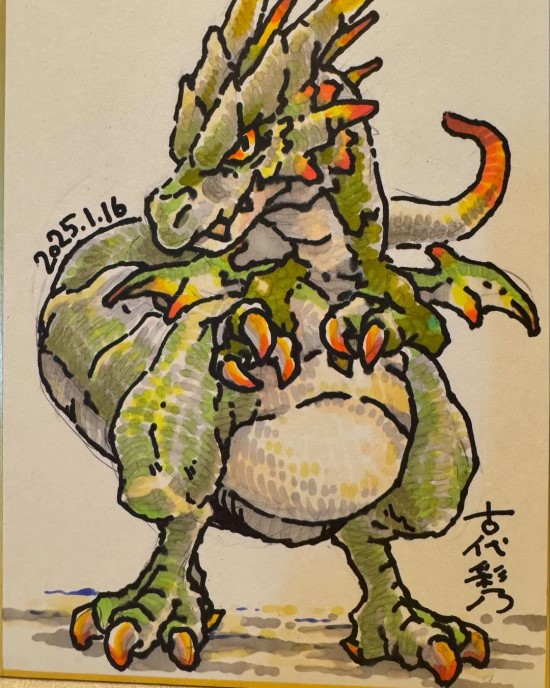
Dragon drawn in 2025
In the 2010s, the youngest of the Koshiro siblings occasionally returned to pixel art for fun, but while she indicated in 2020 that she was open to offers to work in 2D or 3D, she seems to have come round in spite of herself. As she pointed out in 2023, her eyesight is no longer as good as it once was, so it’s not really suited to pixel art.
These days, as well as working on Ariga’s artwork, her main job at Ancient is to manage the finances. She also does a bit of communication work, including the official website for the Switch game Ouritsu Anapoko Gakuen (2021). On the latter, she also did some minor work, helping out with the tiles on the game map and the cutscene illustrations.
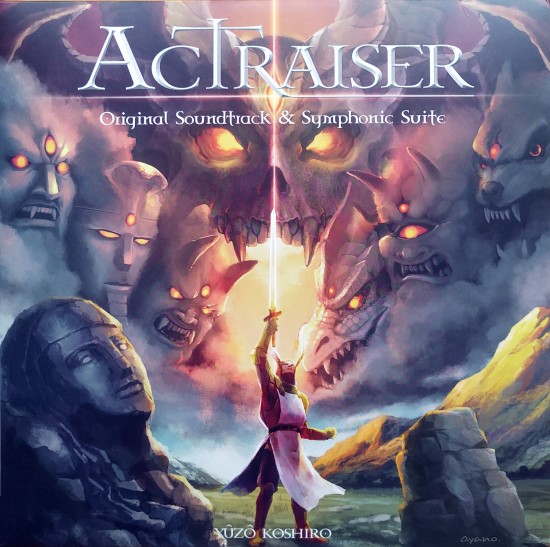
In 2020, she signed the illustrations for the new Actraiser OST, allowing the Koshiro brother and sister to be featured on equal terms at least one last time during the disc’s promotion.
The Koshiros
It would be reductive to limit Ayano Koshiro’s career to what she achieved in the 90s, but that was the period during which her talent was aligned with the technology and means of production available at the time. Many brilliant 2D artists emerged during this decade without managing to make the kind of mark on their medium or on the life of one or even several consoles that she was able to do. Not content with producing masterpieces with the backgrounds for Actraiser 2, she set the bar very high on Mega Drive in terms of sprites, succeeding with Streets of Rage 2 in doing what the best artists at Capcom or SNK would probably have managed to do on the same machine. It then gave Sega’s 16-bit machine another of its aesthetic gems with Story of Thor and its combination of minimalism and meticulousness, even gigantism.
Working at Ancient enabled her to quickly move into an art director role, while also contributing to the game design or story of certain games, something she probably wouldn’t have been able to do at a larger company with the same level of seniority. However, her company may also have been a hindrance in the 2nd half of the 90s, due to its small size. Even in 2D, development teams have continued to grow, and the 2D graphic designers at Capcom or SNK were able to continue exercising their art until the early 2000s on titles that, while declining in popularity overall at the time, remained benchmarks in their genre and continue to be revisited by gamers, and even exploited commercially.
One thing is clear, however: Ayano Koshiro remains one of the best-known 2D graphic designers of her generation, and one of the few whose name is familiar to a certain segment of the public. She could have remained in Yuzo’s shadow and been relegated to the status of sister of, but she has managed to shine and make a name for herself despite her brother’s popularity and longevity, which is no mean feat in itself.
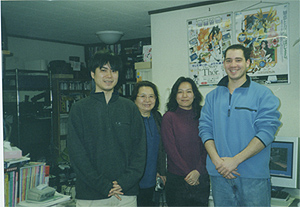
Yuzo, Tomo, and Ayano Koshiro, with one of their guests, in 2001
———-Support me———-
VGDensetsu is the equivalent of a full-time job for me – I spend an average of 30 to 40 hours a week on it. You can help me continue my work by supporting me financially via Patreon (monthly payment with the possibility of a one-off payment by unsubscribing after an initial payment) or via Ko-fi (one-off payment), or simply by talking about my work to those around you.