



Ayano Koshiro – Part 2: The Falcom years
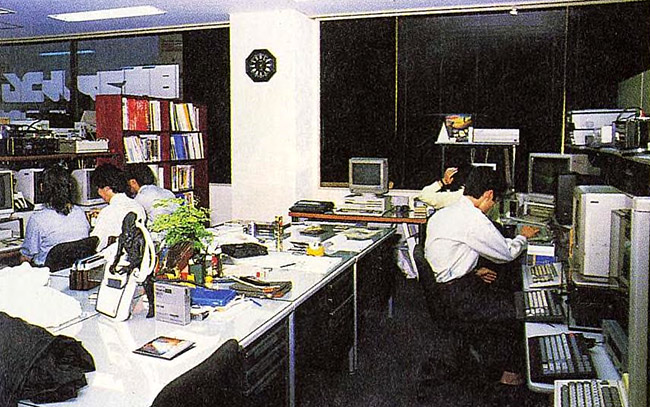
Table of contents:
Part 1: A family of artists
Part 2: The Falcom years
Part 3: Transition to freelancing and amateur games
Part 4: The birth of Ancient
Part 5: The end of the 16-bit era
Part 6: Entering the era of 3D graphics
Part 7: Struggling projects
Part 8: Gradual departure from development
Sources
Games
Gallery
Article aussi disponible en VF
Joining Falcom
During the summer of 1986, while enjoying his holidays as a preparatory school student, Yuzo Koshiro came across an advertisement placed by Nihon Falcom, a company located not far from his home that developed computer games. Armed with a dozen of his own compositions recorded on cassette tape, he applied to this company, which already enjoyed a good reputation among gamers with titles such as Xanadu and the Dragon Slayer series. After being hired on a part-time basis, he made his debut on Xanadu: Scenario II, a game that used most of the compositions he had submitted when he applied (one of them would only be used later, for one of the ending themes in Ys). For subsequent titles, he composed from his home in Hino, but visited Falcom’s offices two or three times a week, as did his sister on occasion.
At the end of 1986, it was her turn to join Falcom, also on a part-time basis. She was 16 at the time and, like her brother and their colleague Tomoo Yamane, still a minor (until recently, the age of majority in Japan was 20). Although, in retrospect, Yuzo described her as a typical high-school girl and his former self as an arcade game fanatic, it probably wasn’t that common for Japanese high-school girls to have this kind of job. However, she and her brother had one advantage over many other video game enthusiasts: their mother was very tolerant on the subject, whereas many parents refused to allow their children to own games, let alone join the video game industry.
Dragon Slayer IV: The Drasle Family
The first game she worked on was the 4th instalment in the Dragon Slayer series, also known as Legacy of the Wizard, and – a rarity at the time for Falcom – a console version was developed in-house at the same time. The project was born of the desire of programmer and game designer Yoshio Kiya to try his hand at the Famicom, a console that was a huge success in Japan. He decided to do reverse engineering in his spare time in order to understand and master Nintendo’s machine, and then showed his project to Falcom’s chairman, who contacted Namco. Falcom began a licensing policy in 1987, which resulted in a de facto move into the console market with Dragon Slayer IV and Faxanadu, an adaptation of the Xanadu licence produced by Hudson Soft for the Famicom.
With the notable exception of Kiya, who only worked on the Famicom version, the team in charge of the 3 versions of Dragon Slayer IV – Famicom, MSX2 then MSX1 – was largely the same, and it was Ayano Koshiro who designed the game’s bosses, drawn directly with the graphics software developed by Kiya.
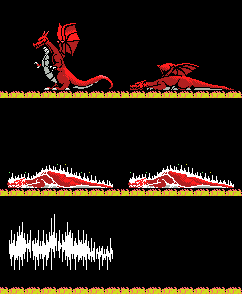
Dragon drawn by Ayano for the MSX1 version of the game
Despite her young age, she already had a certain amount of experience in computer graphics and more particularly in managing limited color palettes, which enabled her to complete her work in a handful of days. The only notable difference from her previous creations was that her professional debut was not on PC-88, but on PC-98, a computer with a larger color palette that Kiya uses for his work.
At the end of development, the members of the team were credited by their real names, except in the Famicom version where, for some unknown reason, Namco decided to opt for pseudonyms. It’s possible that, like Sega, Namco chose to apply the same policy to all the games it published, whether developed in-house or not.
Ys
Although Dragon Slayer IV was the first Falcom title that Ayano Koshiro worked on, it was not the first commercial game to feature her name. Alongside this title, another computer game was started within the studio, with scrolling as its main feature. Unlike many consoles (which were designed more for video games), some computers such as the PC-88 did not have a scrolling function, and it was up to the programmers to implement this function themselves in each of their games in order to obtain a more or less smooth scrolling of what was displayed on the screen.
Initially, Falcom’s new game took the form of a shoot’em up set in a science fiction universe. However, the idea didn’t go down well with either chairman Masayuki Kato or game designer and programmer Masaya Hashimoto. The shoot’em up concept was nevertheless retained for what would become Star Trader (1989), while the rest of the project was set in a fantasy universe, temporarily attached to the Asteka series (under the temporary name of Asteka III). It eventually evolved into an action-RPG and gave birth to its own licence: Ys, a name taken from the Dictionary of Imaginary Places, which Falcom’s developers regularly consulted for ideas.
The game engine had to be tested before development could begin, and Ayano Koshiro was given the task of designing the graphics for these tests. When Tomoo Yamane asked her to draw a monster from a fantasy world, she drew a chicken. As a result, in this prototype, the player’s aim was to catch chickens and sell them.
The project began at the end of 1986, with the developers aiming to complete it in 6 months. Koshiro was in charge of designing all the monsters and bosses, without any prior concept art, drawing the silhouettes of each of them on the screen before going into detail. She was given the kind of freedom that pushed her to excel, even though she had to follow a number of rules set by other members of the team. One of these was the prohibition on using the color blue, a shade that Yamane considered sacred in the game’s diegesis and which he reserved for the hair of his two main female characters: Feena and Rhea. This was without taking into account Dogi, the sidekick of the game’s main character – Adol – whose hair is also blue. A simple oversight.
The two main constraints were the size of the monster sprites, which she would have liked to be larger, and the fact that each type of environment in the game had to contain 3 different types of enemy.
The only human-looking character she drew was Dark Fact, the game’s final boss, originally conceived as a fallen angel, whom she reimagined as a handsome, dark blonde.
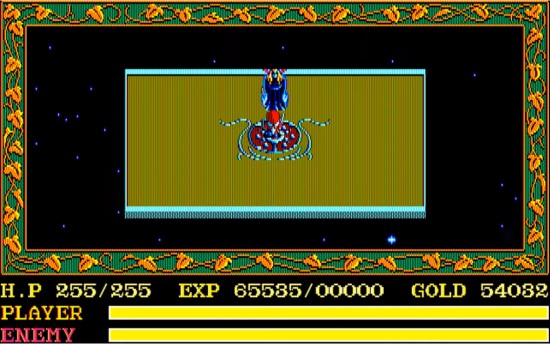
Adol Vs Dark Fact
Tomoo Yamane was responsible for most of the game’s graphics, particularly those for the map. For each set element with a background, such as a tree, you have to redraw the tile or tiles (a block several pixels wide, potentially reusable) of that element with all the different backgrounds that can appear behind it: a tree with grass, with another tree, with sand, and so on. As he had already done on Xanadu: Scenario II, Yamane also took charge of the title screen and drew the game’s logo-title in katakana. He tasked his colleague Takahiro Ōura with drawing the goddess-shaped logo for the game’s cover, while Yuzo composed most of the music, assisted by Mieko Ishikawa, who joined Falcom shortly after him. As for the manual, the color illustrations were created by Yoshimi Satoh, who had already been in charge of those for Dragon Slayer IV, leaving Ayano to draw the monsters in black and white.
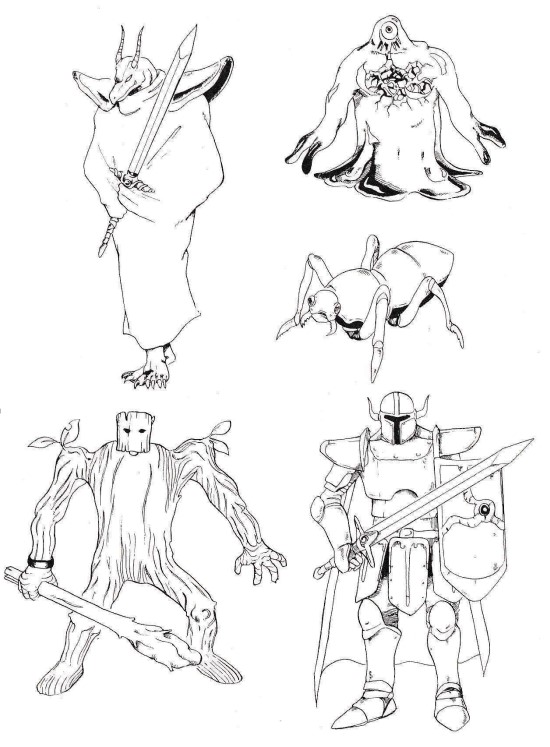
Manual illustrations drawn by Ayano
She took advantage of being at Falcom’s offices to regularly visit illustrator Kazuhiko Tsuzuki’s office to watch him work. Tsuzuki, located on another floor, was working on the manuscript for Xanadu, for which he was drawing a manga adaptation, in addition to creating the illustrations for the MSX version of the game. However, Tsuzuki was not happy with Koshiro’s comings and goings and pointed out that she was being paid by the hour by Falcom. Undeterred, she gave him her sketchbook and he eventually drew a color illustration for her.
The PC-88 version, considered the main one by its developers, was the first to be released, followed a few days later by the X1 version. Apart from the programming, the team in charge of the various versions of Ys released on Japanese computers was more or less the same. But with each new version, elements were sometimes added or modified, as was the case with the soundtrack. Some compositions, including the famous title screen theme, are only present in certain versions. Yuzo Koshiro has reaffirmed on several occasions that his compositions were originally designed for the PC-88 MkII SR and its FM synthesis. He sees each computer as a different instrument, and feels that it is inappropriate to simply convert these tunes to machines that each have their own unique sounds.
Regarding the graphics, while some versions don’t really take advantage of the capabilities of the machine they’re running on (as is often the case with multi-platform games, the PC-98 version is a copy-paste of the PC-88 version), others have some fairly notable differences. For example, the FM77AV version features new ending illustrations, drawn by Ayano and then reused in the MSX2 version. For the latter version, she also redrew the character portraits, taking inspiration from those in The Bard’s Tale, the Amiga version of which she discovered in 1986 (and which was featured in a number of Japanese video game magazines). She took advantage of the MSX2’s color palette, which was more extensive than that of the PC-88, X1 or FM-7, to play with light and shadow. In a sign of the game’s popularity, Sony bundled its MSX2 model with Falcom’s title at the end of 1987.
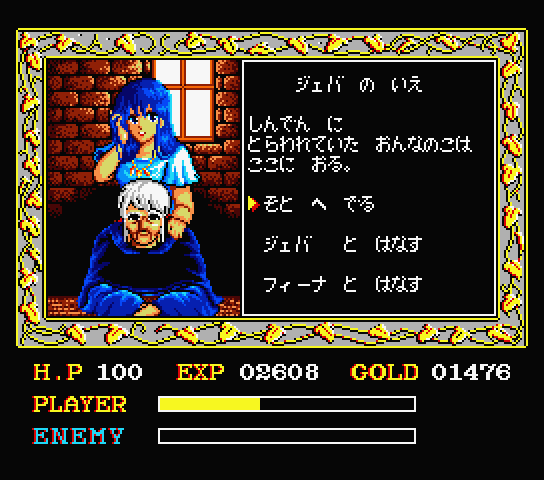
One of the portraits drawn by Ayano for the MSX2 version of Ys
Developers filmed during the development of the MSX2 version of Ys for the TV show Pasocom Sunday. The film crew decided to focus on one of the two female members of the team, Ayano Koshiro, rather than her colleague Yamane, who came dressed in suit for the occasion.
It should be noted that the graphics in this version were apparently designed on a PC-98 but, as Pasocom Sunday was sponsored by Sharp, its reports were arranged so that mainly computers from that brand were shown, hence the presence of an X68000 on Ayano’s desk.
Sorcerian
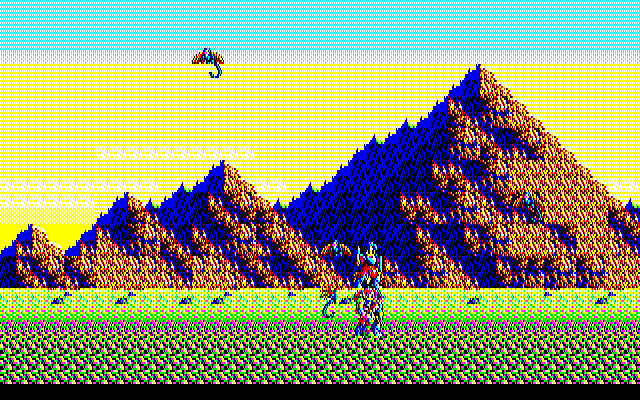
By the end of 1987, there were already six versions of Ys on the market, covering most Japanese game computers of the time with the notable exception of the then-new X68000 (which would not have its own version until years later).
In parallel with all these adaptations, part of the development team was called in to help with Sorcerian, the first episode of a new series that began on PC-88. Credited as character designer on the game, Ayano worked on its graphics while her brother took charge of part of its soundtrack. Kazunari Tomi, a game designer and scriptwriter who had just left Xtalsoft, joined the team during development, marking his first collaboration with the graphic designer.
The game was released in December 1987, and when asked what she planned to do in 1988, Ayano replied that she had to study for her university entrance exams. But before that, she first had to finish her work on Ys II.
Ys II
Often presented as the first episode of a diptych, Ys could very well have gone without a sequel. Up until its release, its developers were unsure whether they would be able to continue Adol’s adventures, so they had to ensure that the game could stand on its own. The ending was open-ended, but ambiguous enough that players didn’t necessarily think a sequel would be forthcoming. However, the success of the game meant that Falcom was able to think about a second episode fairly quickly.
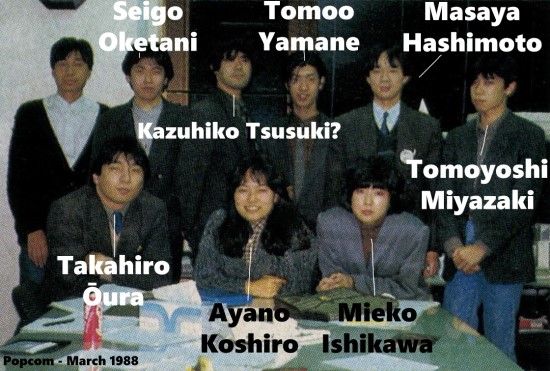
The Ys II development team, minus Yuzo Koshiro. Unlike his sister, he usually worked from home.
While the Ys diptych has left its mark on a wide audience, part of its longevity and popularity seems to be due to what the second episode introduced visually. Just as the first episode was getting under way, another game in a different genre, but also action-oriented, was released on PC-88: Mugen Senshi Valis. Unlike the MSX version, which was the first to hit the shelves, the PC-88 version featured cutscenes with admittedly limited animation (mostly mouth movements and eye blinks), but in relatively large windows for the time – a type of representation mainly reserved for visual novels and adventure games until then. What’s more, these sequences featured two young female characters close to the standards of beauty found in many anime magazines, at a time when rankings of readers’ favourite female characters were commonplace. A number of video game magazines later featured similar rankings, with Yuko, the main character in Valis, winning favour with the public, as did Namco’s Valkyrie, the princess in Phelios and Lilia, the main female character in Ys II.
On seeing Valis, Tomoo Yamane, who was both one of the game’s graphic designers and co-writers, came up with the idea of creating an animated introduction lasting several minutes, giving us a chance to get to know this new character. Kazuhiko Tsuzuki, who had not worked on the first episode, created several illustrations for the manual (which also contributed to the character’s popularity) as well as some of the ending illustrations with Yamane. He was also in charge of the graphics for the map and the characters, while Ayano Koshiro was once again in charge of designing and animating the monsters, as well as drawing illustrations of them for the manual, now in color.
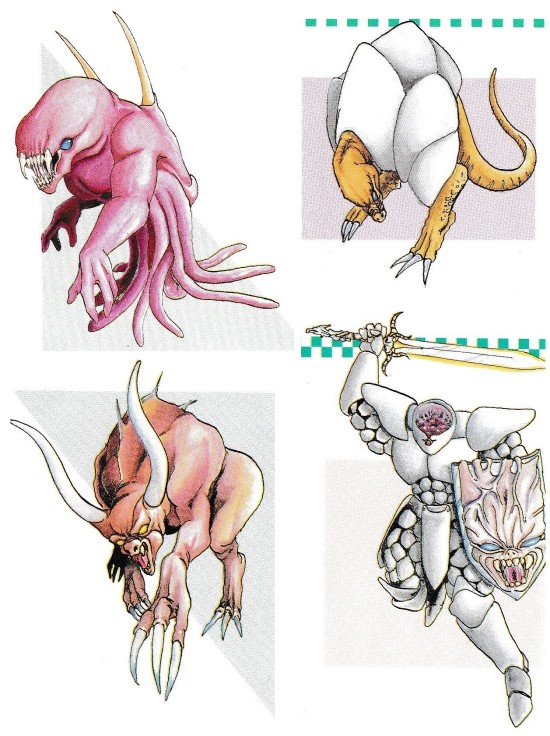
Manual illustrations drawn by Ayano
Ys II: Ancient YS Vanished – The Final Chapter was released in April 1988 on PC-88, just 10 months after the first episode. As with the first episode, subsequent adaptations were made for other computers, and were once again successful. However, all was not well at Falcom, and relations between the company and the Ys developers continued to deteriorate during the development of this second opus.
Crisis at Falcom
The first wave of departures occurred in the summer of 1988. The Koshiros, Kazuhiko Tsuzuki and composer Hideya Nagata (who worked with Yuzo on Ys II) terminated their contracts, and other colleagues soon followed. Among them were Tomoo Yamane after the development of Star Trader (released in March 1989), the duo Hashimoto – Miyazaki and their colleague Yoshihiko Kurata after the development of Ys III (released in July 1989), later joined by Kouji Yokota, and Kazunari Tomi during the development of Dinosaur (1990).
While changing companies is not that uncommon in the video game industry at the time, including in Japan where it may seem more surprising, some of the causes mentioned seem unique to Falcom. Yoshio Kiya, who also left the company around 1994 following a disagreement with its chairman, spoke decades later about this flight of talent. He spoke of rivalry between the teams, who communicated little with each other (a point that probably concerned the game designers, i.e. him and the people in charge of Ys) and added that Kato, Falcom’s chairman, remained very attached to the fact of releasing almost all its games on the PC-88 despite its advanced age and the appearance on the market of increasingly powerful consoles and computers (PC Engine, Mega Drive, X68000, FM Towns). Falcom did make a few attempts on the PC Engine’s CD-ROM add-on and then on Super Famicom and Saturn, often backed by another company such as Hudson Soft, but generally speaking, Kato’s reluctance to enter the console market lasted until the 2000s. However, the console installed base quickly grew larger than that of home computers, and Konami developers were able to testify that even the top-selling titles on MSX 1 and 2 were nowhere near the sales volume of Famicom games produced by the same company. In Japan, more than in many Western countries, personal computers struggled to penetrate the home and for a long time were seen primarily as work tools, opening up to the Famicom (and later to mobile phones) some of the fields of activity taken up by PCs in the West (online betting, banking services, online gaming, etc.). Some of Falcom’s employees wanted to develop for consoles, but Kato considered this too risky because of the sums involved in producing the cartridges and the minimum quantities required by Nintendo to launch production.
Kiya also mentioned a rumor that the success of Falcom’s games had not led to a corresponding increase in salaries or bonuses. Tomoo Yamane said for his part that he didn’t feel valued enough, which seems to be in line with Kiya’s comments. After his departure, he joined Hudson Soft, where he worked on the adaptation of Ys I & II for the PC Engine CD.
Yuzo Koshiro seems to have had a similar problem, although he often prefers to remain vague on the subject. In 2019, he mentioned the fact that he was a part-time employee and wasn’t paid much, although he added a few years later that he had received bonuses (including a very generous one) when in-house games were commercially successful. What’s more, he was only paid as an employee, even though some of his compositions were used outside the games he had worked on. In fact, it was during the two years he spent at Falcom that a market that had been in its infancy until then began to develop: that of OSTs.
Before 1986, this market was more or less non-existent, limited to a few derivative products (Space Invaders, Pac-Man, etc.) and albums of rearranged versions or music inspired by video game music (Video Game Music, Super Xevious), or even a compilation of Game Arts music composed by Hibiki Godai and sold by mail order or at events (Micom Game Music). It wasn’t until 1986 that two labels appeared: G.M.O. Records and Apollo Music, and with them the first OSTs sold commercially like any other music album.
From 1987 onwards, several albums of music from Falcom games were released, from Xanadu to Dragon Slayer IV, including Sorcerian, Ys I and Ys II. Some of them were even commercially successful, with Music from Ys II and Music from Sorcerian doing rather well in the Japanese charts in 1988. However, apart from the fact that Yuzo Koshiro was not systematically credited on these albums (a laconic Nihon Falcom often replaced the names of the composers), he did not receive a penny from their sales. In fact, he signed over the rights to his music to Falcom when he signed his employment contract, at a time when the question of OSTs had not arisen and when he doubted both his talents as a musician and the fact that the public would appreciate his compositions. Incidentally, years later, when he performed one of the tracks he had written for Sorcerian at a concert, Falcom charged him for copyright.
The issue of credits in Falcom games is a recurring problem that is unfortunately not unique to this company. Kunihiko Tanaka learned this the hard way in 1991 with Popful Mail, a title in which his name does not appear even though he designed the main character before leaving the company. He went on to make a name for himself with the comic strip Fam & Irhie, and later with the characters and illustrations for the PS1 game Xenogears.
In the summer of 1988, Yuzo decided to go freelance, hoping to be better paid and more recognised. Without going into detail about the circumstances surrounding his departure from Falcom, he explained in 2025, after Masayuki Kato’s death, that he regretted leaving the way he did.
On the advice of his mother and Joe Hisaishi (who taught him that he had to protect the rights to his music), he insisted that his name be displayed on the title screen of the games he would work on in the future. As for Ayano, she followed the same path after leaving high school, but without limiting herself to commercial games.
———-Support me———-
VGDensetsu is the equivalent of a full-time job for me – I spend an average of 30 to 40 hours a week on it. You can help me continue my work by supporting me financially via Patreon (monthly payment with the possibility of a one-off payment by unsubscribing after an initial payment) or via Ko-fi (one-off payment), or simply by talking about my work to those around you.