



Ayano Koshiro – Part 5: The end of the 16-bit era
Table of contents:
Part 1: A family of artists
Part 2: The Falcom years
Part 3: Transition to freelancing and amateur games
Part 4: The birth of Ancient
Part 5: The end of the 16-bit era
Part 6: Entering the era of 3D graphics
Part 7: Struggling projects
Part 8: Gradual departure from development
Sources
Games
Gallery
Article aussi disponible en VF
Sister Sonic
A multi-faceted title, Sister Sonic is a project about which unfortunately not much is known. While the Mega-CD version of Popful Mail was initially unveiled under this name in 1992, it seems that an unannounced (?) game of the same name was in development around 1993. According to graphic designer Masato Nishimura (Sonic CD), Bubble Bobble designer Fukio Mitsuji was working on a project developed by Ancient mixing action and puzzles, with characters designed by Ayano Koshiro. The title was to be promoted not by Sega, but by Sega Falcom, an entity born of a partnership between the two companies. It’s one of the many aborted projects of this studio, now best known for the aforementioned Mega-CD version of Popful Mail.
As for this cancelled game set in the Sonic universe, it is unlikely that it was a reworked version of SegaSonic Bros, a pure puzzle game developed in 1992 for the arcade market and directed by Mitsuji, which was cancelled following an inconclusive location test. The most likely hypothesis is that once the Mega-CD game Sister Sonic was renamed Popful Mail in early 1993, the Ancient version of Sister Sonic took on this name, either at the start of the project or during development. According to Nishimura, the only known source to have spoken publicly on the subject (which means taking a few precautions, as the risk of confusion has not been ruled out), this action-puzzle game nevertheless saw the light of day on the Super Famicom in the form of an adaptation of the Araiguma Rascal anime series, without either Mitsuji or Ayano Koshiro being credited.
Note that this was not the only game in development at Ancient in 1993, as the studio was also in charge of the mysterious The Stickman is back on Mega Drive. The project evolved and was taken over by another studio, to be released under a different name and with music other than that composed by Yuzo Koshiro (who was also in charge of the Game Gear version), although it is not yet known which title it was. However, Ayano has no recollection of The Stickman is back; it is highly likely that she was involved in another project at another studio at the time.
Actraiser 2
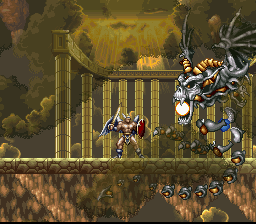
After the success of Actraiser and the more relative success of Soul Blazer / Soul Blader, Quintet continued its partnership with publisher Enix and set development of Actraiser 2 in motion. The first opus was released at a time when the Super Famicom was only available in Japan, and for this sequel Quintet turned to the international market, which in the minds of the decision-makers meant making a few changes. The biggest of these concerned the god game aspect of the first episode, totally absent from this sequel, which concentrates on the action phases, considered more in tune with Western audiences. With hindsight, several members of the development team expressed regret at this decision, reinforced by the fact that the game did not achieve the same sales figures as the first episode (it sold almost half as well as the 1st opus in the USA and 10 times less in Japan).
The second change from Actraiser 1 was in the difficulty level, which was greatly increased in order to keep up with the popular belief that Westerners like a good challenge. It’s not impossible that this belief stems from the demands of American producers eager to sell as many games as possible at a time when rental services were viewed with suspicion by many publishers. One of the most common solutions to this problem was to increase the difficulty of their games, so that renters would not be able to finish them after a single loan, and would therefore choose to buy them (in case you were wondering why Ecco the Dolphin was so punishing in its final levels…).
Regarding the development team, we find the quartet already at work on the first opus, namely Tomoyoshi Miyazaki, Masaya Hashimoto and the Koshiros. For the occasion, Ayano returned to work on the premises of her former colleagues, probably to supervise the work of the graphic designers as art director, and perhaps also because the workstations available to Quintet for development on Super Famicom were different from those used by Ancient. Development took place in good spirits, despite the difficult schedule, with days sometimes ending at 4am and resuming at 10am.
Ayano wrote the game script in collaboration with Miyazaki, defined some of the game mechanics, designed some of the characters and drew the vast majority of the backgrounds (90% according to Ariga). To assist her on the visual side, her brother asked Hitoshi Ariga to join the team towards the end of Streets of Rage 2’s development. Although he never joined Ancient, he did become a regular contributor, working on character animation under Ayano’s supervision. She and Ariga designed the final boss together, the former drawing the body – conceived as a fixed background – while the latter drew and animated the moving parts (head, arms, tail, projectiles). Their comrade Satoshi Nakai, who signed the game’s illustrations, remarked that he was finding it increasingly difficult to distinguish between their respective styles, a phenomenon that eventually affected the two designers themselves. To draw one of the ending backgrounds, Ariga called on one of his former colleagues, Hiroshi Hayashi, to lighten Ayano’s workload – Ariga estimated that development probably took less than six months, which is a relatively short period for a game of this caliber.
Visually, the game is a few notches above the first opus, benefiting like Streets of Rage 2 from a much larger cartridge size than its predecessor. The art style is more assertive, and we assume that Ayano took advantage of her 20th birthday trip to Europe during which she visited the castles of Neuschwanstein, Versailles, Castelnaud (which houses a museum of medieval warfare) and an old prison.
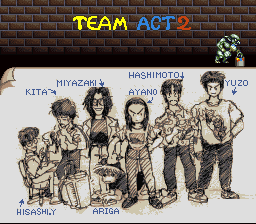
Hidden illustration of the main members of the game’s development team, drawn by Ariga.
Towards the end of the development of Actraiser 2, Ariga received a card from Yuzo presenting his future project: an action RPG in which the player could use spirits. This was neither a commissioned sequel nor an adaptation of a pre-existing licence, but the first known project initiated internally by Ancient and presented to Sega. Its name: The Story of Thor.
The Story of Thor
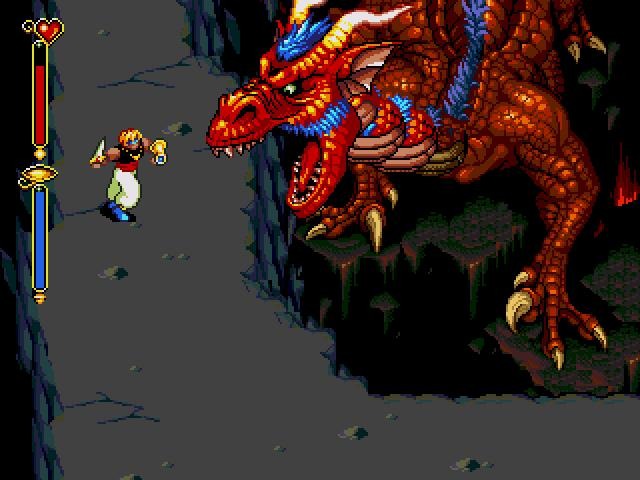
After responding to the success of Street Fighter II with a title mixing brawler and versus fighting game, Ancient decided to try a new formula for its next game, taking inspiration from The Legend of Zelda: A Link to the Past and similar titles. Led by Yuzo, who defined the main mechanics, Story of Thor is an action RPG with a beat’em up feel, two genres he and his sister had already tried their hand at. The basic idea for the game’s universe came from a drawing inspired by Norse mythology given to them by a Dutchman, probably a friend of their mother. In a further attempt to mix sources of inspiration that might seem unrelated, one of the project’s initiators added a character wearing a costume inspired by Prince of Persia. A wave of orientalism then swept through Japanese pop culture, in the wake of titles such as Yume Kōjō: Doki Doki Panic (whose universe was based on an exhibition), Magical Hat (a manga adapted into an animated series and video game for the Mega Drive) and adventure manga featuring journeys to regions inspired by a fantasised Orient (Dragon Ball). After this first wave came works such as Prince of Persia (adapted for many machines, including in Japan), Disney’s Aladdin and its various incarnations in games, Arabian Fight, El Hazard, Rampou, Dragon Quest V and many levels in platform games, RPG regions and characters such as djinns. Ifrit, who gave his name to one of the 4 spirits in Story of Thor, seems to have been inspired by the genius of Aladdin, given his build and floating, legless appearance. It’s worth noting that when Ancient’s game was localised in the West, the main character, a prince originally named Luo / Ruo in the Japanese version, was rechristened Ali (coincidentally, ‘Prince Ali’ is the title of one of the key songs in Disney’s Aladdin).
To these touches of Nordic mythology and orientalism was added a pinch of Greek mythology, the action being set in the kingdom of Poseidonia. Once again, the Western version chose to orientalise this name by renaming it Oasis, although we don’t know whether this was to reduce the heterogeneity of the universe or to ride the wave of the Disney film’s success. Another influence acknowledged by its creators is the adult manga Kakugo no Susume, which provided the inspiration for the game’s antagonist, dressed in a long black cape. A reference that was also used by Capcom, with the character of Jin, created for the game Cyberbots.
The game’s development team was partly the same as for Streets of Rage 2, which is reflected in the control of the main character (who can now attack in 4 directions). A number of Sega employees once again joined the team, notably to design the backgrounds. At the time of the game’s production, Sega was trying to catch up with the competition in the RPG field in the broadest sense, and was producing several titles under the Mega RoPlay Project label (RoPlay being short for Role Playing Game). These included Soleil, Shining Force CD, Surging Aura and Dragon Slayer: Eiyuu Densetsu I and II.
Since Story of Thor was not a commissioned project, Ancient could afford to have a longer pre-production period than for its previous games. As early as May 1993 (almost 19 months before the title went on sale), Ariga was already sketching out various ideas for enemies, including one called Itar, who was rejected during casting.
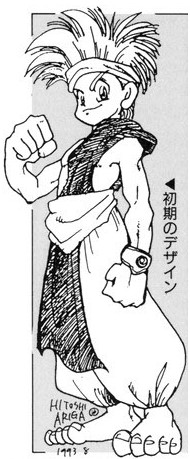
The main character, before he became a prince
Once again, Ayano Koshiro was in charge of the art direction, which involved determining the different color palettes for all the characters. She designed the 4 spirits (and not 3 as initially planned) as well as the main character with the help of Ariga, who finalised her design. She also drew some of the backgrounds, supervised the creation of the remaining ones, and animated the bosses, in particular the imposing red dragon that was featured prominently in the game’s promotion. As for the illustrations in the game’s opening (and probably also those in the ending), Ariga drew them on paper while Ayano adapted them in pixels. It was probably the latter who designed the marble sculpture on which the end credits are displayed. Regarding the characters other than the bosses, Ayano defined the basic proportions of the various sprites and entrusted Ariga with the task of animating them all. He also made his debut as a video game illustrator, signing the box art for the Japanese version as well as the illustrations included in the manual, assisted by Ayano for the coloring of the yonkoma (4-frame comic).
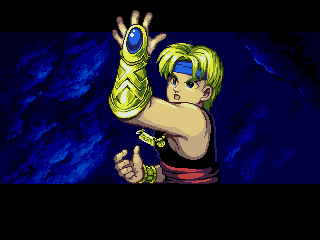
Shot from the game’s opening
The visual aspect of the game is in clear contrast to Ayano’s previous titles, and seems to be inspired more by traditional animation than other video games of the time, with large flat areas of color replacing the usual gradients. As a result, the number of colors displayed simultaneously on screen isn’t very high, but the color choices are generally judicious and give the game a more colorful look than many of the competition’s titles. In this respect, Story of Thor foreshadows what Capcom would later do with Street Fighter Alpha, as well as a number of cel-shaded games such as The Legend of Zelda: The Wind Waker and Jet Set Radio. Even today, it’s one of the Mega Drive games that has aged best visually.
The music composed by Yuzo reinforces the feeling that the game was not trying to evoke a particular universe but rather a multitude of moods. Some of the melodies seem to have been inspired more by Anglo-Saxon medieval universes (the Arthurian legend, Ivanhoe and their many cinematic variations) than by Norse mythology or musical orientalism as it was defined during the golden age of Hollywood. A relatively difficult exercise to accomplish on a console that has rarely been used to produce this type of orchestral sound. As he himself said in an interview, he adopted an approach similar to the one he would have adopted for a film, i.e. sticking more closely to the story and atmosphere of the work. And, as with Streets of Rage 2, he once again lent his voice to the game’s main character. When the director is also the lead actor.
Despite the original recipe for its gameplay mechanics, Story of Thor has no real descendants; even its sequel, planned months before the release of the first opus, ventured down a more conventional path. But before embarking on the development of this 2nd episode, Ayano collaborated on various projects with some of her former colleagues.
Götzendiener
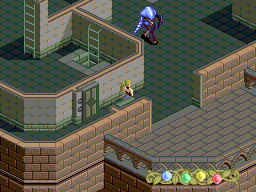
Between the start of Thor’s pre-production and the end of its development, Ayano found time to assist former members of Falcom on the graphics for a PC Engine Super CD ROM game co-developed by Gainax and Studio Alex: Götzendiener.
After confining itself to the computer market during its first years of existence, Gainax’s video games branch opened up to the console market with Alisia Dragoon and continued its work on NEC’s console. Several adaptations of Princess Maker, the successful series created by illustrator Takami Akai, who also worked on Götzendiener, were subsequently released.
Götzendiener slightly overturned the trope of the damsel in distress by making the princess the person who rescues herself from a dungeon, in an isometric 3D action RPG more focused on puzzles than combat. While Gainax took care of the game’s cinematics (in pixel art and with the notable presence of Yoh Yoshinari, future co-founder of the Trigger studio), the graphics for the game itself were mainly created by people who had worked on Ys. These included Yoshimi Satoh, Tomoo Yamane, Takahiro Oura and Ayano Koshiro, all under the direction of Kazunari Tomi. Ayano wasn’t alone, as she was accompanied by Hitoshi Ariga, in charge of animating a handful of enemies, and Kouichirow Kobayashi, a former colleague of Ariga’s who had also worked on Streets of Rage 2.
Produced by NEC Home Electronics and released only in Japan, the game didn’t make much of an impression, suffering from a certain slowness, well-done but somewhat empty backgrounds, and music that did not make good use of the CD format. These are criticisms we would not dare to make about the next project Ayano was hired to work on, her last for a 16-bit console.
Terranigma
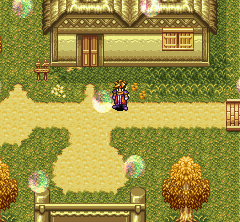
Begun just after the end of development on Illusion of Time, itself developed in parallel with Actraiser 2, Terranigma was Quintet’s last Super Famicom game and its last title produced by Enix.
It was also Ayano Koshiro’s last known collaboration with the studio, on a game for which she was probably brought in as a simple graphic designer during development. Her brother himself was only briefly involved in the game, to the point of forgetting decades later that he had composed a track for it.
An action RPG released at the end of 1995 in Japan, Terranigma was one of the console’s most technically impressive games, with cutscenes combining 3DCG and fractals. Unfortunately, this relatively late release in the life of the console probably cost it a US release. The game suffered the same fate as Alien Soldier, another game with a cult following that was only released in Japan and Europe.
While this was Ayano’s last collaboration with Tomoyoshi Miyazaki, who disappeared from the scene years later, his colleague Masaya Hashimoto joined Ancient for a time after Quintet closed down around 2008-2009. As for the next game to appear on Ayano’s resume, it marked the end of a series of collaborations with another former colleague.
Lunar: Sanpo-suru Gakuen
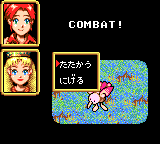
A Game Gear spin-off, Lunar: Sanpo-suru Gakuen was the 3rd game set in the world of Lunar, after The Silver Star and Eternal Blue. As with the first episode, Ayano was in charge of designing the monsters and, although she still drew on paper, she now used computer coloring. This was a process she reused a few months later for the production of Vatlva.
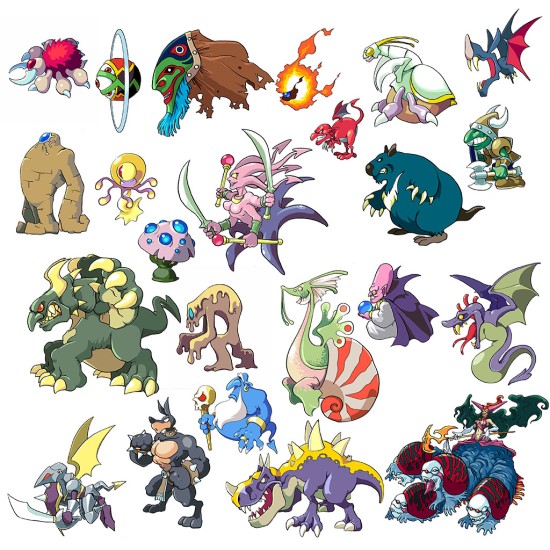
Monsters designed by Ayano
Marketed only in Japan on a console that was at the end of its life and had little presence in that market, Lunar: Sanpo-suru Gakuen added competition from its own series to its list of woes, as a thinly disguised remake of the first episode was in development for the Saturn: Lunar: Silver Star Story. Although Studio Alex and its founder Kazunari Tomi were involved in the Game Gear episode, Game Arts decided to do without them for its Saturn game, thus justifying not paying them any royalties on sales of the latter. Tensions then arose between the two studios, leading in 1997 to a series of lawsuits in which Studio Alex unsuccessfully claimed royalties from Game Arts. The latter counter-attacked and won both at first instance and on appeal. Studio Alex closed its doors in 2003 and Tomi also disappeared from the radar, after some twenty years in the industry.
———-Support me———-
VGDensetsu is the equivalent of a full-time job for me – I spend an average of 30 to 40 hours a week on it. You can help me continue my work by supporting me financially via Patreon (monthly payment with the possibility of a one-off payment by unsubscribing after an initial payment) or via Ko-fi (one-off payment), or simply by talking about my work to those around you.