



Rieko Kodama – Part II: Champion Boxing
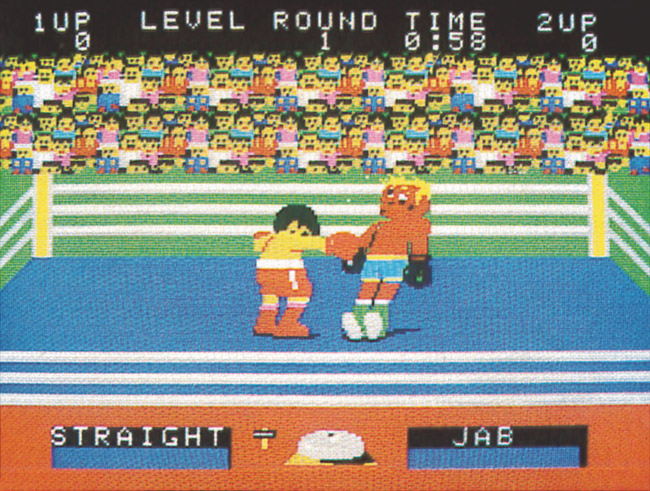
Table of contents:
Part I: Tokyo, 1984
Part II: Champion Boxing
Part III: From arcade to console (and vice versa)
Part IV: Alex Kidd in Miracle World or the birth of a Master System icon
Part V: Breaking out of the canon to go beyond it: the making of Phantasy Star
Part VI: The status of women in the Japanese video games industry
Part VII: Change and new responsibilities
Part VIII: The two Phantasy Star II
Part IX: Working conditions at Sega and in the Japanese video game industry
Part X: A mascot in the making
Part XI: On both sides of the Pacific
Part XII: Final Phantasy
Part XIII: The last Saturn games
Part XIV: Arcadia of my youth
Part XV: Entering History
Games
To be confirmed
Other video game related works
Chronology
Gallery
Sources
General sources (Interviews, liner notes, comments, etc.)
Article aussi disponible en VF
On-the-jab training
Joining Sega in April 1978, Yoji Ishii made his debut as a developer 2 years later following an internal transfer he requested. After working on titles such as Pro Monaco GP, Zaxxon and Congo Bongo, he was promoted to planner in R&D1 (one of the two development divisions formed in 1984). A position specific to the Japanese industry, but often close to that of director and/or game designer, the planner is the person who draws up the development plan for a game, giving the developers varying degrees of latitude in putting it into practice. Ishii, who was to become one of the faces of Sega in the second half of the 80s, overseeing the development of games such as Fantasy Zone, Hang-on and OutRun, did not seem to fall into the category of those who imposed their views on developers. So he entrusted the task of developing an SG-1000 game to a programmer who had only joined Sega a year earlier: Yu Suzuki.
‘At the time,‘ said Suzuki, ‘the term ”supervisor’” didn’t exist at Sega, I was just a project leader. Normally it would take 7-8 years’ experience to be one, and even then only people from the planning department would become a project leader. I don’t know what my boss was thinking, but anyway I became one in my second year!
I was given the SG-1000 project, as arcade game projects are more complex and involve people from hardware, marketing departments and so on, whereas a home console project was relatively simple.’
Up until then, Suzuki’s programming talents hadn’t really been put to good use at Sega, as he was busier working on cabinets for games such as Astron Belt than on the games themselves. Whether due to a lack of manpower or because his superior saw talent in him (or a bit of both), he was appointed head of the team in charge of this new SG-1000 game, for which he also did some of the programming. His decision to make it a boxing game was taken after studying the console’s hardware and taking into account its limitations in terms of display and processor power. He felt that it was a genre that should be feasible without too much difficulty with this machine:
‘At the time there were just 3 of us, recalls Suzuki, so the management of it was quite easy, with a new female colleague doing the graphics, and a new male colleague in charge of the programming.’
While the identity of the other programmer remains unknown, we do know that the new gaphic designer was none other than Rieko Kodama, presumably called in by Ishii to help out. Having received no prior training, she struggled a little at first.
‘I didn’t know the first thing about computers. All I had done in my life was drawing and art up to then. Plus, when it came to the hardware of that era, you could only put out 8 colors max on the screen. The start of my education, and my first struggle, was figuring out how to represent an image on-screen with a limited number of colors.’
In 1984, Sega began equipping itself with Digitizer Systems, a machine which, in its first version, allowed graphics to be drawn on the screen using a light pen, while a second screen allowed the designer to view the result as it would appear on a standard television screen or an arcade cabinet screen. To the right of these two screens was a third block to which the light pen was connected, and the whole unit was encased in a heavy plywood cabinet.
‘For my generation of employees, it was digital from the start. There were specialized tools like digitizers, so I studied up on how to use those first.’
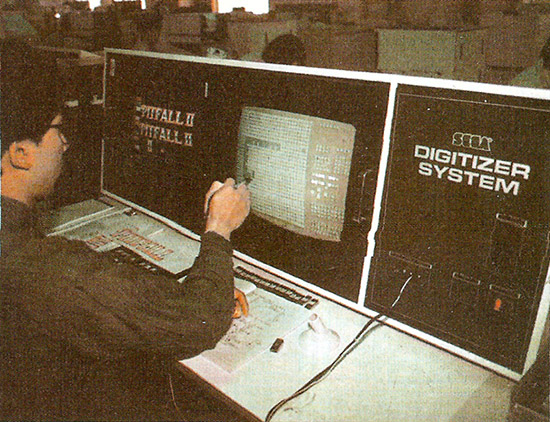
A graphic designer in front of a Digitizer System (~1984-85)
It was a type of tool that few companies in the industry could afford to acquire, and it was still very common for graphics to be designed using simple sheets of graph paper, a pencil and hexadecimal data (which was then transcribed into a computer). Even within Sega, the pen and paper system didn’t disappear overnight, as the company still didn’t have enough units of its Digitizer System. As a result, some people who were already familiar with that hexadecimal system had to make do with a sheet of paper for a while longer.
For Kodama, the first step of her on-the-job training was to familiarise herself with this sometimes capricious tool. She had her doubts about the quality of the graphics she was designing, so she enlisted the help of another graphic designer.
‘At the time, there were about four people working on each title, so, in theory, one graphic designer was enough. But I wasn’t very good at it, so I asked one of my elders to help me halfway through.’
‘There were ‘teachers’ for music, graphics, all the different aspects of development at Sega. That’s how I learned to do graphics, from Yoshiki Kawasaki.
Kawasaki did the sprites for Flicky and other older games. He’s extremely talented.’
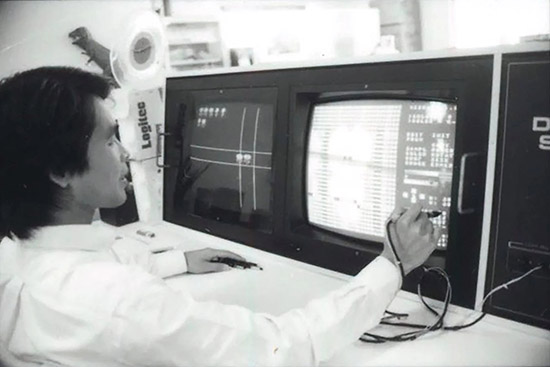
Yoshiki Kawasaki in front of a Digitizer System (1984)
Yoshiki Kawasaki played an important role in Kodama’s early career. He joined Sega in 1976, starting out in the purchasing department, but was transferred to a new position in 1983. Knowing Kawasaki’s taste for drawing, one of his superiors – Hideki Sato – spotted him and got him to join the design section of the research and development department. With a little more experience than Kodama as a developer, it was Kawasaki who took on the task of training her, a training which was done by developing several games together.
‘Kawasaki would put the finishing touches in a cute way on his pixel art for things like birds and ducks, by rounding off the square pixels. He really helped me out by showing me how to do that.’
As a result, Kodama learned to draw on a screen, to anticipate the fact that certain colors bleed on a CRT and to make do with a light pen that tended to overflow onto the squares adjacent to the target square (at a rate of one pixel per square). However, during her training, she had to overcome a test specific to this project: it was a Yu Suzuki game, and he was to make his boxing game one of the most technically accomplished titles on this console.
Technical point:
The sprites displayed by the SG-1000 are limited to 2 colors each, one of which is reserved for transparency (so that undrawn areas of a sprite don’t mask the background), a clear disadvantage compared with the Famicom and its 4 colors per sprite (again with one reserved for transparency). Because of these technical limitations, the developers who worked on SG-1000 frequently used techniques whose usefulness was no longer felt on more powerful machines. Almost from the very beginning of the console’s life, there were titles that superimposed sprites on each other like layers (Sindbad Mystery), with the possibility of joining two stacks of sprites to lengthen a character or a vehicle (Zippy Race, whose car is made up of 4 sprites: 2 on top, 2 on the bottom). But this is not the method Suzuki chose.
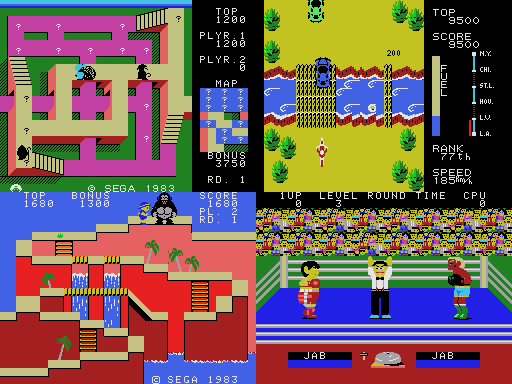
From top to bottom and left to right: Sindbad Mystery, Zippy Race, Congo Bongo Champion Boxing
To put it crudely, and although this is not a universal rule, a game’s graphics are generally made up of 2 types of layers: the sprites in the foreground and the background behind them. However, it is possible to divert the background layer from its function and draw objects on it (the pellets in the Atari 2600 version of Pac-Man, for example), or even the main character. In such a case, the part drawn in the background is generally limited to a single-color silhouette on which the developers superimpose sprites to increase the number of colors and details (Congo Bongo, one of the SG-1000 launch games). The advantage of this second method is that it takes advantage of the color palette of the backgrounds, which is more extensive than that of the sprites on Sega’s machine. Suzuki chose the latter approach, but decided to go much further than his predecessors.
Champion Boxing features characters composed of 8 colors each, almost entirely drawn in the background, and relatively large for their time. What’s more, they’re not the only ones moving around the screen, as the audience watching the fights is also animated. The few sprites in the game are essentially the boxing gloves – they appear during collisions over those already drawn in the background layer.
The background layer is therefore in constant motion, with a clear separation between the audience in the upper part of the screen and the boxers in the lower part. From her very first game, Rieko Kodama had to work in a relatively unusual way, juggling between elements drawn in the background layer and those drawn as sprites.
‘I was still a new recruit, I’d only been with the company for about six months, so Yu sat down next to me and explained quite a lot to me. However, I had a lot of trouble because I couldn’t manage to create unique characters. So Yu, Yoji Ishii and Yoshiki Kawasaki gave me some advice, and we decided to take a comic approach, with characters who had their heads bowed, even though it was a boxing game. I remember that Mr Kawasaki was in charge of the main character and I was in charge of his opponent and the background.’
Adaptations
Champion Boxing may not have the best soundtrack – there’s no music, the sound effects are very basic -, and only features a single fixed shot of the game area, but Sega’s game manages to dominate the competition in terms of the number of colors per character, almost making you forget it was an SG-1000 game. It was a far cry from the fine graphics of Punch-Out! released in the arcade a year earlier, but it managed to outdo contemporary Famicom titles such as Wild Gunman, which also featured large characters.
Even before its release, Sega saw the commercial potential of its title and decided to bring it to the arcade as it was, without altering its graphics. Champion Boxing became the first in a series of three SG-1000 games to be released in the arcade, followed a few months later by Champion Pro Wrestling and Doki Doki Penguin Land. While these titles were no match for the big arcade titles of the day, they did have the advantage for operators of being offered at a lower cost than those titles.
According to Yu Suzuki, both arcade and console versions of the game met with some success, even leading to an adaptation on MSX the following year. However, whatever the medium, the names of the developers are nowhere to be found in the game or its manual. It was not until mid-1986 that Sega games began to credit their developers, but only under pseudonyms and not systematically (as was the case with many other companies in the industry in Japan). Sega did not allow its employees or those of subcontracting companies to reveal their real identities in its games, and the latter complied with this rule, which lasted until the mid-90s, around the time of the arrival of the Saturn. This makes it all the more difficult to draw up a complete list of Kodama’s games and work for Sega, not to mention any potential cancelled titles.
It’s worth noting that Yu Suzuki took advantage of this absence of credits in the early years of his career to point out that his first game was not Champion Boxing but Hang-On, a title far more prestigious than his boxing game, which he has since stopped sweeping under the carpet.
—-Chronological point #1—-
Kodama has repeatedly stated that she joined the development of Champion Boxing around 6 months after joining Sega, but it’s likely that this period of time was actually shorter. Assuming that she graduated from design school in March (the month in which the academic year ends in Japan) and joined Sega immediately afterwards (probably at the beginning of April), and that Champion Boxing was released in November, that only leaves around 7-8 months since her debut at Sega. To these 7-8 months, you have to subtract about 3 months to produce the game’s cartridges once development is complete, and another 1 or 2 months for the development of the game itself. So a period closer to 3 months than 6.
About release dates:
If you’ve ever flipped through the book ‘Sega Consumer History’, you may have noticed that only the year of release is listed for SG-1000 games, unlike Mark III games for which the month is also listed. As producer Yosuke Okunari pointed out in 2011, SEGA does not know the exact release dates of its SG-1000 games, including titles released after the Mark III. We therefore have to do research on a case-by-case basis, using release schedules and magazine advertisements, or better still, receipts from purchases made on the day the games hit the shelves.
In the specific case of Champion Boxing, Yoshiki Kawasaki pointed out that, ‘As it took the factory around three months to create the ROMs (editor’s note: for the console version cartridges), I think it was the arcade version that was released first.’ However, while we know that this arcade version was released in November 1984 according to Sega Arcade History, the release date of the console version remains uncertain. According to a retrospective carried out by the trade magazine Game Machine in 1985, the SG-1000 version was in fact released first, in October 1984. If you have a receipt…
Page 1 2 3 4 5 6 7 8 9 10 11 12 13 14 15 Sources
———-Support me———-
VGDensetsu is the equivalent of a full-time job for me – I spend an average of 30 to 40 hours a week on it. You can help me continue my work by supporting me financially via Patreon (monthly payment with the possibility of a one-off payment by unsubscribing after an initial payment) or via Ko-fi (one-off payment), or simply by talking about my work to those around you.