




Table of contents:
Part I: Tokyo, 1984
Part II: Champion Boxing
Part III: From arcade to console (and vice versa)
Part IV: Alex Kidd in Miracle World or the birth of a Master System icon
Part V: Breaking out of the canon to go beyond it: the making of Phantasy Star
Part VI: The status of women in the Japanese video games industry
Part VII: Change and new responsibilities
Part VIII: The two Phantasy Star II
Part IX: Working conditions at Sega and in the Japanese video game industry
Part X: A mascot in the making
Part XI: On both sides of the Pacific
Part XII: Final Phantasy
Part XIII: The last Saturn games
Part XIV: Arcadia of my youth
Part XV: Entering History
Games
To be confirmed
Other video game related works
Chronology
Gallery
Sources
General sources (Interviews, liner notes, comments, etc.)
Article aussi disponible en VF
On October 27, 2022, the day the Mega Drive Mini II was released, several Internet users pointed out a message written in English and included in the machine’s credits: ‘In memory of Rieko Kodama’. When asked about this, Sega producer Yosuke Okunari dispelled the doubts that were beginning to creep in among some of the public, and disbelief quickly gave way to emotion. Messages expressing both sadness and gratitude poured in, whether they knew her by name or had simply played some of the games she had worked on. From Alex Kidd and Skies of Arcadia to Phantasy Star, Sonic and Altered Beast, many of the games and series to which she contributed have gone down in history and are remembered by countless gamers. Over time, she became one of the faces of Sega and one of the best-known personalities in the industry. Seen as a role model by developers all over the world, she was an exception in an industry where women rarely hold positions of responsibility.
The following article is an attempt both to retrace her career and to pay a final tribute to a woman who worked for over 30 years in the video game industry, as a graphic designer, illustrator, character designer, editor-in-chief, director and producer.
Unless otherwise stated, the quotations scattered throughout this series are by Rieko Kodama.
Part I: Tokyo, 1984
Arcade at home
In the early 80s, the undivided reign of programmers in the development of video games in Japan came to an end with the steady influx of increasingly advanced technologies and, with them, the need to produce increasingly elaborate melodies and graphics. These functions were gradually entrusted to people who specialised in these tasks, even though the first graphic designers were often originally hired as designers in the marketing department and many of the composers had started out as programmers. It was in 1984 that Sega recruited its first artist hired specifically to compose music, and it was in the same year that Rieko Kodama joined the company.
Born on May 25, 1963 in Kanagawa Prefecture, Kodama grew up with a taste for settings apart from her own, with interests ranging from literature to Egyptian and Japanese history. She also dabbled in drawing from an early age, although she confessed that it was not an activity that predominated over the others in her daily life.
Thanks to her parents’ professions, she was quickly exposed to the cultural phenomenon of 1978 in Japan, which, while not the first video game to be released there, nevertheless served as a gateway to this form of entertainment for a large proportion of its population.
‘At the time, my family ran a kissaten [a tea shop]. Our shop was like a cross between a café and bar, serving alcohol in the evenings.’
‘All the adults (there) played Invaders, so for me, that may have been my original experience with video games.’
Kodama’s parents had fallen in with the Space Invaders craze and, like many cafés, restaurants, sweet shops and arcades, they installed a cabinet of Taito’s shoot’em up, later replaced by other games such as Galaxian (1979), Pac-Man (1980) and Xevious (1983). These were all titles that Kodama played after school. However, while she was exposed to some of the most popular titles of the day, she knew nothing about the video game industry, which was still largely unknown to the general public. As a result, she didn’t consider developing games herself straight away, and when she left high school she applied to two different branches:
‘I wanted to study archaeology or painting at university. But I failed all my university exams’.
Having already studied drawing, she decided to go to a professional design school – the Nippon Designer Gakuin, located in Tokyo – thinking that she would have a career in advertising. During her two years there, she studied typography and page layout, while continuing to play a number of arcade games.
‘I became interested in graphic design during college, where I realized I wanted to create my own works rather than just trumpeting those of others.’
Kodama didn’t yet have a clear idea of what she wanted to do, but a former student at her design school was to help her make her choice.
‘My senior at that design school had joined Sega a year or two before. I heard from that senior that “game work is interesting”.’
‘So I applied to Sega and Namco. At the time, Sega was in Ōtorii (Ota Ward, Tokyo) and Namco was in Yaguchinowatashi. So, with Kamata in the middle, Sega employees went to Ōtorii in the east and Namco employees went to Yaguchinowatashi in the west.’
It was not uncommon for Tokyo-based students to apply to these two companies at the time, probably less because of their leading position in the arcade market than because of their geographical proximity. Similarly, a student living in Osaka was more likely to apply to Capcom, SNK or Irem than to a company that required them to leave their city.
It’s worth noting that, as Sega producer Hiroyuki Miyazaki pointed out, Namco and Sega developers (some of whom had studied together) regularly met up in the evenings in Kamata at a bar located between the two companies.
Rieko Kodama was accepted at both the companies she applied to, but decided to join Sega, motivated by the former student who had advised her to choose this path. She began her career with her new employer in the early spring of 1984.
A company in transition
At the time she joined Sega, the company was in the process of undergoing a number of upheavals, the effects of which would not all be felt immediately. The Japanese branch was still controlled by Sega Enterprises, Inc, a company based in the United States and itself owned by the American conglomerate Gulf+Western. But in May 1984, the Japanese group CSK bought the Japanese branch from the American conglomerate. Hayao Nakayama, who had been head of this branch for almost a year, retained the presidency, but with one major change: what is commonly referred to as Sega of Japan went from being a subsidiary to becoming the parent company of Sega.
In 1984, Sega of Japan was still steeped in American culture, a legacy of its past and its successive managers – the branch was run by Americans before Nakayama rose through the ranks. This was reflected in the fact that Sega had a 5-day working week, as opposed to the 6 days used by most Japanese companies; in the use of jargon borrowed from English in administrative documents, half of which were written in English; and in the fact that it was one of the few Japanese companies where Christmas was celebrated.
‘We didn’t do radio exercices (or ‘radio taisō’, a custom very much in evidence in Japan), but we all wore a ‘SEGA jacket’ (beige in color), which was like a work outfit.
The working day started at 8.30am and lasted until 5.30pm.’
The company was already relatively large, but the number of people assigned to development was not very high. As a result, they carried out a variety of tasks that were more in line with the company’s day-to-day needs than with any real logic of specialisation, which was quite limited at the time.
‘The atmosphere was such that we did whatever we could. It wasn’t like today, where there’s a complete division of labor.’
In her early days, Kodama worked in the building opposite Sega’s headquarters. On the ground floor was Esco Boueki – the company founded by Nakayama and bought by Sega of Japan in 1979 – while the first floor, where the company’s assembly line used to be located, was now occupied by the development division. A vestige of its former use, the building still had huge freight elevators instead of traditional elevators.
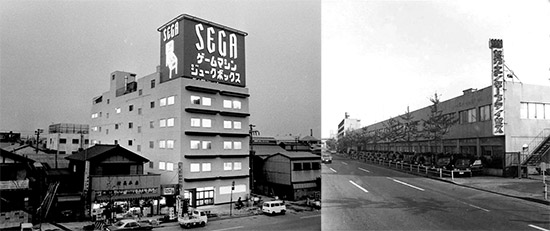
The building where the developers work and, across the street, Sega’s headquarters (Photos taken in 1964 and 1965 respectively, ©Sega)
Within this development division, Sega had three main sections: one for programming and sound creation, a second for planning (game design, direction) and a third for design. It was not until a little later that a section dedicated to sound was opened. The opening of development positions for certain tasks within Sega was a done gradually. According to Masaharu Yoshii, one of Sega’s earliest employees, it was probably during the development of the light gun game Bullet Mark in 1975 that programmers began to no longer be in charge of the graphics for the games. Designers who had originally been hired to design electro-mechanical games or pinball machines were called in to help develop video games. From 1980 and the game Samurai onwards, a person in charge of sound was added, usually initially hired as a programmer. It wasn’t until around 1981-83 that Sega opened a planning department, some time before the company entered the console and computer market.
The design section then included people responsible for creating graphics for the games themselves, as well as people designing illustrations, advertising, arcade cabinet art and game packaging. Kodama was assigned to this section and it seems that her very first job was to create a full-color instruction card for an arcade cabinet. Unfortunately, her work was not approved and the name of the game in question remains unknown (more generally, Kodama said very little about the various tasks she carried out during her first months at the company). However, the graphic designer didn’t stay in the job for very long.
Entering the console market
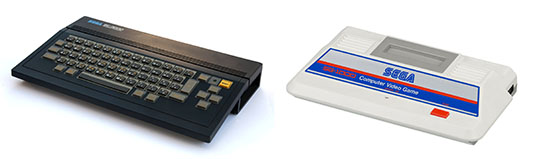
The SC-3000 and its consolized version, the SG-1000 (photos by Evan Amos and Bilby)
After considering distributing the Colecovision in Japan for a time and ruling out the MSX option, a format common to several manufacturers, Sega decided to market its own hardware, perhaps due to Nakayama’s desire to push research and development rather than simply following the competition. This resulted in the simultaneous launch in July 1983 of the SC-3000 and its consolized equivalent, the SG-1000 (whose cartridges were compatible with the SC-3000). As a result, the company could not rely on a pre-existing software library to supply its machine, and its need for games and developers naturally soared. However, while the broadcasting of television advertisements extolling the merits of these machines led to a sharp increase in the number of applications, the company did not recruit developers on a massive scale. According to game designer Yu Suzuki, in 1983 the company only had around fifty developers, including those in charge of games and hardware, which was certainly a lot for the time, but insufficient for its ambitions. Of this group, fewer than ten were assigned to developing SG-1000 and SC-3000 games that year.
Engineer Hideki Sato, in charge of hardware for Sega’s consoles and computers, added that, with the notable exception of Star Jacker, most of the SG-1000 games produced by his company in 1983 were in fact subcontracted to companies such as Compile (Tranquillizer Gun, N-Sub). The same was true in the arcade sector, where companies such as Ikegami Tsushinki and Coreland lent a hand to Sega in developing all or part of titles such as Zaxxon and Congo Bongo for the former, while the latter worked on Pengo and Hang-on. The lack of in-house manpower was not the only cause of this phenomenon, however; Sega developers generally preferred to work on arcade games, which were generally more technologically advanced than console games. The only employees assigned to the development of console games were those who were not deemed necessary for the production of arcade games and whose managers had agreed to their transfer.
The SG-1000’s sales figures certainly exceeded the company’s expectations (160,000 units were sold in its first year on the market), but Sato felt that it benefited both from successive shortages of the Famicom – its main competitor – and from a certain confusion between the 2 machines among some members of the public. What’s more, he felt that the games outsourced were of mediocre quality, which was probably one of the reasons why Sega decided to develop more in-house from 1984 onwards. This had an impact on the number of SG-1000 games produced, with a noticeable slowdown in releases (17 SG-1000 games were released between July and December 1983 compared with 11 during the same period in 1984, including titles published by Tsukuda Original).
With labor shortages still being felt, some of the section heads decided to encourage employees to move into development. So, while Kodama was thinking of staying on to create advertising content, one of the heads of her division suggested that she try her hand at creating graphics for a game, just a few months after joining the company. Although she said she had no particular interest in video games when she joined Sega, she was nevertheless tempted by the offer.
‘At first I thought I’d be doing advertising graphics, but once I saw how the games were being made, I thought game production might be interesting too.’
Kodama thus became one of the first Sega developers to work on SG-1000 / SC-3000 games, but not only that.
Page 1 2 3 4 5 6 7 8 9 10 11 12 13 14 15 Sources
———-Support me———-
VGDensetsu is the equivalent of a full-time job for me – I spend an average of 30 to 40 hours a week on it. You can help me continue my work by supporting me financially via Patreon (monthly payment with the possibility of a one-off payment by unsubscribing after an initial payment) or via Ko-fi (one-off payment), or simply by talking about my work to those around you.