



Rieko Kodama – Part IX: Working conditions at Sega and in the Japanese video game industry
Table of contents:
Part I: Tokyo, 1984
Part II: Champion Boxing
Part III: From arcade to console (and vice versa)
Part IV: Alex Kidd in Miracle World or the birth of a Master System icon
Part V: Breaking out of the canon to go beyond it: the making of Phantasy Star
Part VI: The status of women in the Japanese video games industry
Part VII: Change and new responsibilities
Part VIII: The two Phantasy Star II
Part IX: Working conditions at Sega and in the Japanese video game industry
Part X: A mascot in the making
Part XI: On both sides of the Pacific
Part XII: Final Phantasy
Part XIII: The last Saturn games
Part XIV: Arcadia of my youth
Part XV: Entering History
Games
To be confirmed
Other video game related works
Chronology
Gallery
Sources
General sources (Interviews, liner notes, comments, etc.)
Article aussi disponible en VF
A challenging launch
Although Japan has long been known for its practice of lifetime employment (Shūshin koyō), the video game industry quickly stood out for its high turnover rate, even within big companies. Many employees preferred to give up job security to escape the working conditions imposed on them, either by changing employers or leaving the industry altogether.
At Sega of Japan, several developers testified that overtime was not an unfamiliar concept in the early 1980s. Steve Hanawa, for example, explained that he practically lived at Sega at the end of the development of Turbo in 1981, while engineer Hiroshi Yagi was in the habit of finishing his days at 10 p.m. Yoji Ishii said that developers generally worked until the last trains ran, including on weekends.
However, while there was probably a gradual shift towards longer working hours, 1988 seems to have been a turning point for Sega, with developers agreeing that the period leading up to the launch of the Mega Drive was particularly difficult. It’s worth noting that most of the testimonials that follow were given by people who were still working for Sega at the time, in a way underlining the banality of the situation they experienced. Kodama confided on several occasions about this period:
‘I was working on three titles at the same time, even though the hardware specifications hadn’t yet been finalised. It was a short period but it was very difficult.’
‘I worked myself to death to get (Altered Beast) ready in time for the Megadrive launch.’
Kodama only had around 3 months to work on 3 games, including two Mega Drive games developed on hardware she was just discovering. As Yuji Naka pointed out, the pace of work changed significantly between Phantasy Star I and II:
‘I don’t remember working so many extra hours coding (Phantasy Star I), and I don’t remember it being as difficult to develop as the second episode.’
Developers have probably suffered as a result of Sega’s policy of strengthening its position in the console market. The lack of third-party developers presumably led the company to overload its employees by imposing production deadlines that were sometimes shorter than those applied to Mark III games, in order to produce more titles more quickly. As Yasushi Yamaguchi and Tomohiro Yamamoto pointed out, some of their management seemed to ignore the technological evolution of the machines for which they were producing games, underestimating the time needed for development and consequently imposing impossible deadlines.
While in 2016 Yu Suzuki explained that he had chosen to join Sega because it allowed him to have 2 days off a week and Rieko Kodama started out with standard office hours, it is clear that this was no longer the case 5 years later.
Back in 1985-86, the former more or less lived in his office during the 10 months it took to develop Outrun (as well as for the 15 years that followed), sleeping on a cardboard box on the floor. When the president of Sega found out, he had a shower and a nap room installed for him.
Nights at the office
Until then, the company’s various dormitories were equivalent to youth hostels, designed for recruits who did not yet have their own accommodation – which was the case for Yuji Naka during his first 3 years at Sega. For other employees who had missed their last train after working overtime, they had to make do with what they had, as Miki Morimoto recounted when talking about the development of Phantasy Star (1987):
‘I almost never spent the night in the office, but once we had to work on bug checking late into the night.
So Chieko (Aoki) and I made makeshift beds out of office chairs and spent the night in a conference room.’
It’s worth noting that there was a difference in practice between male and female developers at the time, according to Toru Yoshida: the former mostly started their days at lunchtime, while the latter generally arrived in the morning. Reflecting this difference, working days now began at 10 a.m. and officially ended at 7 p.m. in the mid-1990s, according to Takaharu Terada.
Sega gradually equipped its offices to enable its employees to spend the week at work, with showers and dormitories included in most of its new buildings in the 1990s. Yasushi Yamaguchi nevertheless pointed out that in the late 1980s, the nap room at Sega’s former headquarters was so small and poorly ventilated that a foul odor emanated from it as soon as the door was opened. In addition, the number of places was limited, forcing developers to resort to makeshift facilities during periods of intense work. One of them covered the floor with manga comics to make it a little less hard, while Yamaguchi had a mat and sleeping bag during the period when he worked in the Shibuya offices in 1993 (which did not have a dormitory).
Toyonaka Ozaki, who was responsible for designing the characters in Phantasy Star III (1990), spoke briefly about the game’s development a few months after its release, while she was still working at Sega:
‘The Phantasy Star series is a very important franchise for Sega, so getting assigned to it means lots of overtime, and people called us the “Phantasy Star Elites” because of all the overtime pay… but in reality there was a lot of pressure so I’m not sure how glamorous it really was!.’
In 2022, Yamaguchi said that when he arrived in 1988, his day off was skipped as soon as he started training. He repeatedly spoke about the reasons for his departure from Sega in 1995, discussing in varying degrees of detail the development of the Saturn version of Magic Knight Rayearth (on which Kodama also worked):
“The final stages of developing Rayearth for Saturn were absolutely hellish. I thought I was going to die. I lived under my desk at the company for over six months, and I thought that if I stayed at SEGA any longer, I would soon die. So, after completing the development of Rayearth, I left the company.
The entire development team was engaged in a death march.
We changed our working environment from Mega Drive to Saturn, which meant we couldn’t even estimate the workload in advance. We didn’t have all the necessary equipment, but we were forced to adhere to an incredibly tight development schedule…
Almost everyone, except for the staff who came to lend a hand, spent the night at the office. The women also worked until the last train.
The deadlines were impossible to meet, even working 24 hours a day from the start of the project.
Requests for additional staff were rejected.“
‘It was the same for all the games I’d worked on up to that point. I couldn’t stand having to work such long hours that I couldn’t go home for long periods of time.’
One factor that only made matters worse for these developers in the mid-1990s was the abundance of machines for which they had to create games, resulting in a shortage of staff, as their superiors refused to increase team sizes.
‘When I returned to Japan (in 1994), four development lines were running in parallel,’ said Yuji Naka. There was the Saturn line, the 32X line, the Game Gear line, and there was even still work related to the Mega Drive. Four lines all running at the same time… Before that, it was already almost too much to have the Mega Drive and Game Gear lines running together. Now, the Saturn line had grown, as had the 32X line. With four lines… I mean, there just weren’t enough staff.“
‘If I could go back in time, I would stop the development of the 32X,’ explained Ryo Kudou. ‘Half of Sega’s consumer software development staff was developing games for hardware that had no future. It’s probably hard to believe, but initially, only half of Sega’s development staff was assigned to Saturn development.’
Kudou had previously developed Master System games after the console was discontinued in Japan, but it was enjoying some success in Europe and South America, something that never happened with the 32X.
In addition to the effects these working conditions may have had on his health, Yamaguchi added that these deadlines had a direct impact on the way he worked as a graphic designer, as he was forced to skip the preparatory drawing stage on paper, an important phase in order to save space in the ROM.
According to Toru Yoshida, working conditions did not improve in the second half of the 1990s; quite the contrary:
‘I remember that some people seemed to spend the night at work (during the Mega Drive era). I think it was only during the Saturn era that large teams began working through the night during the debugging phase (ed. note: which was the final stage of development, at least at the time).’
His colleague Takaharu Terada added:
“Sometimes work would start late at night. For example, the Sakura Taisen (1996) team would start their meetings at 1 a.m. […] Until 10 p.m., many people were still at the office.“
School at the office
One of the points that comes up frequently in these testimonials and discussions, both about Sega and other companies, concerns the working atmosphere. For some developers in the 1980s and 1990s, an hour spent at the office did not necessarily mean an hour of work, for two reasons. Firstly, because some of them pursued their hobbies at work (assembling plastic models, playing video games, reading manga). Secondly, because of their passion, some saw their work and the fact of camping out at night in their office with their colleagues as an extension of the preparations for a school festival. Yamaguchi himself drew a parallel with the film Urusei Yatsura: Beautiful Dreamer, which depicts busy high school students rehearsing over and over again the day before their festival and sleeping together. He said that it was this fun aspect of the work that kept him going and that it wasn’t so much the sleepless nights as the impossible deadlines imposed by superiors who weren’t involved in the development itself that were unbearable. Paradoxically, in this film directed by Mamoru Oshii, the latter spoke in subtext about the lives of the animators who worked tirelessly on the series he directed:
“I didn’t take a vacation for the entire time. That’s about 4 or 5 years. I spent most of it at the studio. I chose a school festival, mostly because the school was similar to the world of the anime studio.
[…]
A TV series requires an episode a week, and it has to get done by a certain time. So half the scenes we end up pulling all-nighters on. But we had a young staff. They were in their teens or 20’s, so it felt like we were doing a long school festival preparation. And when we finally looked up, 2 or 3 years had passed. So I just wanted that feeling, or that kind of atmosphere. We were all exhausted, so the character have that same tired look to them. We were probably at the peak of our exhaustion.“
Echoing this comparison, Tomohiro Yamamoto added that the sense of fun generated by this atmosphere was probably largely caused by a lack of sleep, which deprived them of their judgement. He concluded his message by pointing out that at the end of these periods of intensive work, the backlash was felt and a number of developers broke down physically and mentally, leading them to resign shortly after.
One might wonder whether, through an unintended adverse effect, these festivals have conditioned future employees to spend nights at the office without counting the hours, just as game jams can do for video game school students.
Passion blinds
There are still veteran developers who are nostalgic for that era, not always aware of the consequences it may have had on the health of their colleagues or themselves, and remembering only the positive aspects. However, even among this group of people, some acknowledge that they would not do it again at their current age. What’s more, these people often consciously or unconsciously avoid the question of the moral obligation that some of their colleagues may have felt to do as they did, namely to stay and work outside office hours. While women could go home on the last train, several developers confided that there was a kind of unspoken obligation for men to spend their nights at the office. This obligation was reinforced when one’s own superior did the same – it could be frowned upon to leave before them.
From the mid-1980s onwards, some future department heads were characterised as workaholics, the most famous being Yuji Naka and Yu Suzuki. They seemed to enjoy working under these conditions without necessarily perceiving the harmful effects, as the former explained with hindsight:
‘At the time, people like Yu Suzuki and I were almost in competition to see who could spend the most time in Sega’s offices… who worked the most overtime. We lived at Sega.’
‘Yu and I were the ones who worked the most overtime. At the time, I didn’t mind not sleeping, and I worked about 500 hours a month. I thought I’d never die of overwork. ’
During the development of Phantasy Star II, Naka even found time to go to the AM Show in early October 1988, and then to motivate some of his colleagues to make an adaptation of Ghouls’n Ghosts after seeing the arcade version of the game running. By his own admission, he was practically living at Sega at the time and loved a challenge, but halfway through the project he regretted asking to take on a project that was perhaps a little too ambitious for him, given the storage capacity of the cartridge initially planned. The Mega Drive adaptation took 5 months of hard work between December 1988 and May 1989.
The pace of Naka’s work did not improve in the years that followed, particularly during the development of Nights where, according to him, he only found time to do programming at night, his days being spent attending meetings of all kinds.
As for Yu Suzuki, he went so far as to boast nonchalantly that he probably held the record for the most overtime hours in the history of Sega in an interview given in 2000 for volume 2 of the book series Game Maestro. During the development of Shenmue (1999), which spanned more than 4 years, he made a habit of scheduling a meeting every Thursday at midnight, which, according to some members of the team, usually ended around 2-3am. Suzuki, the game’s director, then expected the participants to have carried out the instructions given at each meeting by the time he returned the following morning. As Keiji Okayasu, Programming Director on the game, explained, working through the night was the norm at the time, adding that Suzuki didn’t seem to take his team members’ sleep time into account. Programmer Makoto Wada didn’t go home for 2 months while working on the game, making do with a cardboard box under his desk to sleep on.
An industry not overly concerned with labour law
Even among the most enthusiastic, people sometimes refer to black gaisha/black kigyo (black corporation/black company) or death march to describe these working conditions, two expressions that are not exclusive to Sega or the video game industry. Black gaisha or black kigyo is used to describe a company that exploits its employees under poor or even illegal working conditions, particularly with regard to working hours. Developers, some of whom have a large following on social media, have publicly used these terms when referring to the 1980s and 1990s to describe their experiences at companies such as Sega, Capcom, SNK, Hudson Soft and Chunsoft. What all these people have in common is that they were no longer employed by the companies in question.
The expression ‘death march’ seems less a thing of the past; it is sometimes used by former developers from various companies (ADK, Naxat) to describe periods of intense crunch time they may have experienced, often imposed by management who forced them to meet unreasonable deadlines. Weeks of work without a day off and the inability to get a full night’s sleep (if any sleep at all) are two of the main consequences, preventing those who experience this phenomenon from seeing the light at the end of the tunnel. The expression was still in use in the early 2010s to describe ongoing developments.
As for the festival atmosphere, it seems to have disappeared in the last century during the PS1-Saturn era, when development teams grew in size. Until then, developers had less specific tasks to perform and could contribute to game design informally in small teams.
Many developers, both active and retired, have shared their experiences of working conditions at various Japanese companies during the 1980s and 1990s. Many of these accounts are similar to those given by people who work or have worked for Sega, and it is difficult to determine whether the latter was better or worse than its competitors during this period. There are countless accounts of people sleeping under their desks, to the point where some of them exchanged anecdotes about where they washed: showers installed in the offices, public baths or even gyms. Having a colleague living near the workplace could be very useful for doing laundry, especially when it was not possible to go home at least once a week. Others had to put up with colleagues who were reluctant to wash more than once a week or brush their teeth.
Some companies had standardised overnight stays at the office, regardless of the progress of their game development. Part of the industry treated women differently by allowing their female employees to go home at night, but companies such as Brain Grey and Amorphous did not make any distinction based on gender. The final stretch of game development is usually when working hours and sleepless nights are at their peak, but there were times when developers continued working beyond that. One developer recounted how he and his team found themselves standing around an assembly line, packaging copies of their game so that it could be released on schedule. Norio Okubo, a former developer at Sanritsu and Hudson Soft, learned a lesson from that period: it was recommended to go home whenever possible, because you never knew when you would be able to return again.
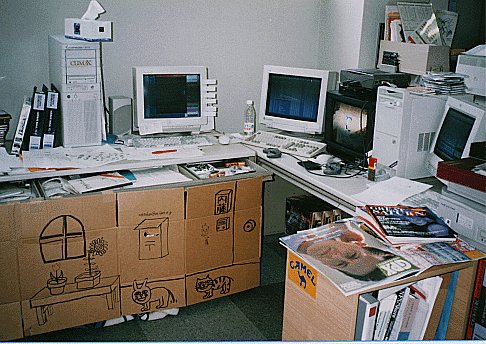
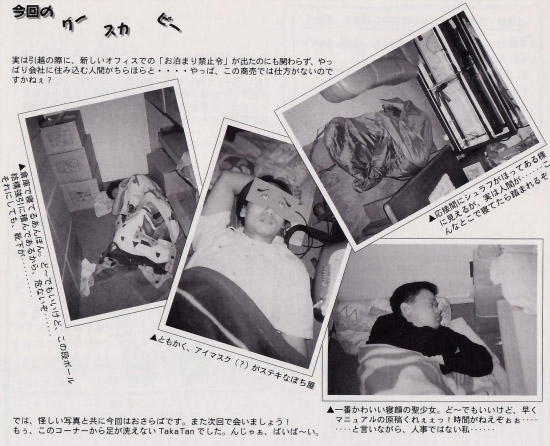
Sleeping under one’s desk was so common that some companies featured it on their websites (1st pic: Climax in 1997) or in their game manuals (2nd pic: Active in 1994).
At Capcom, in the 90s, accommodation was rented by the company to enable its employees to wash and sleep without having to go home, according to a graphic designer in the arcade section. As for the pace of work, they said that overtime was the norm, that the next step up was to work until the middle of the night and that, in the most intense periods, developers would pull all-nighters. Capcom advised its employees, not without irony, to do what was necessary to make their sleepless nights comfortable. Although security made it impossible to enter the company’s buildings at night, that didn’t stop its developers from staying in to work, as Tamayo Kawamoto, a composer who worked for the company until 1988, recalled. That same year, Akira Kitamura and his team were allowed to develop a sequel to the first Mega Man on condition that they worked on other projects at the same time, which meant a lot of overtime during the 3-4 months it took to produce the game.
The company was not spared from sexual harassment, with former producer Yoshiki Okamoto discussing his own behaviour during the development of the erotic game Mahjong Gakuen (1988) on his YouTube channel. He had asked some female employees to pose in bikinis as models, thereby abusing his position. The game was developed outside normal office hours, and the company’s chairman was not made aware of its existence until after the work had been completed. He refused to publish it under the Capcom brand, but Okamoto kept his job.
Regarding SNK, working conditions did not seem any more desirable than at its competitors. Yasushi Adachi, hired in 1986 by the company where he co-created Samurai Shodown, explained that there were no real working hours. He had to work 250 to 300 hours of overtime a month and, while these hours were certainly paid, he didn’t have the time to spend the money he earned anyway.
One of his colleagues, a graphic designer on The King of Fighters in the 1990s, added that overtime was not paid beyond 100 hours per month. While SNK did for a time provide a place to sleep for its employees who ended their days in the middle of the night, this graphic designer said that he and his colleagues began their nights by sleeping on the floor before rental futons were brought in. Yasuyuki Oda told that the team responsible for Real Bout 2 (1988) more or less lived in SNK’s offices during the few months they were given by their management to create the game.
In the early 90s, new SNK recruits were put through their paces before even taking up their positions at the company. Two former developers hired in 1991 and 1992 respectively reported that training took place in Nara under Spartan conditions. The group of just under 50 new recruits had to spend 3 days and 2 nights looking after each other in what seemed more like a test of physical and mental endurance than a team-building exercise, wearing prison uniforms and going on long night walks, armed with a map and onigiri, not forgetting to write a letter of thanks to the company president every evening. Several people dropped out during the course, while almost half of the new recruits quit within the first year, according to one of the developers.
While overtime was expected of developers in most companies in the industry, some of them did not pay for it. This was particularly the case at Naxat (Coryoon, Air Zonk) and another company whose management believed that employees might abuse the system to earn more money. But this phenomenon could also affect people in senior positions, as explained by Tsutomu Maruyama, head of ADK’s planning department in the early 1990s, making him third in the company hierarchy. He generally worked from 9 a.m. to 1 a.m. or later and reported that overtime was at least 100 hours per month, with peaks of 250 hours. When he was about to be appointed director of development in 1993, he chose to leave the company, explaining that he was under so much pressure that he regularly woke up to the sound of his own screams.
There are countless examples of difficult, even untenable working conditions, whether at Square, where developers were expected to spend the night working on site in the early 1990s, according to Takashi Tokita, or at Nintendo during the production of Super Metroid (1994), which – and this is probably no coincidence – was released just before the end of a disappointing fiscal year for the company (Mega Man 7, developed in just three months on Super NES, apparently suffered the same fate, and it is probably not the only one). These practices were so widespread in the Japanese industry that neither Sega nor any other company had any reason (other than empathy or humanism) to question them of their own accord, and an emulation phenomenon persisted that was harmful to all developers.
Evolution
Under the legislation in force in Japan since 1987, working weeks are in theory 40 hours, at a rate of 8 hours per day, with a maximum of 15 hours overtime per month. However, there are systems in place to allow exceptions to both this limit on overtime and the standard number of working hours per week, with relatively high ceilings.
Nevertheless, various factors, many of which affect both the video game industry and Japanese society as a whole, meant that by the turn of the 2000s, spending nights at the office no longer seemed to be such a widespread phenomenon: increase in the number of developers with the possibility of reassigning some of them when the workload increases on a project, publicly traded companies that are mindful of their image, gradual recognition of the phenomenon of sudden death at work, increased employment of post-maternity women, high staff turnover, a fall in the average number of hours worked each year, etc. Several developers even said that they were no longer allowed to sleep at their place of work, a point that their building’s safety department would ensures is respected. It’s only a short step from saying that working conditions have become respectful of video game industry employees in Japan, but we’d be wary of crossing that line. In a company founded in 2000 by a former producer of a company famous for its fighting games, tickets giving access to public baths were still in circulation at the beginning of the millennium, a sign that its employees did not always have the opportunity to go home every evening. As for Nintendo, Motoi Okamoto recounted that during the development of Super Mario 64 DS (2004), Shigeru Miyamoto used to schedule meetings starting at 11pm and finishing around 2am. He would then advise those present at the meeting not to wait too long to go home once he had given them new instructions, even though they would then have to spend 2-3 hours writing up the instructions to be communicated to the rest of the team. Even back when the original version was released on Nintendo 64 in 1996, two programmers stopped developing games once this title was completed, each suffering from burnout, according to Giles Goddard, himself a programmer on the game.
Another point to bear in mind is that in the 90s, certain Japanese companies distinguished themselves by their ability to circumvent labour law, which was more restrictive than in many Western countries when it comes to dismissals.
As employees could not be made redundant solely on the basis of their performance (supposed or proven), their employers introduced new techniques akin to sidelining, with the aim of pushing them out themselves. The video games industry has been no exception to this new practice, dubbed Oidashibeya, and Sega made headlines in a case of this type in 1999. An employee recruited at the beginning of the decade and judged not to be performing well by their management was moved from department to department before finally being placed in a Pasona Room. Behind this deliberately vague name lay a room designed to arouse deep boredom or a feeling of uselessness and, inevitably, the desire to sign the letter of resignation that management had handed them. While suggesting resignation is not forbidden under Japanese law, sidelining an employee can have an impact on their morale and even their mental health, which can be more difficult to prove. In this case, the matter could have ended there had the employee in question not refused to sign the letter of resignation. Faced with their determination, Sega decided to dismiss them, which led to its former employee suing them for termination without just cause, thus bringing to public attention the existence of this practice within the company.
Cases of this kind have broken out in other Japanese companies, each time with a different but equally unevocative name for the litigious room, whether at Sony, NEC, Ricoh, Hitashi or Toshiba.
As this practice was quickly exposed, some companies changed it in order to conceal this sidelining. Konami, for example, reassigned employees it wanted to get rid of to positions that did not match the work skills they had acquired. A Nikkei article published in 2015, the content of which was quickly spread by video game news sites outside Japan, explained that some employees were reassigned to positions as security guards, fitness club maintenance staff or assembly line workers.
In 2024, Bandai Namco was in turn accused of dismissing some of its employees by the website Leakpress, which went online the same year and whose author(s) have not been identified. For the time being, the information remains difficult to verify, either to deny or to confirm, which raises another problem.
Since around 2010, a handful of English-, French- and Spanish-language websites and newspapers have been reporting on the working conditions of employees in the video games industry, a subject that until now had received little or no coverage in the Japanese video games press. The website 4Gamer recently made an exception in August 2025 during an interview with Sega employees who were already working for the company in the 1990s, in which they described their working hours and some of the habits they had developed for sleeping at the office in the last century. Unfortunately, the article seems rather watered down compared to the numerous reactions sparked a few days earlier by one of Yasushi Yamaguchi’s threads looking back on the development of Magic Knight Rayearth (dozens of developers responded to him, while others wrote messages of their own, sparking some of the most open discussions ever held on the subject of working conditions in the Japanese video game industry, even though they were mainly focused on the past)
There is another factor that may explain the scarcity of accounts of difficult working conditions during the development of more recent games: communication is more controlled than it used to be. While some companies had no objection to their employees describing what amounted to crunch periods to the press in the 80s and 90s, they are now much more careful about this, aware that it can reflect badly on them. What’s more, the almost continuous growth in the size of development teams, in line with the curve of technological change, means that developers at the bottom of the ladder, be they graphic designers, programmers, QA testers or others, rarely have the opportunity to give interviews about their work, when their employer doesn’t forbid them to do so altogether (at From Software, for example). Unless they choose to leave the industry, they know that denouncing difficult working conditions without recourse to anonymity can be a brake on their career, either within their own company or within a company to which they might want to apply in the future.
More generally, there is a gulf between what we discover every day about the working conditions of certain Western studios and what we know about the Japanese industry where, if there are protests, there are not enough relays for the public to learn about them. In the absence of any in-depth journalistic investigation, testimonies from developers, even on condition of anonymity, are rare, and the vagueness reigns over this whole area of the industry. On a positive note, however: in January 2025, Square-Enix announced that it was taking measures to protect its employees from attacks coming not from within, but from outside, and more specifically from toxic fans practising harassment. A phenomenon not unique to Japan, since Ubisoft did the same 2 months later, to coincide with the release of Assassin’s Creed: Shadows.
Page 1 2 3 4 5 6 7 8 9 10 11 12 13 14 15 Sources
———-Support me———-
VGDensetsu is the equivalent of a full-time job for me – I spend an average of 30 to 40 hours a week on it. You can help me continue my work by supporting me financially via Patreon (monthly payment with the possibility of a one-off payment by unsubscribing after an initial payment) or via Ko-fi (one-off payment), or simply by talking about my work to those around you.