



Rieko Kodama – Part IV: Alex Kidd in Miracle World or the birth of a Master System icon
Table of contents:
Part I: Tokyo, 1984
Part II: Champion Boxing
Part III: From arcade to console (and vice versa)
Part IV: Alex Kidd in Miracle World or the birth of a Master System icon
Part V: Breaking out of the canon to go beyond it: the making of Phantasy Star
Part VI: The status of women in the Japanese video games industry
Part VII: Change and new responsibilities
Part VIII: The two Phantasy Star II
Part IX: Working conditions at Sega and in the Japanese video game industry
Part X: A mascot in the making
Part XI: On both sides of the Pacific
Part XII: Final Phantasy
Part XIII: The last Saturn games
Part XIV: Arcadia of my youth
Part XV: Entering History
Games
To be confirmed
Other video game related works
Chronology
Gallery
Sources
General sources (Interviews, liner notes, comments, etc.)
Article aussi disponible en VF
Super Janken Bros.
As soon as it entered the console market, Sega did not hesitate to use manga and anime licenses for some of its games, including Golgo 13, Orgus, Sukeban Deka, Anmitsu Hime and High School Kimengumi. After a mixed start, Dragon Ball and its animated adaptation were so successful that many publishers became interested in the licence. This was the case with Sega, which planned to adapt it for the Mark III. R&D2 planner Kotaro Hayashida was commissioned to produce it, but was forced to rethink the project when his employer told him that his company had not obtained the rights to use the license after all. We don’t know the legal background to the case, but we do know that the Dragon Ball license had already been exploited by Epoch on Super Cassette Vision, and then by Bandai on Famicom within a few months of each other in 1986.
At the same time, Super Mario Bros. also met with such critical acclaim and success that it became difficult for Sega to ignore it. So Hayashida and his team decided to develop a title to rival Nintendo’s game, and create their own character. The planner laid the foundations of the game’s universe, then entrusted an in-house graphic artist with the task of designing one of the company’s first flagship characters.
Yoko Kobayashi
When Hayashida joined Sega in April 1983, the development department was not exactly a model of parity and, as he pointed out, “with the exception of the artists, most of the staff were men”. The sound and music department had not yet opened its doors, while programmers and planners were largely male-dominated, at Sega as elsewhere.
When she joined Sega, Kodama wasn’t the first woman in her section. Among her more senior colleagues was Yoko Kobayashi, also known by the pseudonyms Yoko Matilda or Yoko Alex. The fact that her surname remained unknown for decades (it was only revealed after her death, which occurred at an unknown date) is unfortunately a common phenomenon for developers of this era who didn’t make a career in the industry. The latter often had the double misfortune of not being allowed to put their names in the credits of their games, nor granting interviews to magazines or TV shows. As a result, it’s hard to know whether Kobayashi was the first graphic designer or the first woman to design characters for Sega, which, according to Masaharu Yoshii, had a high turnover of staff. On the other hand, we know from various accounts that she designed (and presumably illustrated) the characters for Teddy Boy Blues and Alex Kidd, who also share the characteristic of having a name indicating the age group targeted by Sega. Teddy Boy Blues, an arcade game released in 1985 and then one of the two launch games for the Mark III, is the oldest known title in Kobayashi’s ludography, but it’s likely that she worked on other games before that. She went on to work on other episodes in the Alex Kidd series, as well as on various Mark III games such as Fantasy Zone, Space Harrier, Kujaku-Ō and Sukeban Deka II. She probably left her position as graphic designer (and probably also Sega) after Alex Kidd in Shinobi World (1990), long the final episode in the series.
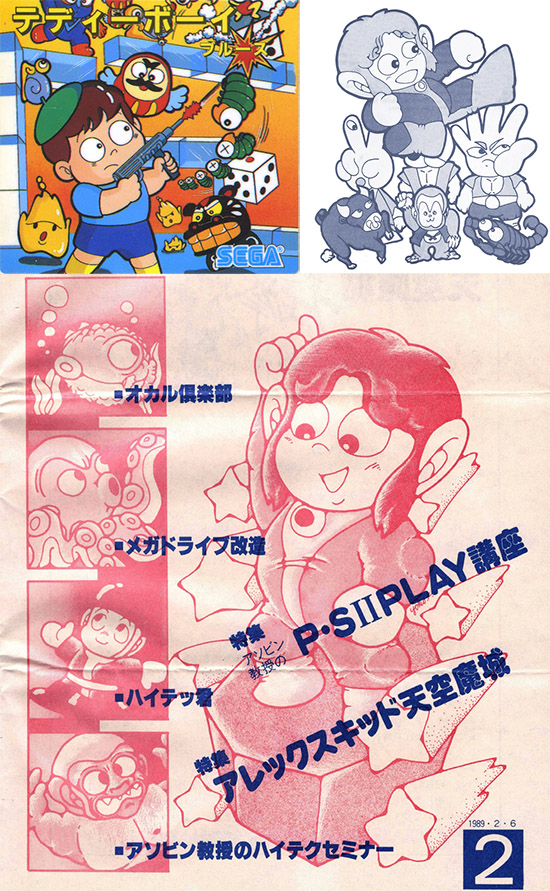
Like a family resemblance between Teddy Boy Blues and Alex Kidd. Rieko Kodama has indicated that the manual illustrations for Alex Kidd in Miracle World were produced in-house, unlike its box art. The illustration at the bottom is signed “Yoko K”.
The game was developed over a period of about 3 months, which was standard for Mark III games at the time, but the pace of work imposed on Kodama meant that she retained few memories of this period. Years later, however, she claimed to have designed most of the backgrounds, as well as the world map, which appears both in the game and in its manual. As for the title screen, she was in charge of the illustrations resembling screenshots and may have been the one who transposed the logo into pixel art, but she was not the one who drew it on paper.
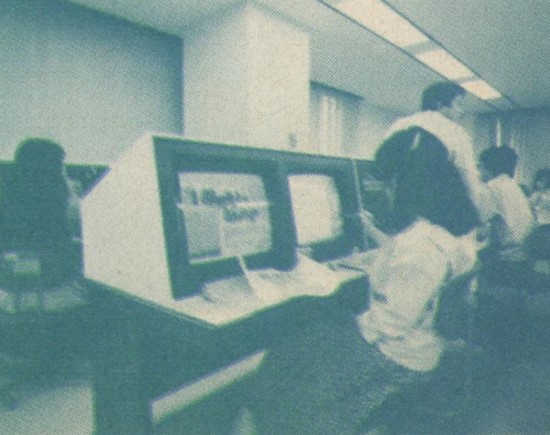
A graphic designer at one of Sega’s workstations displaying Alex Kidd’s title screen. It’s not clear whether this is Kodama or Kobayashi or someone else, either a member of the game’s development team or someone asked to pose for the occasion.
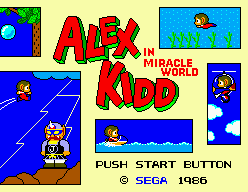
The game’s title screen
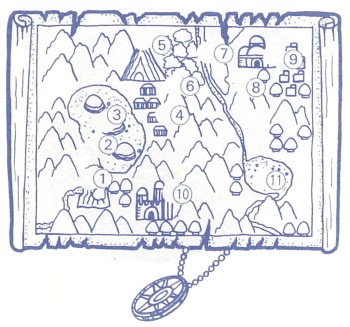
The game’s world map, drawn by Kodama
Regarding the game’s art direction, Kodama provided some clarification in a 2019 interview:
“In terms of color design, the palette for the main character and the enemies was determined by the graphic designer in charge of the characters, while I took care of that for the backgrounds.”
New Kidds on the block
The seminal episode in the series, Alex Kidd in Miracle World saw a number of sequels, spin-offs, cameos and tie-in products in the 4 years following its release. Perceived as a mascot by some gamers, it seems that Sega was more interested in making him a recurring character, without attaching him to its logo as it did some time later with Sonic. What’s more, other characters such as Pengo and Flicky have also made appearances in other titles before Alex Kidd was born, while Opa Opa, the main character in Fantasy Zone, was on a par with the latter for a long time (6 games each between 1986 and 1992, plus various appearances in other titles such as Phantasy Star, Altered Beast and a few board games). One of Teddy Boy Blues’ enemies – Daruman – is also part of the Miracle World cast. But Alex Kidd appeared in several platform games at a time when it was one of the best-selling genres on consoles. Above all, he benefited from having his first episode included in the Master System for years in the West, becoming de facto one of the most played and best-known titles on the machine.
Pseudonymity
Alex Kidd in Miracle World is the first known game in which Rieko Kodama is credited, under the short-lived pseudonym Rie Wakashimazu, which only appears in the Japanese version and only after entering a code. Wakashimazu is a reference to one of the characters in the sports manga Captain Tsubasa, which was very popular with both men and women at the time. The female gents, moreover, largely adopted its characters in various fanzines that were a little less football-centred, even though Kodama claimed to have been a great fan of the sport since secondary school.
Her other pseudonyms followed the same logic of referring to male characters or personalities, whether Phoenix Rie, a reference to Ikki, the wearer of the Phoenix cloth in the Saint Seiya manga, or Rieko Kataoka, whose surname is borrowed from her favourite kabuki actor of the time.
Even within Sega, in-game credits and design documents are not enough to determine who worked on which game. Consequently, even if the company wanted to retroactively credit all its developers, it wouldn’t necessarily have the means to do so, as illustrated by this discussion between Yosuke Okunari and Rieko Kodama:
Okunari: “I regularly consult documents from the time, but often the names in the credits for graphics and sound don’t correspond to the people who actually worked on the game. The design department and the sound department worked together on various projects, but only the name of the team leader(s) is indicated in this or that game, whereas they were actually made by various people.
So I don’t know what Ms. Kodama worked on, unless I ask her to look at some images and tell me if she was the one who designed them.”
Kodama: “If you show me my work, I can give you an answer because I know my own quirks. The way I drew the leaves in Alex Kidd and the leaves in the forest in Phantasy Star, for example, are similar.”
Kodama’s answer also shows that, although she had to adapt as quickly as possible to the projects she was called upon to work on and stick to an artistic direction she hadn’t determined herself, we can find distinctive signs specific to each graphic designer here and there.
If the absence of credits led to the invisibilisation of the developers, the presence of their names in these credits can sometimes lead to an unintentional overestimation of the role they played. Given the relatively short production deadlines of the time, a graphic designer or composer was frequently called in to help out for a day or less, as Yasushi Yamaguchi, credited as a graphic designer on Borgman (1988), attested:
“I wasn’t involved in any project, I arrived at work when everyone had gone home for summer vacation, and someone said to me, ‘Yamaguchi, do you have a minute to draw a monster?’ and I did it on the spot in two or three hours.”
This echoes Kodama’s comments:
‘I used to ask graphic designers from other departments to design small elements for me. I don’t know if they did this for Outrun, but for things like roadside billboards, it was more appropriate to have a multitude of styles, so we’d ask other people to design one each.’
‘Sometimes they’d tell me, “We need a design here.” So, I’d ask, “Sure, what kind of design?” And they’d tell me, “You decide! It’s all up to you!” So I’d make whatever I wanted as long as it felt like it worked. (Laughs)’
‘I would get little requests for art from different projects on a daily basis.’
Furthermore, the order in which names appear in the end credits is not necessarily representative of the amount of work accomplished by each of the developers, but rather follows the logic of seniority: for an equivalent position, an employee with several years’ seniority within the company generally had their name listed before that of an employee recruited after them. This practice has sometimes been a source of frustration and even conflict, notably at Konami during the development of Silent Hill (a young employee who was more involved than his predecessors and more qualified in 3D than they were was unable to get proper credit for his work). Also, employees who have only worked briefly on a game are sometimes listed in the Special Thanks category instead, perhaps to get around this seniority rule which may seem unfair to some developers.
From one console game to another
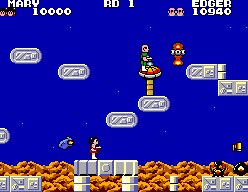
Double Target, a.k.a Quartet, Mark III version
Among the people whose identities were discovered many years after the games they were involved in have been released, there’s one who made news in the mid-2000s. A tax accountant since 1991, Kazuo Yamada revealed his past career in a post published on his professional blog in 2005, giving anecdotes about 4 titles he had directed. What’s special about these 4 games is that none of them have end credits, but people such as Yosuke Okunari have been able to confirm that he was indeed a former Sega employee.
Yamada was hired around the time Quartet was released in arcades, and was quickly given the task of adapting this title, originally designed to be played by up to 4 players, to a machine that could only support a maximum of 2 players. Rather than making a simple adaptation that was almost doomed to be inferior to the original, he decided to create an episode in its own right, using only some of the elements of the original version to make the most of the console’s specific features. Unusually for the time, the game was programmed by a man and a woman, who were to marry some time later.
With only two playable characters left in the game, the visuals created for Quartet could not be reused for this Mark III episode, and it seems that Kodama was the person in charge of designing the box art. She was probably also responsible for the manual illustration of Mari, a female character whose appearance has changed since Quartet.
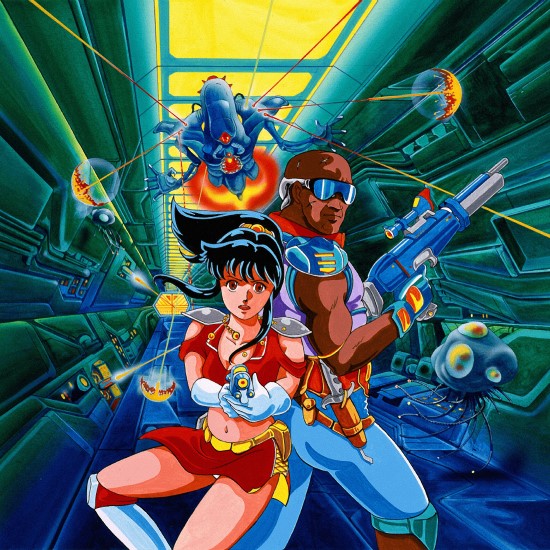
Main visual for the Japanese version of Double Target, which was renamed Quartet in the West.
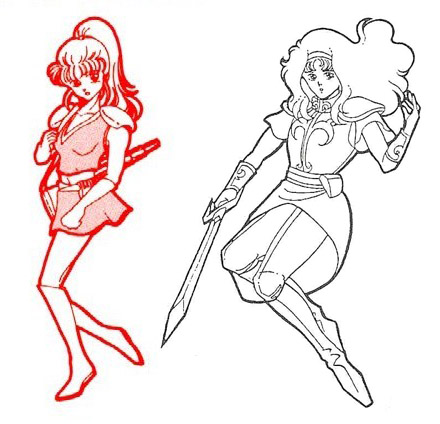
Mari (on the left) as depicted in the Japanese version of the game’s manual. The art style is quite similar to some of the manual illustrations Kodama drew for Phantasy Star some time later.
The illustration of Edgar featured in the manual is taken from the arcade version.
Kodama then went on to work on several titles released in 1987: a late adaptation of The Black Onyx on SG-1000, for which she drew a single enemy, as well as a sequel to Fantasy Zone long exclusive to the Mark III – Fantasy Zone II: The Tears of Opa-Opa.
She also briefly joined the team in charge of adapting an RPG originally developed by Kogado Studio and released on Japanese computers at the same time as Dragon Quest: Haja no Fuuin. Renamed Miracle Warriors at the time of its localisation, this title was produced at a time when tabletop role-playing games, which originated in the United States, were beginning to spread to Japan. The idea of bundling a video game with a metal figurine and a map of its world was probably born out of a desire to appeal to this pen-and-paper RPG-loving public. But Haja no Fuuin was also very probably inspired by certain Western RPGs released on computers, and Sega happened to have a few fans of this type of game in its ranks.
As planner Kazuo Yamada pointed out, it was his superior – one of the fans in question – who suggested that he develop a Mark III version of Haja no Fuuin. While the idea of including a world map and a figurine was retained (at least in the Japanese version), Yamada decided to make a few changes to Kogado’s game to make it more accessible. With this in mind, he chose to simplify the map on which the player moves, aware that the latter may have little or no experience with RPGs. What Yamada probably didn’t foresee was that his game would also become a gateway to the West where, along with Phantasy Star, it was one of the very first RPGs of Japanese origin to be released, preceding Final Fantasy and Dragon Quest in particular (especially in Europe, where neither were released on the NES).
As with The Black Onyx, Kodama only made a brief appearance in the development team, drawing just one or more dragons. The fact that Haja no Fuuin and Fantasy Zone II were released one day apart in October 1987 in Japan illustrates well that Sega developers were required to change teams as needed without waiting for the game they were initially assigned to finish development. As Kodama pointed out,
‘There were usually two main graphic designers (on each game), and the others would come in and lend a hand as needed.’
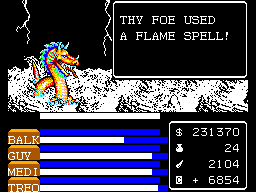
A dragon encountered in Miracle Warriors
The mystery remains as to Zillion, a series of games adapted from an animated series itself produced to sell a toy marketed by Sega. Kodama said in an interview that she had worked on a game with this name, without specifying which episode it was. In Japan, the second episode is simply called Tri Formation, which implies that only the first episode – Akai Koudan Zillion – is called Zillion. The most likely hypothesis is that Kodama came to lend a hand during the development of the first episode for a shorter period than the main graphic designers of the team, which would explain why her name is not listed in the credits. There is, however, another hypothesis: as composer Izuho Numata pointed out, a third episode featuring the console’s light gun was in development, but the public never got to see it.
Page 1 2 3 4 5 6 7 8 9 10 11 12 13 14 15 Sources
———-Support me———-
VGDensetsu is the equivalent of a full-time job for me – I spend an average of 30 to 40 hours a week on it. You can help me continue my work by supporting me financially via Patreon (monthly payment with the possibility of a one-off payment by unsubscribing after an initial payment) or via Ko-fi (one-off payment), or simply by talking about my work to those around you.