



Rieko Kodama – Part XIII: The last Saturn games
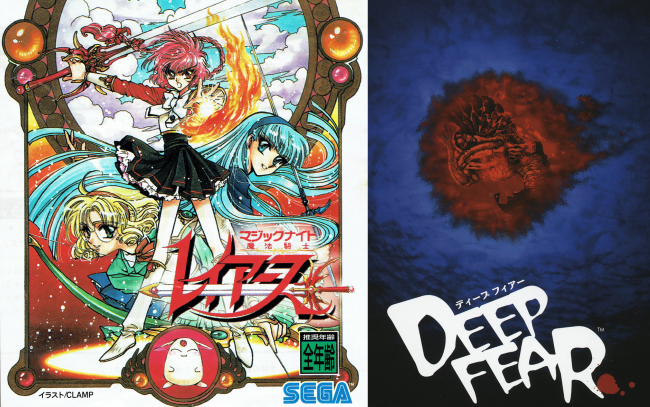
Table of contents:
Part I: Tokyo, 1984
Part II: Champion Boxing
Part III: From arcade to console (and vice versa)
Part IV: Alex Kidd in Miracle World or the birth of a Master System icon
Part V: Breaking out of the canon to go beyond it: the making of Phantasy Star
Part VI: The status of women in the Japanese video games industry
Part VII: Change and new responsibilities
Part VIII: The two Phantasy Star II
Part IX: Working conditions at Sega and in the Japanese video game industry
Part X: A mascot in the making
Part XI: On both sides of the Pacific
Part XII: Final Phantasy
Part XIII: The last Saturn games
Part XIV: Arcadia of my youth
Part XV: Entering History
Games
To be confirmed
Other video game related works
Chronology
Gallery
Sources
General sources (Interviews, liner notes, comments, etc.)
Article aussi disponible en VF
RPG Production Department
Prior to the release of the Saturn, Sega had always struggled when it came to J-RPGs. While Japanese third-party publishers joined the Mega Drive ship once the console became a success in the US, few of them produced RPGs for it. By Kodama’s own admission, Phantasy Star was not a best-seller in the West and the Mega Drive only had a relatively limited installed base in Japan, the market where most sales of the J-RPG genre were concentrated. In fact, Sega was the main provider of RPGs in the broad sense on its console, even if its involvement was sometimes limited to producing certain titles such as Shining Force, Landstalker and, later, Soleil and Light Crusader. The Mega-CD was proportionally a little better off thanks to the involvement of Game Arts and Wolf Team, two development companies that until then had mainly worked on computers, but the partnership that Sega formed with Falcom clearly did not live up to all its promises (several announced titles never saw the light of day).
In 1982, the Role Playing and R.P.G trademarks were registered by Hobby Japan and Bandai respectively in Japan, forcing their competitors to find other names if they didn’t want to pay them royalties for each use of one of these terms. Sega most likely found itself in this situation after including the term ‘Space Fantasy Role Playing Game’ on the box of the first Phantasy Star. As a result, on August 6, 1992, the company registered the trademark ロ-プレゲ-ム / RoPle Game, a contraction of Role Playing Game, and a name that later gave rise to the Mega RoPle Project label. It was around this time that Kodama was asked to develop what became Phantasy Star IV, while the RPG Production Department was set up in 1993, some time before the game’s release and with the strong support of Sega president Hayao Nakayama, who was keen to produce a flagship RPG for his upcoming console. Phantasy Star IV thus became the first title produced by this new department, which was based in Shibuya, a trendy district of Tokyo – until then, the developers had been based in the Otorii district. The number of people employed by Sega doubled between 1989 and 1993, rising from 1,460 to over 3,000; in 1994 there were almost 3,500, 350 of whom had been recruited the previous year, bringing the total to around 1,000 developers (compared with around 50 in 1983). This also had an impact on the size of the development teams, which, although considered insufficient by some developers given the deadlines imposed on them, no longer had much in common with the standards of the 8-16-bit era. Released in 1996 on Saturn, Sakura Taisen had a team of nearly 100 developers.
logo of the Mega RoPle Project label
When this department was established, Kodama was appointed ‘section chief within the RPG production department of Sega’s consumer division’, a title she already held in October 1993, as reported in the pages of Famitsu. This department was responsible for producing titles in the Mega RoPle Project range developed by other companies, supervising their development (Story of Thor, Soleil) or writing their script (Surging Aura). These three titles also have in common the fact that they are Mega Drive games, unlike the two titles developed in-house by the department, namely Blue Seed and Kodama’s next title: Magic Knight Rayearth.
Magic Knight Rayearth
In the early 90s, Sega had already established a foothold in the distribution of VHS and Laserdiscs and was beginning to look into the world of animation with the intention of getting involved. Years before co-producing Neon Genesis Evangelion, the company’s name was to be found on the production of the RPG Densetsu Hepoi series, an adaptation of which was due for release on Mega Drive and which marked its first known collaboration with RED company (Sakura Taisen, Bonk). In 1992, Sega acquired Tokyo Movie Shinsha, now known as TMS Entertainment, which began producing animated series adaptations of Virtua Fighter and Magic Knight Rayearth in 1994–95.
The latter was originally a manga by Clamp, a studio composed of four women who collaborated on titles such as RG Veda, Tokyo Babylon, and X, which Sega decided to adapt into several video games. The AM3 department (which developed Sega Rally around the same time) was itself briefly involved in the production of the animated series, as one of its developers was tasked with creating computer graphics for the opening sequence, including an emblem that would be reused for the title screen of the Saturn version. This game would in turn reuse the opening of the animated series, its voice actors, and its character designer, Atsuko Ishida.
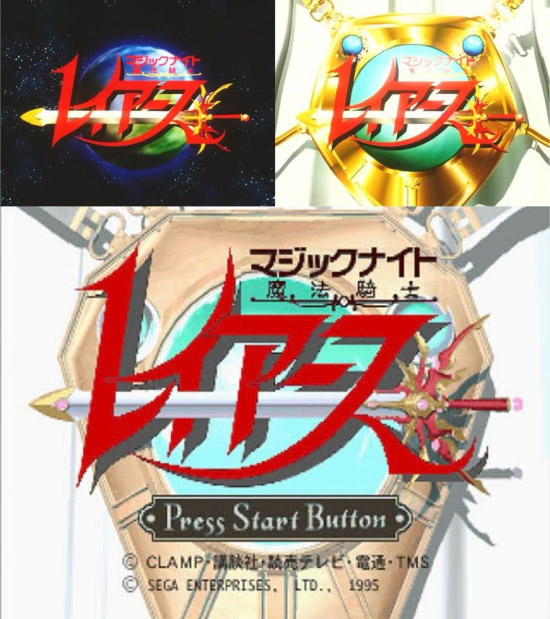
Top: two screenshots from the opening of the animated series, featuring elements created within AM3. Bottom: title screen of the Saturn game.
It was on this Saturn version that Kodama was given the position of director, a position she formally held for the first time and which she would only hold for a short time, as she was promoted to producer during its development. She believed that she was entrusted with this adaptation of a manga drawn by women partly because of her own gender. It should be noted that it was for this same reason that she briefly worked on a game scripted by her colleague Tomohiro Yamamoto, who asked her to check that there was nothing offensive from a woman’s point of view in the dialogue of his game (presumably The Hybrid Front, a 1994 title in which Kodama is credited in the ‘development cooperation’ section).
The project began even though the Saturn had not yet been released and Sega’s own developers did not have access to some of the information about it. Always with a view to naming its projects after the stars, Sega gave constellation names to the various titles being developed for the Saturn, with the teams themselves sometimes taking names from this lexical field. Magic Knight Rayearth was given the code name “Delphinus”, a name that was used again a few years later for one of the main ships in Skies of Arcadia.
For this new RPG, Kodama opted for a “character game”, or CharaGe. A term rarely used outside Japan, a character game is a game in which the developers decide in advance on the personality of the characters, a concept perhaps more appropriate for an adaptation of a pre-existing work than a more traditional approach (for example: Zelda). But it’s a choice that can also be explained by her previous work:
‘I decided to try my hand at a character game this time because I’d already worked on an original RPG called Phantasy Star. At the time, I wondered how I could make the characters from Phantasy Star become major characters, but I didn’t succeed then.’
Rather than developing a traditional Japanese RPG in which the main character is an empty shell into which the player can project whatever they wish, Kodama opted for the other approach. And this had a direct impact on the dialogue:
‘Normally, in an RPG, if you’re the protagonist, you don’t speak, that’s an absolute rule. But this time we didn’t do that and we made the game easy to understand by making everyone talk.’
‘When we were developing Phantasy Star IV, there were discussions about a Mega-CD version. At the time I thought it was better not to dub the characters, but nowadays (ed. note: in 1995) we play talking games a lot, so I thought it was better to do the same.‘
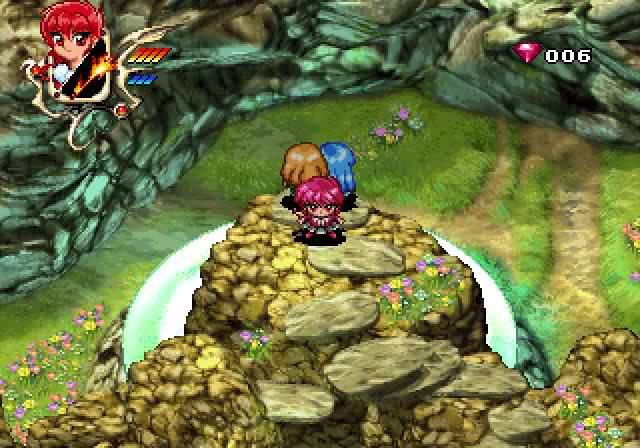
In addition to the cover illustrations drawn for the Saturn game and the two Game Gear titles, Clamp took part in a number of meetings at the start of production, while leaving all the purely videogame-related aspects to Sega. Kodama collaborated mainly with Nanase Ohkawa, the head of the studio and main author of Magic Knight Rayearth. She chose not to adapt the original storyline as it stood and rearranged the scenario for the game with her colleague Akinori Nishiyama, who was also in charge of game design. Rather than making it a turn-based RPG, the decision was made to create an action RPG.
Yasushi Yamaguchi was art director on what was both his first Saturn game and his last game for Sega. He had to learn to master this new hardware while juggling deadlines that meant making concessions. The change in hardware also affected workstations, with Sega equipping itself in 1994 with Macintoshes (already used by the AM2 studio since the first Virtua Fighter) and producing its own graphics software: Sega Painter (3D models were then created on Silicon Graphics workstations, which were already in use in 1992 in both the consumer and arcade sections). Apart from the fact that graphic designers had to adapt to this new environment, they also had to deal with the fact that their machines often crashed, without being able to determine whether this was due to their software or the Macintoshes.
One of Yamaguchi’s requests to the programmers, which would later be incorporated into Sakura Taisen, concerned lip-syncing: the spoken dialogue was pre-recorded, and the programmers developed a system that allowed the various character portraits to animate in sync with the dialogue. Unfortunately, some of the dialogue recorded for side quests remained on the cutting room floor, as the quests in question could not be finalised. As seen in a previous chapter, Yamaguchi and Tomohiro Yamamoto told on Twitter that Sega’s RPG production department had been given impossible deadlines by its management. Development began without programmers, as they were assigned to Blue Seed, which was being developed in parallel within the same department. It was estimated that the workload for the latter would be lighter than for Magic Knight Rayearth, which meant that no programmers were assigned to its development during the first few months. According to Yamamoto, the department’s management wanted to produce licensed games within tight deadlines – Blue Seed is an adaptation of an OVA based on a manga by the author of 3×3 Eyes – presumably in the hope of marketing lucrative tie-in products while requiring minimal investment. This vision clashed with the wishes of both the president of Sega and the developers themselves, who suffered the wrath of their department head, who was surprised that the project had not been completed in six months.
Once the development of Blue Seed was complete, the entire department set to work on adapting Clamp’s manga. Rieko Kodama herself returned to her role as graphic designer one last time, notably to create certain animations. She was also involved in other aspects of the game, such as marketing and sales. One of her last contributions to the game came after its development had been completed: in order to produce a game guide, a publisher asked her for the names of the various enemies, which had not yet been christened. Rather than coming up with original names for each of them, Kodama and her team took advantage of the end-of-development party at a bar in Shibuya to give each enemy the name or nickname of one of the team members. The director suffered the same fate as some of her colleagues when she saw her nickname attached to an enemy she refused to choose.
Magic Knight Rayearth was released unaffiliated with the Mega RoPle Project range, Sega having discontinued it after less than two years. Nevertheless, the game was integrated into a new campaign entitled Rōpure Ōkoku Sega Saturn (Sega Saturn, the RPG kingdom) also featuring Riglord Saga / Mystaria and Shining Wisdom. Despite this, Magic Knight Rayearth was the final game from Sega’s RPG production department. Shortly after development was completed, the publisher decided to merge it with the CS2 department, which produced the first two Sakura Taisen games. As a result, Kodama’s team once again packed its bags and left Shibuya to return to Otorii.
During the game’s development, on her way back from an event to which Clamp had invited her, Kodama was asked by her superior Noriyoshi Ohba to take charge of a project that would take several years to develop. Its name: Deep Fear.
Deep Fear
Founded in 1981, System Sacom was one of the first studios to use Silicon Graphics workstations to develop pre-rendered 3D animation sequences and backgrounds in the early 90s. The company worked on a number of Play Station projects, the ill-fated CD-ROM drive for the Super Famicom, including Fortezza, a shoot’em up that served as a technological showcase, and Wondrous Magic, a game that was eventually released on cartridge.
Like Digital Pictures (Night Trap), System Sacom then turned to the Mega-CD, even though the number of colors that could be displayed simultaneously on screen – 64 – meant serious compromises for all video-based titles. 1993 saw the release of Yumemi Mystery Mansion, an adventure game in which the characters and movements were entirely animated in pre-rendered 3D, something that only a few titles such as The 7th Guest and the CD-ROM version of Dune (only for outdoor movements) offered in the same year. The game was published by Sega, and the desire to build a bridge between video games and cinema was already apparent, if only through the presence of composer Yūji Nomi, who had worked with Ryuichi Sakamoto on several films and went on to compose several film scores for Studio Ghibli.
The collaboration between Sega and System Sacom continued on Saturn, notably with Gale Racer and Mansion of the Hidden Soul in 1994, then on what was not yet called Shenmue (presumably before the development switched to Dreamcast). In 1995, Kodama joined one of their projects as a producer and, as such, she was responsible for approving or rejecting the decisions taken by the director(s) and planner(s) of the games she was working on. In this case, it was on what would become Deep Fear that she held this position, and it was the first time she worked full-time on a title developed in part outside Sega. As for System Sacom, this was one of their very last released games, as the studio concentrated on hardware from 1999 onwards.
Often presented as a Resident Evil clone, the Deep Fear project began before the release of Capcom’s game, although it is highly likely that it evolved along the way to take inspiration from it. With development spread over at least 3 years (1995-98), the gestation of this survival horror seems to have been complicated, to say the least.
During the same period, System Sacom also encountered problems with Fake Down, a Saturn game produced in-house and featuring prestigious names such as Katsuhiro Otomo and Hiromasa Ogura. This project, conceived as a trilogy, never saw the light of day and part of its team was reassigned to the game produced by Kodama once the game’s cancellation was finalised.
Deep Fear also relied on renowned personalities, who were widely used to promote the game, and who were highlighted as having worked in the film industry. These include designer and sculptor Yasushi Nirasawa (Godzilla vs. Biollante, Shin Kamen Rider) and composer Kenji Kawai (Ghost in the Shell, Patlabor). Set in the depths of the ocean, the game is more reminiscent of Leviathan than The Abyss (2 movies released in 1989), featuring various creatures designed by Nirasawa and making fear the key word of the adventure.
It was promoted mainly via its cinematics, and Sega even went so far as to broadcast commercials in cinemas and at the Tokyo Game Show, featuring actors filmed in live action. The company reused cinema as a promotional tool some time later with Zombie Revenge (1999), continuing the link between horror and cinema.
While Magic Knight Rayearth was the last Saturn game to be released in the United States, Deep Fear was the last to be released in Europe. It didn’t even have the honor of a US release, as the American branch had already decided to put an end to the commercial life of its console. We had to wait over a year before seeing any new Sega games released on consoles on this side of the Pacific. As for the Japanese branch, it was preparing the launch of the Dreamcast on its territory for the end of 1998.
Page 1 2 3 4 5 6 7 8 9 10 11 12 13 14 15 Sources
———-Support me———-
VGDensetsu is the equivalent of a full-time job for me – I spend an average of 30 to 40 hours a week on it. You can help me continue my work by supporting me financially via Patreon (monthly payment with the possibility of a one-off payment by unsubscribing after an initial payment) or via Ko-fi (one-off payment), or simply by talking about my work to those around you.