



Rieko Kodama – Part XII: Final Phantasy
Table of contents:
Part I: Tokyo, 1984
Part II: Champion Boxing
Part III: From arcade to console (and vice versa)
Part IV: Alex Kidd in Miracle World or the birth of a Master System icon
Part V: Breaking out of the canon to go beyond it: the making of Phantasy Star
Part VI: The status of women in the Japanese video games industry
Part VII: Change and new responsibilities
Part VIII: The two Phantasy Star II
Part IX: Working conditions at Sega and in the Japanese video game industry
Part X: A mascot in the making
Part XI: On both sides of the Pacific
Part XII: Final Phantasy
Part XIII: The last Saturn games
Part XIV: Arcadia of my youth
Part XV: Entering History
Games
To be confirmed
Other video game related works
Chronology
Gallery
Sources
General sources (Interviews, liner notes, comments, etc.)
Article aussi disponible en VF
Phantasy Star IV
The annual Tokyo Toy Show opened on June 4, 1992, at which Sega presented several forthcoming titles, including a non-playable demo made up of illustrations presumably produced on Mega Drive for what was then called Phantasy Star IV. This teaser, probably inspired by the opening of Gradius III (1988), briefly showed the game’s characters and setting, while recalling previous episodes. This was also an opportunity for Kodama to create a new Phantasy Star I illustration. The announced release date was a vague 1993, implying that it would be at least 7 months before the game hit the shelves.
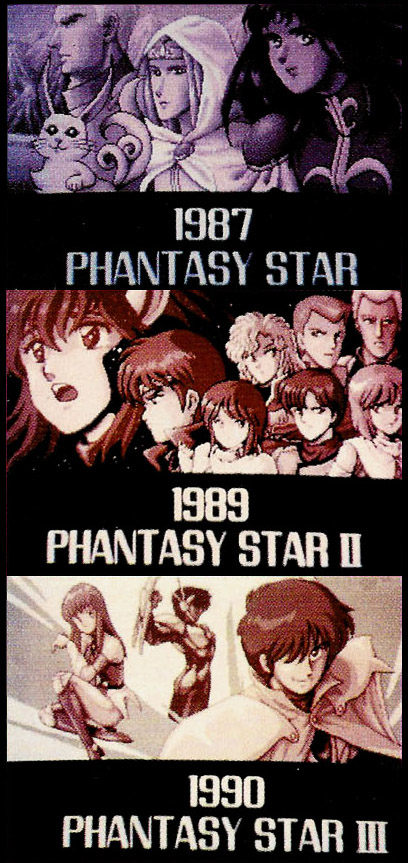
Illustrations by Rieko Kodama, Toru Yoshida and Akinori Nishiyama respectively.
At the end of the summer of 1991, Naoki Aoki, Managing Director of Sega of Japan’s Planning and Production Division, was asked about the possibility of a fourth opus, to which he replied that several proposals had already been drafted but that none of them had been given the green light. The project actually began a few months later through a fortuitous coincidence, when Kotaro Hayashida, director of the section to which Kodama was attached, suggested that she make an RPG:
‘The company asked me to make an RPG as soon as possible. I was also asked to try and get the original scriptwriters, illustrators and character designers together, but I bumped into Yoshida in the meantime, and I heard that a story had come to him while he was taking a bath (laughs).’
Her colleague Toru Yoshida agreed:
‘Just when we were considering making another Phantasy Star, Sega asked us if we wanted to make one.’
It had already been two years since the release of Phantasy Star III when this project began. Due to both this time lapse, which would eventually be extended to more than 3 years by the time it was released, and the lukewarm reception of the 3rd episode, Sega decided not to call the sequel Phantasy Star IV, but simply to attach a subtitle to the name Phantasy Star.
‘We were told that if we called it Phantasy Star IV, people who hadn’t played through to III wouldn’t be able to play it. They asked us not to call it Phantasy Star IV, but it’s completely Phantasy Star IV (laughs).’
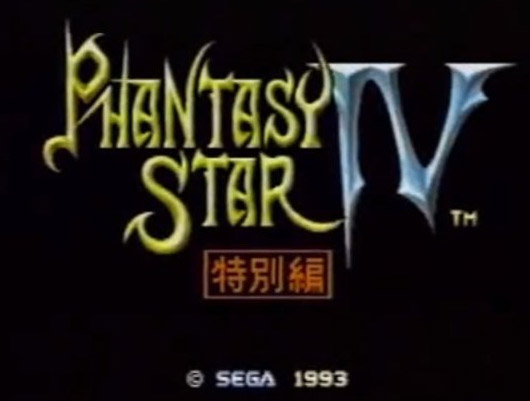
Screenshot from the promotional video Sega Video News Vol. 2 released in 1992 showing a working title.
A designers’ project
Part of the team behind this new RPG was revealed in a brief interview in the August 1992 issue of the Japanese magazine Mega Drive Fan (traditionally published a month before the date indicated), in which they spoke under a pseudonym. Phoenix Rie was introduced as the team leader for this canonical 4th episode, while Yoshibon (Toru Yoshida) returned as character designer. Locky★P (Akinori Nishiyama) and L.C. (Kazuyoshi Tsugawa) were already on the project at this point. No images of the game were shown, as the title was still in its preparatory phase.
At the start of development, Kotaro Hayashida still held the title of director of the section to which Kodama belonged, so she only had the informal title of team leader on this game, even though in practice she performed the same duties as a director.
According to Yoshida, ‘The development team didn’t have any members whose main job was planner. So four designers, including myself, worked on the game while also fulfilling planning duties.
The main reason for this was that Ms Kodama enjoyed a great deal of trust within the company.‘
After 8 years with the company, more than 7 of which were spent developing games, Kodama was finally given the opportunity to direct her own project. Having joined Sega via the design section rather than the planning section, it doesn’t seem surprising that it took so long for such an opportunity to arise, given that Japanese hierarchy is heavily based on seniority. It is likely due to this system that Yoshida referred to himself as the ‘sub-leader’ rather than co-leader or co-director on this project, with Kodama being the ‘main leader’. Nevertheless, both were credited as directors in the game.
Although Yoshida already had an idea for the main plot, he designed the characters before laying the groundwork for the scenario with some of his colleagues. One of the first decisions made regarding the story was to remove Nei, a character he wanted to bring back, but his wishes were vetoed by several of his colleagues.
The story begins a thousand years after the events of Phantasy Star II. The Algol system is in decline, and strange creatures are proliferating on the now-desert planet of Motavia. Lyle / Alys and her apprentice Rudi / Chaz set out to investigate a possible causal link between these two phenomena.
Once the game’s bible was compiled in September 1992, already featuring numerous illustrations and a title borrowed from guide books published in Japan (“Phantasy Star IV Kōshiki Guide Book”, i.e. “Official Guide to Phantasy Star IV”), the rest of the development team could be put together. Yoshida then went around the office asking his colleagues if they wanted to join the project, as Kodama explained:
‘The development team ended up being a mix of creators who had worked on past Phantasy Star titles, and more recent recruits who had grown up playing the series before they joined the company.‘
‘That’s also partly why this development was a lot of fun, I think: we (the developers) started the project on our own initiative, and many of the team members who had worked on PSII were able to address the shortcomings and unfinished ideas they had in that game for PSIV.‘
‘Since I got together all the talent that they [Sega] asked me to, they let us have our own way.‘
It’s worth noting that composer Izuho Numata was the only developer on the team to have worked on the 3rd episode of the series.
The core team consisted of eight people, and thanks to Kodama’s vision, the participatory and horizontal nature of the project was fully exploited.
‘Until then, designers rarely worked on the same project from start to finish. Even with Phantasy Star I, I was involved in the design of the characters and the storyline, but that was only as part of my design work. With Phantasy Star IV, I wanted to be involved in everything, including marketing the game and producing merchandising.‘
‘Writing the scenario, game balancing…basically everything but the programming was done by the designers. I think that someone with the job of designer creates the scenario and world feel as they’re drawing, and is good at giving a game color by taking an extensive view of everything.‘
Tsugawa was thus credited with the mecha design, combat system, backgrounds and game map, while Nishiyama wrote the game script, took charge of part of the game design and drew numerous elements.
Several decisions were made early in development, including abandoning a Shining Force-inspired combat system and deciding not to produce the game for the Mega-CD. The latter was considered for a time, but low sales soon dissuaded the developers. They also attempted to implement 3D dungeons once again, but, unable to bring themselves to adopt such a minimalist aesthetic as on the Mark III, the idea was quickly abandoned:
‘When I was working on “Phantasy Star IV: The End of the Millennium”, I sort of challenged myself to make a bunch of varied 3D dungeon designs. Unfortunately, we couldn’t get them to transition smoothly. We had a hard time without the aid of the 3DCG software, so we ended up doing a top-down view for the dungeons.‘
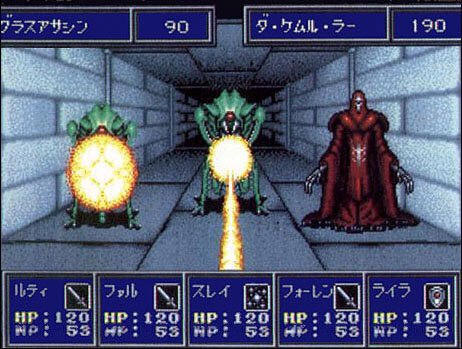
Screenshot published in 1995 in the book ‘Phantasy Star Kōshiki Settei Shiryōshū’. As early as the October 1992 issue of Mega Drive Fan magazine, the public was informed that these 3D dungeons had been abandoned
Kodama and Yoshida worked hand in hand on this project, collaborating on some tasks and dividing others between them. She was responsible for coordinating the various sections of the team, from sound engineers to composers, graphic designers and programmers. In addition, because of deadlines, she was asked by her colleague to draw a number of backgrounds, particularly battle areas and dungeons, while he drew some of the cutscenes and a few enemies.
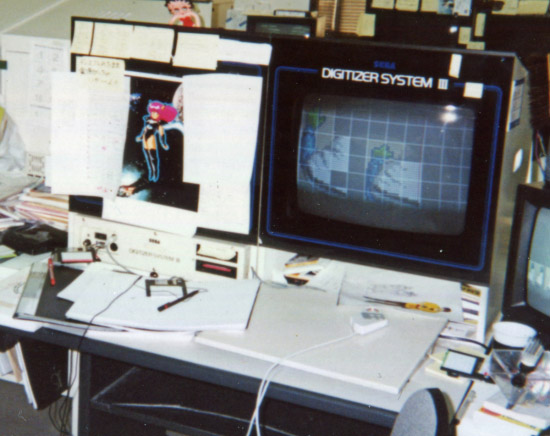
Yoshida’s workstation during the development: a Digitizer System III
Phantasy Star IV is teeming with panels that appear one after another on the screen like a dynamic comic strip, which probably explains why its creators were allowed to use a 24-megabits cartridge during development, rather than the 16-megabits cartridge originally planned. As with the adaptation of After Burner for the first opus, it’s not unlikely that the developers benefited from the release of Street Fighter II’ on Mega Drive, the first title to inaugurate this cartridge size on the console in September 1993.
The partial end of pseudonymity
The game was released in December 1993 in Japan, but the core team was responsible for promoting it throughout the development process. This was an opportunity for the public to see the evolution of Sega’s policy concerning the pseudonymization of its employees. It was in the January 1993 issue of the American magazine EGM that Rieko Kodama and Toru Yoshida were first seen in a photograph, accompanied by Minoru Kanari, Sega’s Mega Drive development manager. Only the latter was identified by his full name, while Kodama and Yoshida were referred to by their first names. Well, almost: Rieko is referred to as Reiko throughout this interview, which was probably conducted a few months earlier, before the programmers began their work. It wasn’t until the summer that members of the development team were finally allowed to express themselves under their real names and appear in photos in Japanese video game magazines, starting with the August 1993 issue of Dengeki Mega Drive.
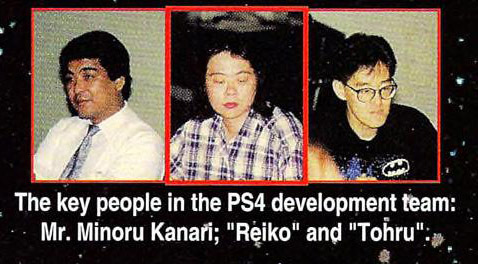
Minoru Kanari, Rieko Kodama and Toru Yoshida (EGM #42 – January 1993)
This relaxation of the rules was still far from systematic for Sega games produced in Japan, but it became widespread in the mid-90s, at about the same time as the rest of the industry in that country. As for games produced by Sega of America, this pseudonymisation policy was never implemented, with a few rare exceptions: on Kid Chameleon, Yasushi Yamaguchi was still credited as Judy Totoya, while both his name and pseudonym appeared in the end credits of Sonic 2, as did his other Japanese colleagues at studio STI. On the other hand, those who had already left the studio before the end of this episode’s development, or who had remained in Japan, had to make do with a pseudonym. This was notably the case for Kodama and the sound engineers in charge of adapting the tracks composed by Masato Nakamura to the Mega Drive.
As for Yuji Naka, then employed by STI, it was through the pages of the US magazine Sega Visions that he first had the opportunity to express himself under his real name, in their August-September issue. This publication preceded his first interview for a Japanese magazine by a few months, which appeared in the January 1993 issue of Beep! Mega Drive, alongside Yu Suzuki and Kan Naito (co-founder of Climax). Suzuki, who had already appeared in promotional photos at the time of Space Harrier (1985), had the opportunity to see his name displayed underneath his face on Japanese television on the occasion of a report on Virtua Racing (1992), one of the very first Sega titles to feature the names of its developers without the need to enter a code. It was preceded by Wally wo Sagase! (June 1992), an arcade adaptation of Where’s Wally. Other arcade games such as Dark Edge and Title Fight followed before console games began to follow suit. These included Doraemon on Mega Drive (March 1993), a game co-developed by several studios including Sega, and Mega-CD games Panic! (April), 3×3 Eyes (July) and Sonic CD (September).
Nevertheless, many of the Sega-developed titles also released in 1993 still stuck to pseudonyms, making it difficult to discern any internal logic. Beyond Sega’s desire to hide the identity of its employees so as not to be poached, there was probably also a desire on the part of some of them to retain a certain anonymity, or even an attachment to what became a pen name that some of them kept after leaving the company. To this day, Toru Yoshida and Yasushi Yamaguchi don’t use their names but their pseudonyms in their Twitter profiles, whereas Kodama used both.
The release of Phantasy Star IV was an opportunity for Sega to produce an adaptation of the first episode on Mega Drive, which only lacked FM sound. Purchasers of the fourth installment were invited to enter a lottery by returning a coupon included in the game manual to win one of the 2,000 units of the episode originally released on Mark III. For the occasion, Kodama created an illustration for the back of the box of this new version and also drew two other illustrations for the Phantasy Star Collection artbook. These were presumably her last works as an illustrator for her employer, although she continued to draw and paint for her own personal pleasure.
As for Phantasy Star Fukkoku-ban (literally Phantasy Star New Edition), in response to demand from those who had been left out, new copies were produced, this time for commercial release.
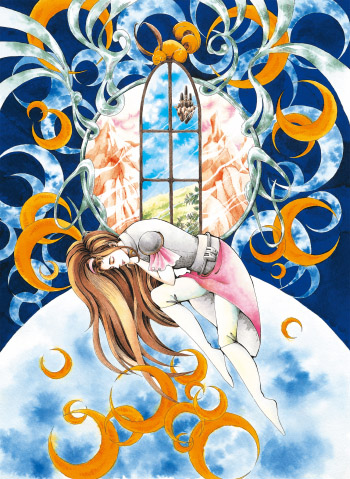
Phantasy Star Fukkoku-ban illustration drawn by Kodama
Although the interview published in EGM magazine in 1993 might have suggested that a release in the United States was already being considered, it seems that this was not part of Sega of America’s plans. If we are to believe Victor Ireland, CEO of the now-defunct Working Design, the U.S. branch only agreed to release the game in its country at the request of its parent company, when members of the latter discovered that Working Design, not SOA, intended to do so. It wasn’t until mid-winter 1995 that the game was released in the U.S. under the Sega banner. It should be noted that the game was renamed Phantasy Star IV in the West, but only on the game’s packaging, as the title screen did not feature any numbering.
Phantasy Star V
In the years following the release of Phantasy Star IV, Kodama was regularly asked about the possibility of a 5th instalment.
‘When IV was finished, we did talk about what the story of Phantasy Star V would be if we ever made it. It was more of a rough concept than a detailed story. We were discussing things like “Is Dark Force really evil?” “Are there gods in the Phantasy Star Universe?” “What is the Light Force in the world that opposes Dark Force? Is it justice?”. If we had made a Phantasy Star V, I think we would have tried to tie up the entire series, the whole Phantasy Star universe.‘
‘We’ve talked about a change of setting, trying to set the action of the game in a different world or something like that.‘
Her colleague Yoshida confirmed the desire to move away from Algol, the planetary system used up to that point in the series.
In 2004, Kodama indicated that she was still having discussions about a 5th episode with some of her colleagues, years after the release of Phantasy Star Online. She was not involved in the latter, but when it was decided during development to set this online RPG in the Phantasy Star universe, Yuji Naka invited her to Sega’s meeting room to give her a presentation and ask for her opinion.
As for Phantasy Star V, it never saw the light of day, making the 4th opus the last canonical episode to be marketed.
Page 1 2 3 4 5 6 7 8 9 10 11 12 13 14 15 Sources
———-Support me———-
VGDensetsu is the equivalent of a full-time job for me – I spend an average of 30 to 40 hours a week on it. You can help me continue my work by supporting me financially via Patreon (monthly payment with the possibility of a one-off payment by unsubscribing after an initial payment) or via Ko-fi (one-off payment), or simply by talking about my work to those around you.