



Rieko Kodama – Part XI: On both sides of the Pacific
Table of contents:
Part I: Tokyo, 1984
Part II: Champion Boxing
Part III: From arcade to console (and vice versa)
Part IV: Alex Kidd in Miracle World or the birth of a Master System icon
Part V: Breaking out of the canon to go beyond it: the making of Phantasy Star
Part VI: The status of women in the Japanese video games industry
Part VII: Change and new responsibilities
Part VIII: The two Phantasy Star II
Part IX: Working conditions at Sega and in the Japanese video game industry
Part X: A mascot in the making
Part XI: On both sides of the Pacific
Part XII: Final Phantasy
Part XIII: The last Saturn games
Part XIV: Arcadia of my youth
Part XV: Entering History
Games
To be confirmed
Other video game related works
Chronology
Gallery
Sources
General sources (Interviews, liner notes, comments, etc.)
Article aussi disponible en VF
Back on track
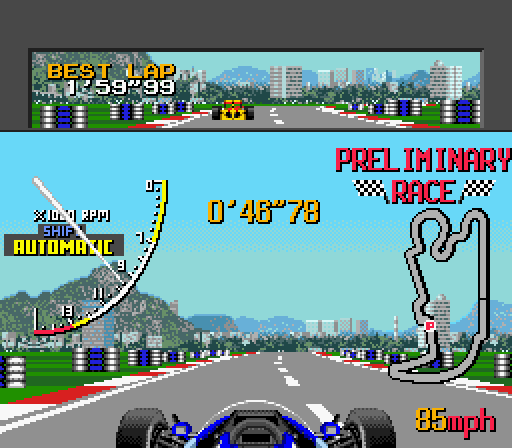
While Sega underwent a new restructuring in which R&D2 was split into several subdivisions, Rieko Kodama retained her position as head of section and continued to work on different games as the need arose. An avid F1 fan and Alain Prost supporter, it comes as no surprise to find her on the second episode of Super Monaco GP which, unlike the first, was not adapted from the arcade.
Although this was the last episode in the series, Sega was not finished with F1 and became a sponsor of the Williams-Renault team in 1993, while producing other games of this kind under licence for Mega-CD and Saturn. As for Ayrton Senna, the face of Super Monaco GP II, he was the subject of special software on Saturn in 1995, consisting of an audio interview recorded before his death in 1994.
But before Sonic joined Alain Prost and Damon Hill on the F1 circuits, he was preparing to appear a second time on Mega Drive.
Ayrton Senna’s Super Monaco GP II
Once his work on Sonic was finished, Hirokazu Yasuhara was finally able to join Mark Cerny at the Sega Technical Institute (STI), a studio that was relatively independent of Sega of Japan and located in California, in the San Francisco region. From the outset, STI’s aim was to train young local developers alongside experienced Japanese developers, who arrived in dribs and drabs in the early years of the studio’s life (the Gulf War did not help). These included Yasushi Yamaguchi, who had worked on Kid Chameleon, and Yutaka Sugano, game designer on Shinobi.
In the summer of 1991, Mark Cerny learnt that Naka had left Sega and decided to visit him, as he recounted years later:
‘I’d been setting up and running the Sega Technical Institute, so I was in Japan quite a bit. I was shocked to hear he’d left, so I found out where he lived and dropped by. His apartment was in a rather dingy building, but it was perfect for him because it was just a few minutes walk from the office. At any rate, I heard his long list of issues and started thinking about how to resolve them.
He was tired of working at Sega. One big issue was that even though Sonic was immediately a big hit, he got a lot of grief for having missed the schedule (he took fourteen months rather than ten, I believe) and head count (total head count was 4.5 people rather than three, I believe). I think he also felt unappreciated on many levels, including financially.“
“The pressure was to make a game that could sell a million copies. This is another one of [Hayao] Nakayama’s brainstorms, the ‘Million Seller Project’.”
“Sonic was terribly controversial. Part of the idea there was, let’s put much more resources on this project than we usually do. What’s usual – 3 people, 3 months. So they were going to do, if I remember properly, 3 people, 10 months. But they ended up needing 4 and a half people for 14 months (I’m a little hazy on the numbers these days). And though it was a success, they blew their budget so badly by putting in a couple of engineering years on this, that Yuji Naka was just getting yelled at and quit the company.“
“[Sonic] pays off fantastically well for Sega. But Yuji Naka was pretty tired of the situation by that point. I mean, he was making $30,000 a year.“
“We’re talking about somebody who’s a top-level creator making $60,000 in their best year (editor’s note: in the event that he received bonuses that could double his salary) and gets yelled at a lot, and he’d had it. And so that’s what led to Sonic the Hedgehog 2 being developed in the States because we didn’t have those rules.”
Multinational team
After hesitating to apply to Nintendo, Naka joined STI as vice-president towards the end of the summer (August or September depending on the source), just over 2 months after the release of Sonic 1 in the United States. Cerny, who already had plans to develop its sequel in his studio, encountered a double problem: neither Sega’s marketing department nor Naka wanted this sequel. Cerny and Naka therefore began working on another project, until Sega’s American branch woke up to the success of the first instalment as Christmas approached and requested that a sequel be put into production. Sonic the Hedgehog 2 was due for release at the end of the following year, leaving the developers only 8 to 9 months to complete it, starting around November.
Naka was only persuaded to do so on the condition that he could add a two-player mode, something he had not managed to do in the first episode. On the other side of the Pacific, President Hayao Nakayama, anxious not to see his programmer leave again, gave him the opportunity to bring 10 developers of his choice to STI, according to Shinobu Toyoda, then Vice President of Sega of America.
Quite logically, Naka chose to bring in Ohshima who, although he had prepared to move to the United States, encountered an obstacle: his management never gave him the green light to leave Japan and join STI, without telling him frankly. Cerny, with foresight, had some time before already obtained Yamaguchi’s agreement that he would work on Sonic 2 once Naka had joined STI. Out of respect for his colleague, with whom he regularly spoke at night in the office when one was working on Sonic and the other on Advanced Daisenryaku, Yamaguchi contacted Ohshima to get his approval. Once this was done, he became the project’s art director.
Yamaguchi was initially destined to become an animator, which he did for a time as an in-betweener on the film Royal Space Force: The Wings of Honnêamise. When he joined Sega in 1988, he was assigned to the team in charge of Space Harrier II and designed a female character to be used in a two-player mode. Unfortunately, this mode was abandoned and Yamaguchi was transferred to the Super Thunder Blade team. He subsequently worked as a graphic designer and illustrator on titles such as Sorcerian and Advanced Daisenryaku, before joining STI.
Due to Naka’s desire to include a two-player mode, a competition was held within STI to determine who the second playable character would be. Yamaguchi, who had already proposed a hedgehog and a tanuki during the mascot competition organised by Sega’s Japanese branch in 1990, emerged victorious this time with the character Miles Prower, better known as Tails.
The developers had to meet relatively tight deadlines, forcing Yasuhara to shelve the time travel concept he had started working on. For his part, Yamaguchi had to call in reinforcements, starting with Jina Ishiwatari, whom he entrusted with supervising the creation of the backgrounds. She worked in collaboration with Craig Stitt from STI, who was joined by Brenda Cook (née Ross) and Tom Payne. The collaboration between Japanese and American developers involved a certain number of adaptations (STI was equipped with the same workstations as Sega of Japan for its graphic designers, namely Digitizer Systems whose data was recorded on floppy disks formatted for PC-98s), while each of the two groups seemed to maintain its own work rhythm (overtime for the former, office hours for the latter). Years later, during the development of Red Dead Revolver (2004), the same discrepancy was observed between the US developers and the Japanese character designer Akiman, who was used to sleeping on the job, whether in Capcom’s offices in Japan or those of Angel Studios in the United States.
Although over time he became more measured towards his American colleagues, Naka was not always considerate towards them, indicating in 2000, for example, that most of the work on Sonic 2 had been done by a group of around 5 Japanese.
Yamaguchi drew the concept art for the game’s various levels, whose names or themes reflected the team’s recent travels. These include Emerald Hill(s), named after an area of Redwood, and Casino Night, inspired by Naka and Yamaguchi’s expeditions to casinos.
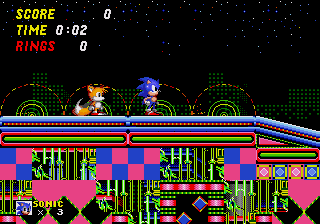
To design the latter zone, they called on Kodama, , with Ohshima’s on-site support to convince her to go to the United States. Three days after returning from a trip to Europe, she found herself working at STI in California:
‘I helped a little with the background of Casino Night, but there’s not much of my work left in the final version. As I didn’t visit a casino and therefore couldn’t draw a picture of one, I pictured a casino as the Japanese imagine them.’
Yamaguchi added:
‘She had never set foot in a casino and the atmosphere wasn’t there. So I modified some parts to make them more beautiful, and the final version was created.’
Early version of Casino Night Zone
Little or nothing remained of Kodama’s work in the commercial version of Sonic 2. Brenda Ross suffered a similar fate, with her levels (desert, winter and forest) being abandoned for various reasons (time, space, initial concept).
In the end, Ishiwatari designed the backgrounds for Emerald Hill, Hill Top, Aquatic Ruin and Mystic Cave, while Yamaguchi took care of Chemical Plant (completely redone at least three times, according to Craig Stitt), Death Egg, Wing Fortress and Sky Chase, as well as touching up Oil Ocean and Casino Night and animating the characters. The American team included Craig Stitt on Oil Ocean and the ill-fated Hidden Palace, Tom Payne on Metropolis / Cyber City, and Tim Skelly and Peter Morawiec on the bonus stages.
As for Mark Cerny, he left STI shortly before the completion of Sonic 2, following a disagreement with Naka, leaving the reins of the game and the studio to veteran Masaharu Yoshii, in charge of making the transition until a new studio director could be found. It was he who oversaw the debugging phase of Sonic 2, employing around 50 people to film their gameplay in order to identify bugs, at a time when this practice was not yet standardised (this task was generally the responsibility of developers, with the notable exception of the Super Mario Club, which had been working with Nintendo since at least 1988).
Regarding Kodama, she did not wait for development to be completed before returning to Japan, and her new project, Phantasy Star: The End of the Millennium, was unveiled in the spring of 1992.
Page 1 2 3 4 5 6 7 8 9 10 11 12 13 14 15 Sources
———-Support me———-
VGDensetsu is the equivalent of a full-time job for me – I spend an average of 30 to 40 hours a week on it. You can help me continue my work by supporting me financially via Patreon (monthly payment with the possibility of a one-off payment by unsubscribing after an initial payment) or via Ko-fi (one-off payment), or simply by talking about my work to those around you.