



Ayano Koshiro – Part 6: Entering the era of 3D graphics
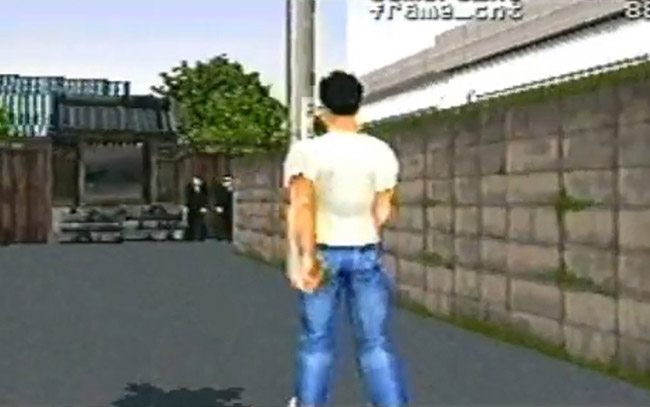
Table of contents:
Part 1: A family of artists
Part 2: The Falcom years
Part 3: Transition to freelancing and amateur games
Part 4: The birth of Ancient
Part 5: The end of the 16-bit era
Part 6: Entering the era of 3D graphics
Part 7: Struggling projects
Part 8: Gradual departure from development
Sources
Games
Gallery
Article aussi disponible en VF
3D training at Sega
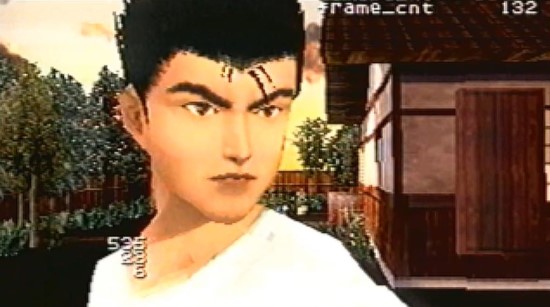
In the mid-1990s, Yu Suzuki was at the height of his fame, riding the wave of success of the Virtua Fighter series, which had become a social phenomenon in Japan since the release of the second instalment in 1994. Eager to explore new horizons, the director decided to embark on the creation of a large-scale adventure game for consoles. However, his ambitions were such that Sega could not reasonably agree to assign all the developers needed to this single project – other titles had to continue to be produced in parallel. It was therefore decided to call on other companies for this Saturn game, which would not be named Shenmue until years later – the game was then known internally as Virtua Fighter RPG, or Genpuuki (the name Project Berkeley would only be used in official communications).
From the outset, several companies were involved in this fully 3D game, at a time when many of them were still working exclusively in 2D. It was probably around 1995 that Ancient joined the project, then known as Virtua Fighter RPG, alongside companies such as Micro Cabin and System Sacom. Yuzo, whose name was suggested to Suzuki by composer Takenobu Mitsuyoshi, used his breaks to play Virtua Fighter 2 on an Astro City arcade machine with other developers, while Makoto Wada, a graphic designer and motion designer who had been hired shortly before, played Sega Rally in free play mode. Among the four or five Ancient employees assigned to the project was Ayano Koshiro, whom Masato Nishimura trained in 3D using Softimage software on Silicon Graphics workstations. Nishimura worked on Shenmue and its sequel until the early 2000s, training several developers along the way. However, he pointed out that he only worked with Ayano for a short period of time, adding that this was Ancient’s first experience with 3D. Ancient’s employees worked at Sega’s offices during this period, with Wada handling motion capture (mainly for Shenmue 2, much of which was developed before the first instalment) and even receiving a visit from Suzuki and Tomo Koshiro during one of his work sessions. As for Yuzo, he was working outside his own studio, which was unusual for him. It was a difficult time for him and his motivation was low; he had to adapt to office hours, follow precise guidelines in his compositions and work with headphones, whereas he usually worked alone at home, at night, with speakers and a certain amount of freedom in writing his scores. When switching from Saturn to Dreamcast, the audio files recorded up to that point were heavily compressed and their quality reduced in order to fit them onto the four discs that make up the game.
Developers have come and gone on this mammoth project involving dozens of companies, and while the credits list an impressive number of people for a game released in 1999, we now know that they are incomplete. Perhaps this is because she only worked on the Saturn version of the game, or because of the brevity of her time there, but the fact remains that Ayano is not credited in Shenmue. During the more than four years it took to develop the game, many developers left the project along the way, leaving their places to newcomers—internally, this hunt for developers was referred to as Shenmue Kari. Some companies went so far as to recruit developers and assign them directly to this project, which was produced outside their premises. It became so commonplace for Japanese developers to have worked on Shenmue that, in the years following its release, some people claimed to have worked on it even though they hadn’t.
Story of Thor 2
While the Saturn was not yet commercially available and Ancient was working on The Story of Thor, the studio was already beginning to consider producing a direct sequel for the 32X (or maybe a kind of expansion, according to Ariga, who designed new enemies for the occasion), a peripheral for the Mega Drive which itself had not yet been released. A game design document was drawn up as early as June 1994 for presentation to Sega, the producer of the first episode, and indicated a production period running from September 1994 (the probable projected end date of Thor 1’s development) to June 1995, but the project was cut short. On the one hand, it is likely that Sega preferred to wait and see the sales figures for the first episode before committing to a sequel. Secondly, the failure of the 32X, released in the USA at the same time as the Saturn in Japan, was quickly acknowledged by Sega. From then on, unless its American branch specifically ordered titles, the parent company had no interest in launching production of new titles for this machine, especially since the Saturn was off to a good start in Japan at the same time. This last point is also what may have motivated Ancient to fall back on the Saturn and rethink its project, different from the original according to Yuzo. As a result, Ancient never had a development kit for the 32X.
As Story of Thor 2 was once again developed in-house, it featured much the same small team as the first episode. With the transition to the PlayStation-Saturn era, development teams grew in size, and a studio like Ancient, which rarely developed games without the help of other companies or freelance developers, was living out its last hours at the forefront as a small studio.
The earliest known sketches date from February 1995 and are signed by the duo Ayano Koshiro-Hitoshi Ariga, who divided up the design of characters and enemies. Ariga designed Leon – the main character – and his master, as well as most of the enemy soldiers, while Ayano took care of the bosses and Myra. As a reference to the Ys diegesis, she conceived Myra as the only character in the game universe to sport brown hair, forcing Ariga to modify the old master’s design by whitening his beard and hair. It should be noted that Ayano said shortly after the game’s release that she had been influenced by the Hong Kong films she was watching at the time, and it’s likely that this old master character is the result of this influence.
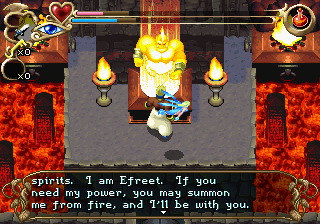
The duo also designed 2 new spirits in addition to the 4 already present in the first episode, focusing more on the various puzzles the game may contain. One of the two new spirits, Sieg, seems to have been inspired by Silver Chariot, one of the characters from Jojo’s Bizarre Adventure. However, the design of this armored knight floating behind the main character didn’t suit Yuzo, who asked for a dragon-shaped spirit instead. This metal dragon was named Brass, while Sieg joined the ranks of the game’s enemies. The second spirit, a pudgy, cartoonish character, was turned into one of the game’s main enemies. He gave way to Airl, a cloud-shaped character designed by Ayano.
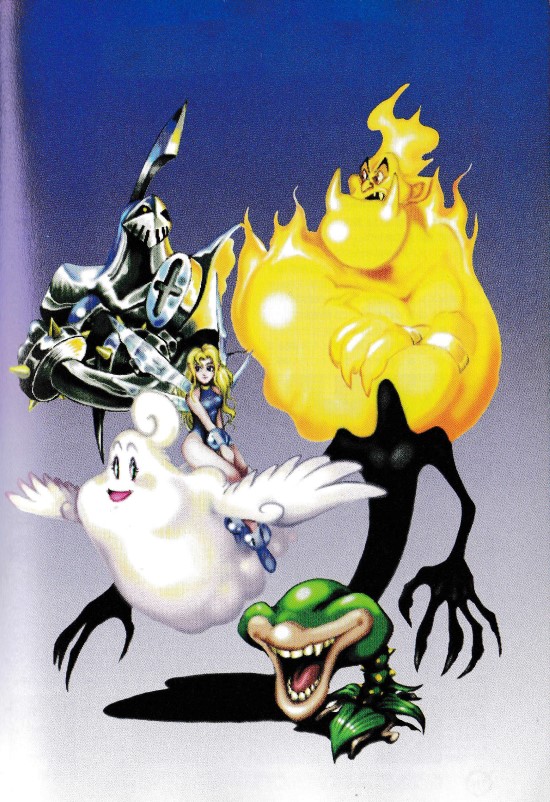
An early illustration drawn by Ayano before Brass replaced Sieg (top left)
Story of Thor 2 began appearing in magazines in the spring of 1995, and while its polished graphics and its name ensured it relatively decent media coverage, the press and public were already beginning to gradually lose interest in 2D games. As a result, it was perhaps the last game made by this studio to enjoy such coverage, before a relative return to favor for 2D in the 2010s (it would even be the last game directed by Ancient to be released in Europe until that period).
From the very first episode, Ayano tried to think of the game in 3D, but found it hard to translate her ideas into reality. In this sequel, she put her 3D training to good use and modelled certain elements and metal-covered enemies in pre-rendered 3D before converting them into sprites, as it had been done on Donkey Kong Country and Clockwork Knight. Ariga was responsible for animating the main character, as well as other characters and enemies. Ayano defined the game’s universe and drew the map as well as some of the backgrounds, while supervising the creation of the other ones.
Visually, the game is far more detailed than the previous instalment, and each screen change brings its own set of background elements. On the downside, the game’s world is also tighter than Thor 1’s, giving the impression that the whole adventure takes place in a small neighbourhood, where the starting village is a hub from which every zone/temple can be reached in a few steps. Musically, it follows the European Romantic movement and makes remarkable use of the Saturn’s sound chip. However, the OST was not marketed in the traditional way, Yuzo exceptionally self-publishing it. This disc, released in 1998 and sold on the composer’s website, was not professionally pressed, but was in fact a simple home-made CD-R.
Story of Thor 2 was released in April 1996 in Japan, at a time when the Saturn was still the dominant 32-bit console in that territory for a few weeks, while it was already struggling in Europe and North America. Without being shameful, sales of Ancient’s title were in the middle of the rankings, with almost 50,000 units sold in its country of origin, which was certainly more than the first episode had done, but less than many games released on Saturn, PS1 or Super Famicom at the same time. Sega’s console was already home to a number of RPGs and action RPGs, to the point where it became the machine of choice for fans of the genre until the release of Final Fantasy VII on PS1. What’s more, the gameplay system was more traditional than in the first opus, partially abandoning the beat ’em up aspect that made it unique.
For its next title, Ancient chose to put the combat back in the spotlight, but with added wheels.
Vatlva
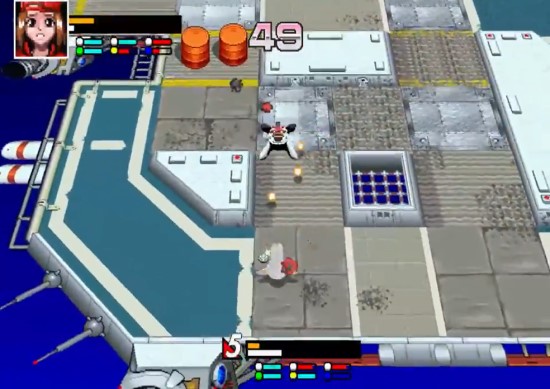
Released the same year as Thor 2, Vatlva was a game of firsts for Ancient. It was their first project not to be produced by Sega and released in the West, but also their first title to feature real-time 3D graphics and a 6-player mode, made possible by the Saturn’s multiplayer adapter. It supported half the console’s peripherals, from the Arcade Racer steering wheel to the analogue pad released during the game’s development, as well as the Mission Stick and Video CD card (for cinematics). It was both a somewhat confidential title and a field of experimentation for the studio, which had to adapt and build up its CV to ensure its continued existence. Finally, this was the first Ancient game on which its president, Tomo Koshiro, was credited (as executive producer).
Kataru Uchimura, a regular at the studio who worked as (co)planner and/or game designer on titles such as Streets of Rage 2, Story of Thor and its sequel, was responsible for the concept of Vatlva, a top-view combat game in which armed cars clash. Uchimura also designed the Ancient logo as well as that of Vatlva, illustrating the fact that employees of studios of this size are often multi-talented. As a result, it’s no surprise that Yuzo was in charge of balancing and music on Vatlva.
The game isn’t particularly eye-catching, with its real-time 3D arenas and pre-rendered 3D cars, but it has built up a small community of Japanese players who have been taking part in tournaments for years, sometimes in the presence of Ariga. It was he who designed the characters and drew most of the game’s illustrations (particularly those for the selection and victory screens, as well as the portraits that appear during battles), often assisted by Ayano as colorist, who continued to try to teach him how to color. In the decades that followed, Ariga sometimes colored certain illustrations and manga plates himself, but he still regularly called on the woman who would become his wife at the beginning of the third millennium.
It’s worth noting that two characters from the Story of Thor universe make their appearance in the game: a pair of rats with the same characteristics as the enemies in the aforementioned series.
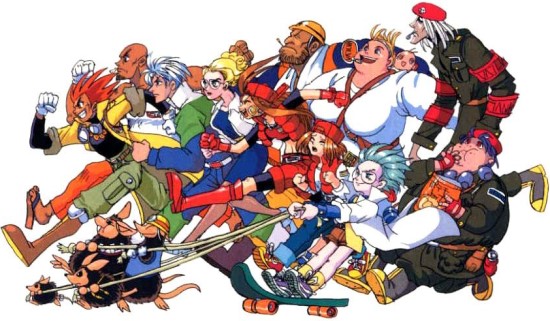
Vatlva box art drawn by Ariga and colored by Ayano
From Saturn to PlayStation
Aware of its heritage and keen to exploit it as Namco had done before it (and even Dempa Micomsoft with the Video Game Anthology range on X68000, which adapted games from other publishers), Sega launched the Sega Ages range, a series of adaptations of some of its best-known games, which began on Saturn in 1996 and continued at least until the Switch. As part of this collection, Ancient was commissioned to develop a compilation of Columns games released in arcades, under the evocative name Columns Arcade Collection. Former Falcom graphic designer Takahiro Ōura joined the Koshiro’s studio around this time and was in charge of the compilation, which was art directed by Ayano.
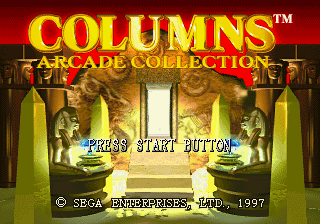
Columns Arcade Collection
The studio followed this up with another title released exclusively in Japan on Saturn: Sega Saturn de Hakken!: Tamagotchi Park, a game which has the particularity of being released a few months after the failed merger between Sega and Bandai, but which features characters from both the former (Sonic, Alex Kidd, Flicky, Pengo, Opa Opa) and the latter (Tamagotchis, a social phenomenon that began in 1996).
It’s an indirect return to the Sonic license for Ayano Koshiro after the 8-bit versions of Sonic and the aborted Sister Sonic project, as she once again took charge of animating the blue hedgehog, renamed Sonictchi in his tamagotchi version.

Sprites from the game Sega Saturn de Hakken!!: Tamagotchi Park
Releases slowed down and media coverage dwindled for Ancient in the late 90s. Increasingly out of step with producers’ demands and working methods, Yuzo Koshiro stepped back from composing to concentrate more on directing and planning. It was also a period during which the studio worked on projects that were either canceled or switched to another console. The composer mentioned the case of a prototype for PS1 in the vein of Wii Fit, but without its famous peripheral. The concept of this aborted project was to train by following exercises designed to help you lose weight. Ancient presented its prototype to Sony, which chose to reject it.
It was through another game that Ayano Koshiro made her PS1 debut with Animatic Story Game 1: Card Captor Sakura, adapted from an animated series itself based on a successful manga by Clamp.
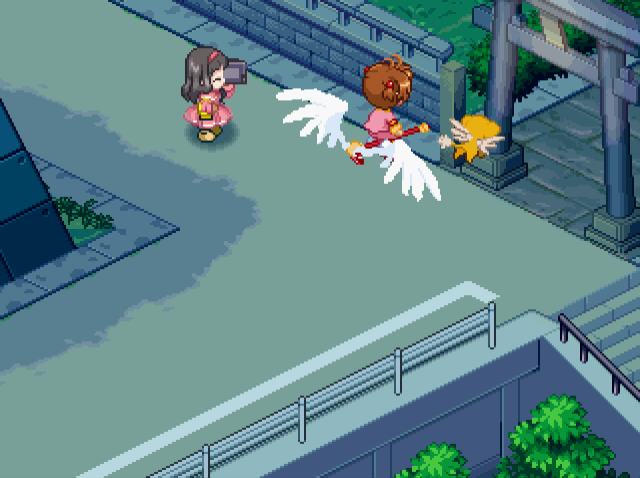
Animatic Story Game 1: Card Captor Sakura
The fruit of collaboration between Ancient and Arika (Street Fighter EX, Tetris: The Grand Master), this hybrid work bears witness to a time when people were still experimenting with the possibilities of the CD-ROM, mixing RPG sequences and mini-games, all interspersed with numerous cinematics. Despite the game’s status as a spin-off product, the two studios in charge of it remained true to their reputation as good craftsmen, offering, among other things, relatively polished 2D graphics. It was Ariga, who was busy drawing his manga The Big O, who animated Sakura in the first part of the game, assisted by Ayano who drew the basic shape of the sprite as well as providing art direction. Ancient took care of the graphics (presumably assisted by a few freelance artists) and supervised the sound, while Arika managed the programming. For the Koshiros, this project was an opportunity to collaborate with the co-creator of Street Fighter II, Akira Nishitani. But in a way, this collaboration highlighted Ancient’s difficulty in not confining itself to 2D. Its next project should have allowed it to break away from its image while returning to the spotlight. But alas…
———-Support me———-
VGDensetsu is the equivalent of a full-time job for me – I spend an average of 30 to 40 hours a week on it. You can help me continue my work by supporting me financially via Patreon (monthly payment with the possibility of a one-off payment by unsubscribing after an initial payment) or via Ko-fi (one-off payment), or simply by talking about my work to those around you.