



Ayano Koshiro – Part 3: Transition to freelancing and amateur games
Table of contents:
Part 1: A family of artists
Part 2: The Falcom years
Part 3: Transition to freelancing and amateur games
Part 4: The birth of Ancient
Part 5: The end of the 16-bit era
Part 6: Entering the era of 3D graphics
Part 7: Struggling projects
Part 8: Gradual departure from development
Sources
Games
Gallery
Article aussi disponible en VF
The Scheme
In August 1985, a friend of Yuzo’s invited him to Comiket, a famous biannual convention where a large number of artists, researchers, developers and amateur and professional circles come to present creations of all kinds. It was on this occasion that the composer met Harvest, an amateur group that developed PC-88 games, some of which were presented at their booth. The group invited him to join them, and in the process introduced him to games such as Gradius (May 1985) and Space Harrier (December 1985), two titles that left their mark as much for their playfulness as for their musical and visual qualities. Squilla, the dragon that appears at the end of the first level, made a strong impression on Ayano Koshiro.
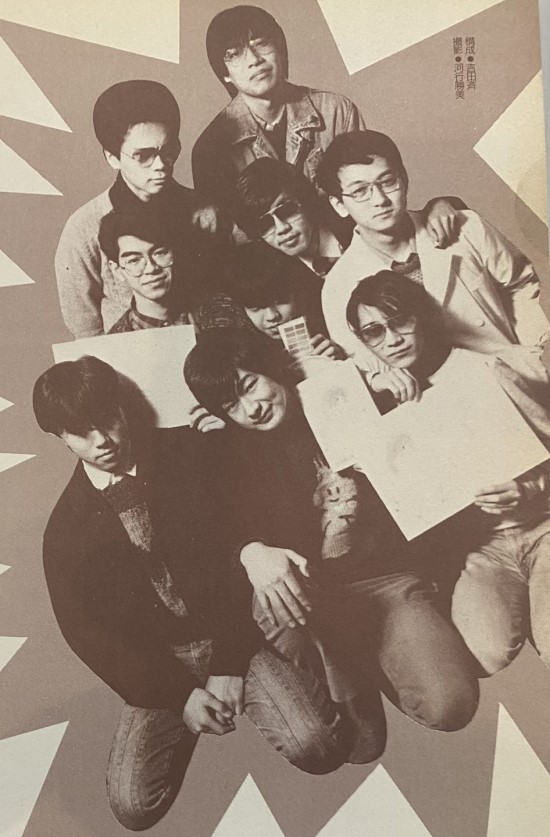
This photo, which appeared in the March 1987 issue of Technopolis and features some or all of the members of Harvest, shows Yuzo, hidden by his sunglasses in the background on the left. This group was itself divided into several entities, one of which – GPM – published fanzines, while another produced games under the Onionsoft label (whose oldest known title appeared in 1980).
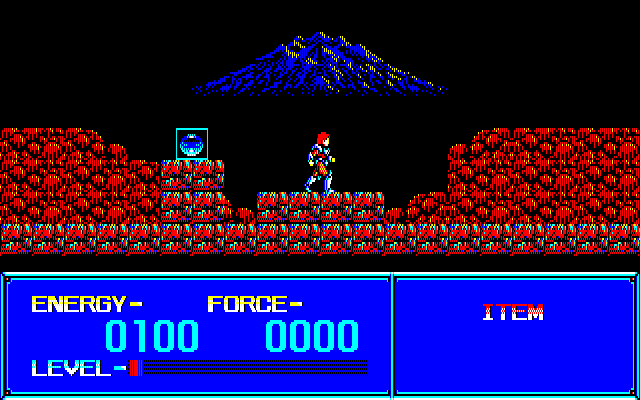
Although Ayano was not a member of this doujin circle, she did create graphics for some of Harvest’s games, in parallel with her work at Falcom and even afterwards, as did her brother, who sometimes contributed to their soundtracks. Among the developers in this group was programmer and graphic designer Shinobu Hayashi, who later collaborated with the Koshiros on several occasions. He had already developed small games for the 100 Yen Disk collection and was working on a Metroid-inspired project when he saw an advertisement for a contest organized by Bothtec, a publisher primarily active on the computer market. For this title, called The Scheme, Ayano was responsible for both the backgrounds and the animation of the main character, openly parodying Adol, the main character from Ys. The games developed by Onionsoft were generous with nods to titles from different publishers, and the menus of those in the 100 Yen Disk collection include their fair share of characters and illustrations from Zelda II, Takahashi Meijin no Bōken Jima / Adventure Island, Metroid and Paperboy. By Yuzo’s own admission, The Scheme was partly made up of bits and pieces from previous projects developed by Hayashi, who ended up working on this game for nearly two years.
The Scheme won an award in the competition, allowing its developers to earn some money, but before marketing it, Bothtec asked them to enrich its content. The title was released in August 1988, a sign that it was probably conceived while the Koshiros were still employed by Falcom. The point on which this game stands out and has since passed into posterity is its soundtrack, composed by Yuzo. NEC produced many computers in the PC-88 and PC-98 ranges, and their sound generator, designed by Yamaha, also sometimes evolved from one model to another. The Scheme is one of the very first games to take advantage of the second-generation sound generator used in PC-88s (released in October 1987 with the PC-8801FA/MA model), while also offering a version compatible with the first generation (released in 1985 with the PC-8801mkIISR).
An OST was released at the end of the following year, illustrated by Kazuhiko Tsuzuki, the Koshiro’s former colleague. This was the first OST for which Yuzo retained the rights, released alongside The Revenge of Shinobi OST with great fanfare in the various video game magazines of the time.
Wanderers from Super Scheme
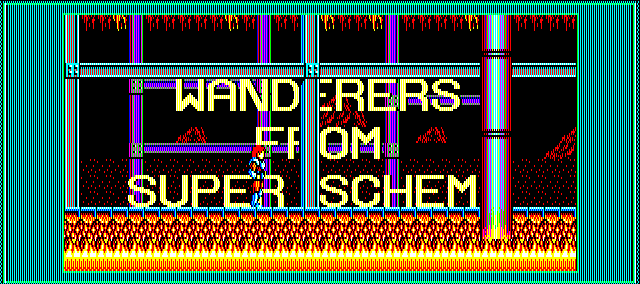
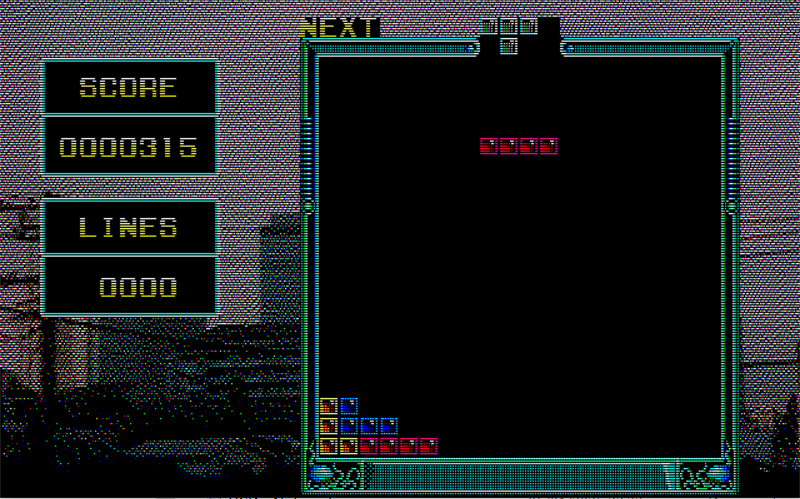
Ayano Koshiro worked on several amateur games early in her career, including Tacoris, a Tetris clone developed with Shinobu Hayashi for PC-88, but the best-known of these is undoubtedly Wanderers from Super Scheme. This sequel to The Scheme was born out of Hayashi’s desire to test a new programming routine that improved scrolling. This time, he drew inspiration from Ys III: Wanderers from Ys (1989), both in terms of the title and the opening, in which the main character wanders between beams, some of which, in the foreground, partially hide the character and the text that appears on the screen. However, according to Ayano, although the characters that appear in the game were created by her, she originally designed them for fun. Hayashi took advantage of the fact that they were finished to integrate them into the game, and the graphic designer did not have time to make any changes before the game’s release. The development took significantly less time than the first instalment, but the game’s credits suggest that the team was bigger.
Wanderers from Super Scheme was originally only available for sale during a single edition of Comiket, and it took 25 years for it to be released again. It was through Project EGG, the Japanese equivalent of GOG that offers dematerialised versions of old computer titles, that Wanderers from Super Scheme left the amateur circuit in 2014 to join the list of games that have benefited from more official marketing.
Tacoris
Bemaga
At the beginning of 1986, on his way home from high school, Yuzo Koshiro saw an advertisement in one of the two volumes of All About Namco (1985) stating that the publisher Dempa Shimbunsha was looking for music to publish in Basic Magazine, also known as BeMaga. The deadline had passed, but the publisher told him he could submit his own music at any time. In the April 1986 issue, he started a column called The Video Game Music Collection (soon renamed The Video Game Music Program), with Space Harrier as the first track featured. It was because of the latter that he took the pseudonym YK-2, a combination of his initials and the (supposed) name of the Jet 2 ship in the game. It’s probably no coincidence that he later found himself working on the X68000 adaptation of Space Harrier, produced in 1987 by Dempa Micomsoft, the video game branch of Dempa Shimbunsha. During this period, Yuzo held a job at Falcom, produced various soundtracks for games produced by Dempa Micomsoft (Dark Storm: Demon Crystal III on X1, Bosconian on X68000, still under the pseudonym YK-2), continued his activities in doujin circles and contributed almost monthly to a column in BeMaga.
He occasionally mentioned his sister in the pages of the magazine, but only under a pseudonym – Kopiron – making her a topic of discussion among both the editorial team and the readership. Her identity was revealed in an interview with the entire Ys development team in August 1987, published in a special issue of BeMaga: Adventure Games and RPG III. Around the same time as the latter was published, a TV report produced by Pasocom Sunday on the same team was broadcast, further fuelling the rumour that YK-2 was in fact Yuzo Koshiro, even though he was content to deny this open secret.
Adventure Games and RPG III is part of a series of introductory books on RPGs and adventure games produced by BeMaga editor-in-chief Akira Yamashita. For one of these volumes, published in 1989, he commissioned the cover illustration from Ayano, who created it on computer, as had already been done by other artists for magazines such as Popcom and MSX Magazine.
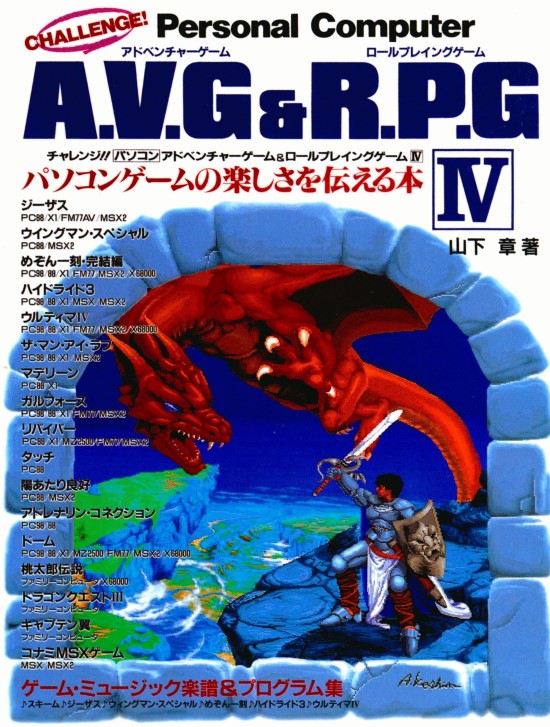
Illustration created with Z’s Staff Pro 68K on X68000 (probably with a mouse)
Ultima III: Exodus
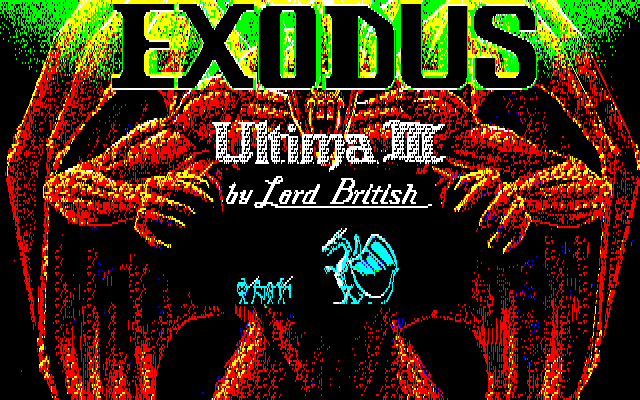
The period between her departure from Falcom and the founding of Ancient is not the best known in Ayano Koshiro’s life. We don’t know when she stopped studying and we don’t have a list of the games she worked on as a freelancer, with two exceptions. The first is Ultima III: Exodus, a game originally developed by Origin for various Western computers and then adapted for PC-88 and PC-98 on two occasions. Starcraft produced an adaptation for each of these machines in 1985, before Pony Canyon obtained the rights to the Ultima series in Japan and produced new adaptations for consoles and computers. These included Ultima III, for which the PC-98 version released in 1989 served as the main version. As a result, when she was asked to work on the graphics for the PC-88 version, Koshiro received the assets from the PC-98 version in order to adapt them to a machine on which the number of colours that could be displayed simultaneously on the screen was much smaller.
The game hit Japanese shelves in November 1989, at a time when the release of a certain new console was seriously overdue.
Actraiser
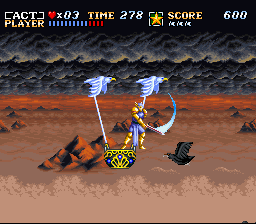
The talent drain that Falcom suffered in the late 80s certainly didn’t sink the company, which is still standing more than 40 years after it was founded, but the list of those who left includes some of its most famous developers and artists (although the most famous is probably Makoto Shinkai, who worked at Falcom before devoting himself to his career as a film director). Several of them regrouped or continued to collaborate within different companies founded after their departure. The first of these entities, Quintet, was founded in April 1989 by Tomoyoshi Miyazaki and Masaya Hashimoto, who called on the Koshiros and graphic designer Kouji Yokota (Ys III) for their first game: Actraiser.
As a direct response to one of the issues Falcom refused to solve, Quintet immediately entered the console market with a title destined for release on a machine that had not yet been released: the Super Famicom (or Super Nintendo in the West).
For a while called Sacred Master or The World Master, Actraiser was originally conceived as a Dragon Quest-style RPG to be available from the launch of Nintendo’s new console. However, things didn’t go exactly according to plan. One of the first problems encountered by the team concerned the development kit, which was much more expensive than that for the Mega Drive, for example, and also more difficult to use than the computers on which the developers were used to working until then.
Development nevertheless continued until, at around 70% according to Miyazaki’s estimate, the whole project was called into question, for a number of reasons. Firstly, the remaining development time was deemed insufficient to finish the game on schedule. Secondly, the studio’s ambitions had come up against the problem of the size of the cartridge, limited to 4 megabits of data (a larger cartridge would have had a significant impact on the game’s sale price, which in turn has an impact on sales figures). Finally, programmer Hashimoto made no secret of his preference for action-oriented games—he spent a lot of time playing Mega Man.
With around 6 months to go before the deadline, the game’s concept was changed and it had to be reworked from scratch. The original project was not completely abandoned, however, as it served as the basis for Terranigma (1995), which took up the idea of depicting the life cycle of a planet.
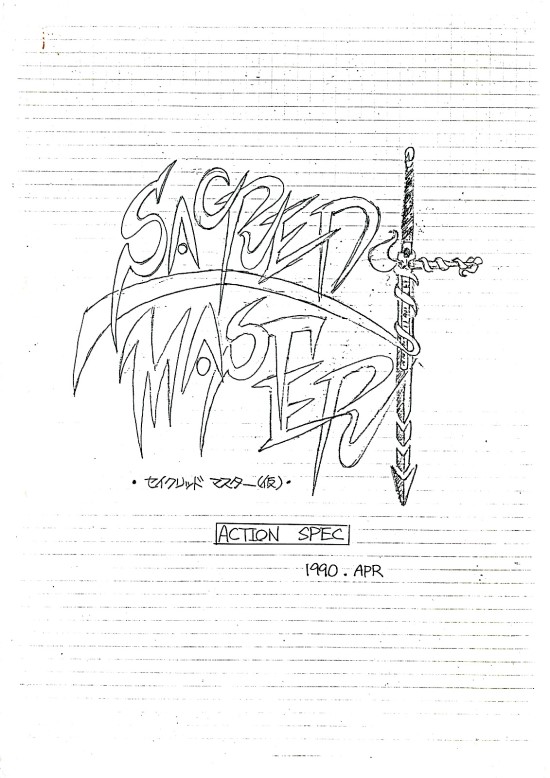
Design document dated April 1990 for the reworked version of the project
Although not an employee of the studio, Ayano Koshiro worked at Quintet’s offices throughout development. Years later, she reported another problem encountered by the team during the production of the game, namely that its programmers and game designers were more accustomed to computer games than console games. Despite their talent, they struggled with things that would be considered trivial today, such as determining whether, when a platform is right above the playable character, he hits his head when jumping or whether he passes through the platform to land on it. Another consequence of their lack of console experience was that they had to adapt the game’s controls to a machine with smooth scrolling. Whether on PC-88, PC-98 or MSX 1 and 2, the screen doesn’t scroll pixel by pixel as it does on console, but by block of pixels, giving the impression that the character controlled by the player is moving across an invisible checkerboard (something we find in Ys, for example, and which is even more glaring when we compare Famicom titles such as Final Fantasy or Dragon Quest with their adaptations on MSX). It’s a fundamental difference in an action game, and more particularly in a game where judging distances is important for dealing blows with swords, jumping from platform to platform or avoiding spikes.
As a result of all these obstacles, Actraiser’s developers failed to deliver their copy in time for the launch of the Super Famicom. However, their title was released just under a month after the console’s launch, and benefited from the spotlight it received. Quintet was also able to rely on its publisher Enix to advertise and distribute the game, which sold 400,000 copies in Japan, compared with 180,000 in the USA and 40,000 in Europe.
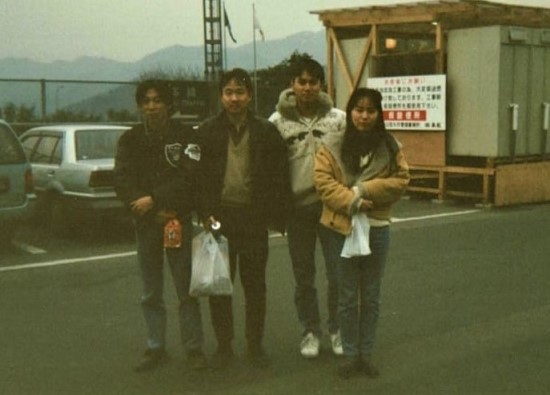
Tomoyoshi Miyazaki, Masaya Hashimoto, Yuzo and Ayano Koshiro, some time after the game’s release
———-Support me———-
VGDensetsu is the equivalent of a full-time job for me – I spend an average of 30 to 40 hours a week on it. You can help me continue my work by supporting me financially via Patreon (monthly payment with the possibility of a one-off payment by unsubscribing after an initial payment) or via Ko-fi (one-off payment), or simply by talking about my work to those around you.