



Rieko Kodama – Part X: A mascot in the making
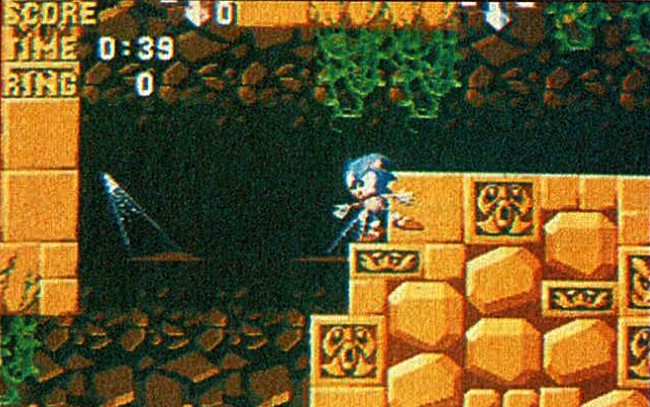
Table of contents:
Part I: Tokyo, 1984
Part II: Champion Boxing
Part III: From arcade to console (and vice versa)
Part IV: Alex Kidd in Miracle World or the birth of a Master System icon
Part V: Breaking out of the canon to go beyond it: the making of Phantasy Star
Part VI: The status of women in the Japanese video games industry
Part VII: Change and new responsibilities
Part VIII: The two Phantasy Star II
Part IX: Working conditions at Sega and in the Japanese video game industry
Part X: A mascot in the making
Part XI: On both sides of the Pacific
Part XII: Final Phantasy
Part XIII: The last Saturn games
Part XIV: Arcadia of my youth
Part XV: Entering History
Games
To be confirmed
Other video game related works
Chronology
Gallery
Sources
General sources (Interviews, liner notes, comments, etc.)
Article aussi disponible en VF
Various works
Since her return from the States, Kodama has been in charge of the design section, moving from development to development without staying there as long as the other graphic designers in her department. The game credits from this period are, unsurprisingly, likely to be very incomplete, and it is once again difficult to determine how many titles she worked on.
During 1989, she designed part of the backgrounds for Kujaku-Ō 2, a title that underwent several visual changes in its Western version – Mystic Defender. She can also be found in the credits of World Cup Soccer, a game featured in a number of compilations bundled with the console, and Golden Axe, an adaptation of the first episode of one of Sega’s main series during the Mega Drive era.
In 2023, composer Yuzo Koshiro reported seeing Rieko Kodama working with the team in charge of The Revenge of Shinobi during a visit to Sega’s offices. It’s likely that her involvement was fairly brief and that she or one of her managers didn’t feel it necessary to include her pseudonym in the game’s credits. It is also possible that she simply trained Takashi Yuda, who was then making his debut in the industry by designing some of the game’s backgrounds and who would later go on to design Knuckles.
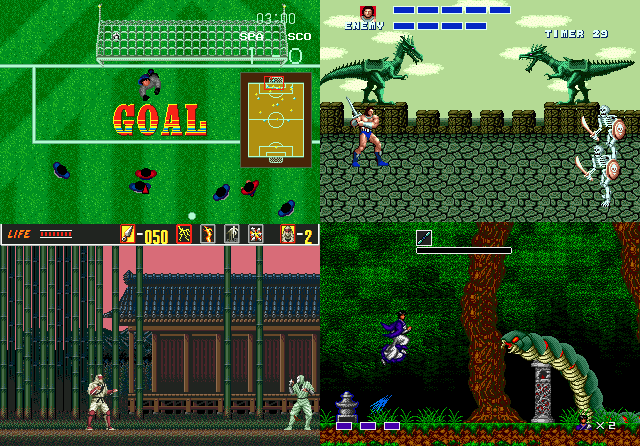
Top row: World Cup Soccer, Golden Axe
Bottom row: The Revenge of Shinobi, Kujaku-Ō 2
The credits for titles released in 1990 are not really any clearer, with Kodama’s pseudonym only appearing in 3 of the 4 games for which we have a source concerning her contribution to their development. We do know, however, that she worked as a graphic designer on Sorcerian, an adaptation of a Falcom game that began, like Ghouls ‘n Ghosts, with a request from a Sega developer to make a Mega Drive version. A notable feature of this version was that additional scenarios had been written and were to be made available to players via the console’s floppy disk drive. This accessory, which had been considered by the manufacturer and presented to the press, was ultimately abandoned.
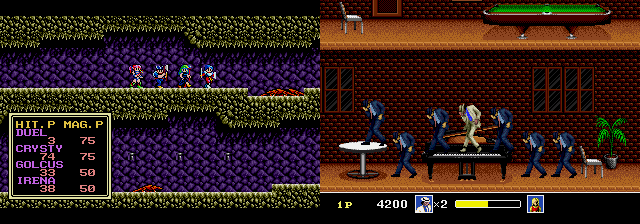
Sorcerian and Moonwalker
Kodama also worked on the Mega Drive version of Moonwalker, although the credits made no mention of it, as well as on one of the big titles of 1990: Phantasy Star III. An under-appreciated episode in the series, it only features a small part of the team from the first two instalments, although some of its other developers were consulted.
‘The person who did the game design for Phantasy Star II planned Phantasy Star III. Because we wanted to go into a new direction with PSIII, we formed a different team from the one that had created PSI and II.’
‘At the beginning, there were a lot of talks about what kind of concept the game should have and I ended up participating in such discussions related to the scenario and to the story, but I actually left most of that up to the development team of the game.’
‘We thought that we wanted to make something that could be played without being familiar with the first two games, instead of being a direct continuation. I think it’s an interesting game in its own right.’
As a result, the series changed character designers once again, with Toyonaka Ozaki taking over, while art direction was handled by her future husband, Masaki Segawa, who until then had been attached to Sega’s arcade branch.
Perhaps the game on which Kodama spent the most time that year was Shadow Dancer, a title which, like Cyber Police ESWAT and Moonwalker, differed greatly from its arcade namesake and became its own game. On this episode of the Shinobi series, she was asked to draw a background requiring a large number of tiles for a level that takes place in front of the Statue of Liberty.
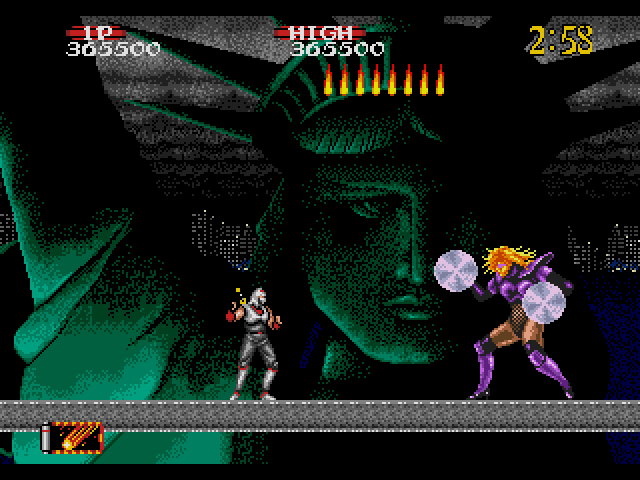
‘This one is really huge. It must be at least eight screens high.
I made a sketch on a sheet of (graph) paper about 1 meter wide and 1.5 meters long, laid out on the floor, so that it wouldn’t look too ugly when the screenshots were pasted together (editor’s note: to recreate the stage) in a magazine. It was easy to draw, but it took me months to do it. What’s more, we only had one photo of the front of the statue. I wish they’d let me charter a helicopter to cover the front of the monument. (Laughs)’
‘The scene was influenced by films such as Escape from New York and Planet of the apes as well as North by Northwest, the final of which takes place on top of Mount Rushmore.’
Since the release of the Mega Drive in the United States, references to that country have multiplied in the games produced by Sega, as have action-oriented titles, a category that the company believes sells better in that market. Kodama nevertheless made a detour into strategy games with a somewhat unusual position:
‘I remember Advanced Daisenryaku; the planner was passionate about everything to do with the army, he wanted to put planes he’d never seen into the game. And as they were impossible to find in encyclopaedias, we had no choice but to buy plastic models and assemble them. These were used as reference models for the vehicles in the game.
I remember him congratulating me and telling me that I was good at building models, even though it had nothing to do with my work.’
After assembling models with other colleagues for this title, which had the particularity of being playable online via the Mega Drive’s modem, Kodama joined a project that was going to keep her busy for longer than the ones she was used to working on since she had been section head.
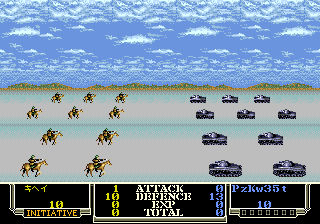
Advanced Daisenryaku
A hedgehog in the pipeline
Sonic the Hedgehog is one of those titles about which we learn a little more every year, as its developers make statements, so that the story of its origins is not yet completely set in stone. Long presented to the public as the fruit of a collaboration between Yuji Naka and Naoto Ohshima, the latter was in fact already working on a project that began in early 1989 and involved another colleague, as he stated in 2021:
‘I recently found the second version of the proposal written for (what would become) Sonic. It was written by Hayashida (Kotaro, who was then head of the planning department and had already helped to create Alex Kidd) and myself. In the first version, the main characters were called Twin Star, two boys fighting nightmares. In the second version, there are still traces of the word ‘nightmare’.’
The idea of a character curling up into a ball on the ground to attack enemies was already included in the document co-written by Hayashida and Ohshima and, although this attack was called ‘Wonder Hedgehog’, the nature of the character to be played had not yet been determined. Another point already included in this document is a level design featuring loops, an element that would also become one of the series’ trademarks. On Hayashida’s advice, Ohshima teamed up with Naka, who already knew how to program movement on slopes from his work on the adaptation of Ghouls’n Ghosts (making a character move on a slope rather than on flat ground was one of the great advances of the second half of the 80s, and one of the new features of Super Mario Bros. 3 and Capcom’s game). Naka, who had spent a few months working on a new 3D game project that didn’t see the light of day – Metal Lancer on Mega Drive – then joined in the development. According to Minoru Kanari, future director of the CS1 department, the team began to form in November 1989, but it would be several months before it was complete.
After ruling out the idea of a dog, an armadillo, a character inspired by Bart Simpson or even what would become Eggman, Naka and Ohshima developed a prototype in which a rabbit could pick up objects and throw them at its enemies. Unfortunately, this test proved inconclusive and the two men began looking for another way. In the meantime, Sega had launched an internal competition to create a mascot for the company and, although it never came to fruition, it did provide Ohshima with the idea he was looking for. Among the contestants was Yasushi Yamaguchi, who submitted a hedgehog character. Ohshima spotted this concept and combined the hedgehog idea with that of a character he had imagined some time earlier, then refined the design for three months, giving it some Mickey Mouse features in the process.
Arrival of reinforcements
At this stage, the team was made up of just 2 people, and needed a planner to handle the level design and solidify the game design. It was to Hirokazu Yasuhara that the two developers turned, as the planner explained:
‘At the time, I was supposed to go the United States to establish a new R&D team with Mark Cerny. But then the Gulf War started (ed. note: in August 1990) and my move for the United States was postponed for three months. Work was progressing on the game, but Naka and Ohshima needed a full-time game designer on the project. They saw that I was free, and looked to me for help designing the game until my departure. So, I officially joined the project as a game designer, planning to work on it only until I went to the US. But I ended up staying in Japan for a year until we finished the project.’
Naka designed the game’s engine, which allows for very fast scrolling and for which he drew inspiration from what Namco had done with Marvel Land. This scrolling speed influenced the way game design was conceived, in particular by putting aside the object-grabbing mechanic. Naka was adamant that the game should be playable with a single button to further distinguish it from Super Mario Bros. and suggested that the character should jump while curling up into a ball to attack enemies. With speed in mind, the level design is all slopes of varying steepness, reminiscent at times of Strider (1989), which nevertheless features a main character with abilities quite distinct from those of Sonic.
In June 1990, a demo was presented at the Tokyo Toy Show showing an early version of Green Hill. Ohshima later stated that he had worked on this level, but it is unclear whether he was solely responsible for the graphics in this version. While he did draw the concept art for the game’s various levels (two of which – Chinese World and Gold World – were ultimately not chosen), the backgrounds were divided between 3 people. One of them – Jina Ishiwatari – joined the team at the start of development. She would later reflect on this difficult period in her career in 1997, the year she left Sega:
‘I was in my first year with the company when I started working on Sonic, and I got alopecia areata (editor’s note: hair loss in one or more areas of the scalp) because I kept getting my work on my backgrounds rejected, no matter what I drew.’
Ishiwatari was hired by Sega in 1989, just a few months before joining the project, and was responsible for designing several backgrounds under Ohshima’s supervision. She was forced to redesign Green Hill 4 or 5 times over the course of almost a year to satisfy Ohshima’s requests, in addition to having to take charge of other areas of the game (by deduction, these were likely Marble Zone and the first two levels of Scrap Brain). For his part, Ohshima drew Spring Yard, the game’s opening animation, the ending illustration and animated all the characters. As for the two remaining zones – Labyrinth Zone and Starlight Zone – they were entrusted to Rieko Kodama:
‘I arrived halfway through, but I was involved in designing the backgrounds. At the time, I used to join projects to lend a hand when they were behind schedule, and I often left a project midway through to move on to the next one. But for Sonic The Hedgehog, I was with the project right to the end.’
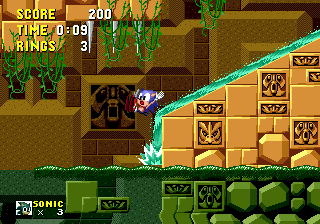
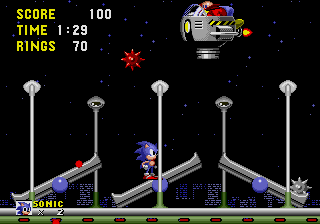
Labyrinth Zone an Starlight Zone
Ohshima’s art direction led the team of graphic designers to create backgrounds filled with simple geometric shapes and elements inspired by some of the first pre-rendered 3D illustrations that were beginning to become more widespread in 1991. Squares, rounds and ovals stand side by side with angularly curved palm trees and blocks of earth, stone or Formica in which perfectly symmetrical cavities create a sense of depth.
‘It was still hard to display polygons back then, but the graphics in Sonic the Hedgehog were designed incorporating polygonal styles. We intentionally created the designs as if they were illustrated artificially with CG tools. To tell you the truth, we drew them bit-by-bit because the software for computer graphics had not been developed much at the time. (Laughs)’
Like her colleague Ishiwatari, Kodama had to redesign Labyrinth Zone several times, once to change what was originally a cave into a sculpted background, and again to include a new color palette. This zone is an aquatic level which, like many games at the time, originally used only a chequered filter to distinguish the submerged part from the rest. But this was without counting on Yasushi Yamaguchi, who discovered Gaiares during one of his traditional visits to video game stores to see the competition’s games in action. A shoot’em up produced by Masaya for the Mega Drive and released around 6 months before Sonic, it offered a different way of depicting water: by changing the color palette on the fly to represent all the elements underwater, both sprites and background. Seduced by the idea, Naka decided to implement it in his game, presumably rather late in the development process.
Kodama had to juggle between two palettes for this background, or even four; it’s likely that she was also responsible for the last level of Scrap Brain, which uses the same background as Labyrinth Zone, but with a different pair of color palettes. This last level was originally intended to have its own background, but time and space constraints forced the team to reuse one.
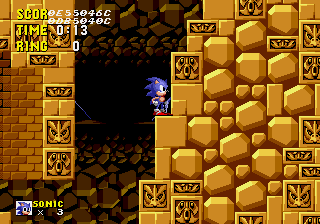
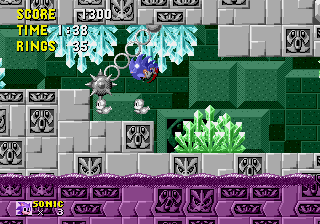
An early version of Labyrinth Zone and the final level of Scrap Brain Zone
Perhaps because of the importance of the project, Kodama stayed with the development team until the end, getting involved in the playtesting phases in particular. She spent a night debugging the day before the master was due with most of the other team members, before celebrating the end of the project with them in a nearby family restaurant.
While the game features traditional end credits in which the developers are credited under their pseudonyms (with the notable exception of composer Masato Nakamura, who didn’t work at Sega), one of them has managed to include hidden credits revealing the identities of the people hiding behind theses pseudonyms. With one exception, once again, since she was unsure whether she could or wanted to reveal her real name, Kodama chose not to do so. She is therefore credited as Rieko Kataoka, in addition to the traditional Phoenix Rie in the end credits.
Posterity
There is much to be said about how Sonic the Hedgehog and its developers talked about in the years and even decades following the game’s release. Some of them have spoken at length, both about the creation of this first opus and their contribution to it, in dozens of interviews and conferences, while others have rarely been given the opportunity to talk about it. The game, and Sega along with it, found itself some figureheads, faces recognisable to the public in the press, to the detriment of its other creators (both male and female). It’s a phenomenon that’s far from confined to Sonic, but one that raises questions when you consider that Kodama, herself one of the faces of Sega, has rarely been interviewed about her contribution to this game, despite it being the best-known in her career. For the record, it was via a monthly column in Mega Drive Fan magazine in which Sega employees took it in turns to present their work in a few lines (always under a pseudonym) that we learned in 1991 that she had designed the backgrounds for 2 zones of the game.
Even before the release of Sonic The Hedgehog, 3 of its developers were briefly interviewed by Beep! Mega Drive, and their comments were published in the April and May 1991 issues of the magazine. One photo shows Yasuhara hiding behind a Sonic drawing by Ohshima, but the 3 men were referred to by their pseudonyms: YU2 (Yuji Naka, the 2nd ‘Yu’ after Suzuki), Bigisland (Big island is a literal translation of Ohshima) and Carol Yas (Yasuhara). Interviews with Sega’s in-house developers were very rare at the time, as the company preferred to let its public relations officers or department heads do the talking. This was the case, for example, with Yu Suzuki, who, as assistant director of AM2, had been able to introduce himself under his real name since the studio’s creation in 1990, when he was still referred to only by his first name in 1988. The relationship between Naka and Suzuki seems to have been based on a one-sided rivalry, probably tinged with a certain amount of jealousy towards the latter, and this difference in treatment between the two men may have contributed to the lack of recognition that Naka complained about to his superiors.
A few months after the game’s release, Ohshima was the only developer on the team to be featured under his real name in the September 1991 issue of the US magazine EGM. At the same time, Yasuhara, who had finally moved to the United States, was lamenting that he wasn’t getting more recognition for his work, according to Mark Cerny, who was also now domiciled on the other side of the Pacific. As for Naka, he had already left Sega, without waiting for Sonic 1 to be released. It would take him a few months before returning to his former employer, via an alternative route.
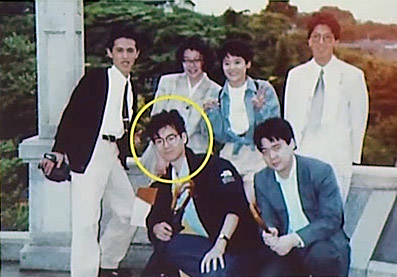
The Sonic development team, around January 1991
Page 1 2 3 4 5 6 7 8 9 10 11 12 13 14 15 Sources
———-Support me———-
VGDensetsu is the equivalent of a full-time job for me – I spend an average of 30 to 40 hours a week on it. You can help me continue my work by supporting me financially via Patreon (monthly payment with the possibility of a one-off payment by unsubscribing after an initial payment) or via Ko-fi (one-off payment), or simply by talking about my work to those around you.