



Rieko Kodama – Part V: Breaking out of the canon to go beyond it: the making of Phantasy Star
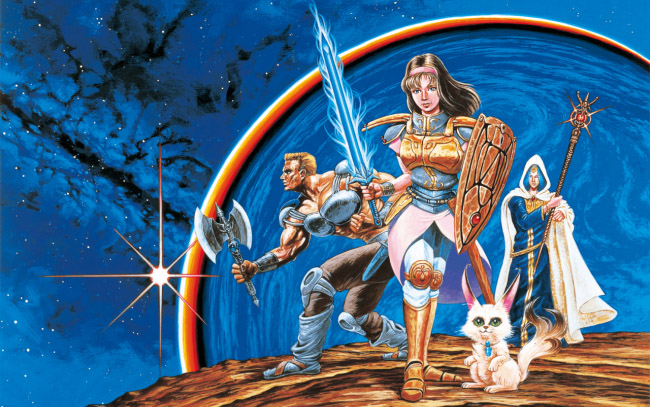
Table of contents:
Part I: Tokyo, 1984
Part II: Champion Boxing
Part III: From arcade to console (and vice versa)
Part IV: Alex Kidd in Miracle World or the birth of a Master System icon
Part V: Breaking out of the canon to go beyond it: the making of Phantasy Star
Part VI: The status of women in the Japanese video games industry
Part VII: Change and new responsibilities
Part VIII: The two Phantasy Star II
Part IX: Working conditions at Sega and in the Japanese video game industry
Part X: A mascot in the making
Part XI: On both sides of the Pacific
Part XII: Final Phantasy
Part XIII: The last Saturn games
Part XIV: Arcadia of my youth
Part XV: Entering History
Games
To be confirmed
Other video game related works
Chronology
Gallery
Sources
General sources (Interviews, liner notes, comments, etc.)
Article aussi disponible en VF
Multicultural RPG
As a sign that the RPG genre was in full bloom in Japan in 1987, the year ended with the birth of two of its most famous series, respectively on Famicom and Mark III with Final Fantasy and Phantasy Star. While titles such as Dragon Quest and Haja no Fuuin / Miracle Warriors sought to reinterpret Western RPG references such as Wizardry and Ultima in their own way, Square and Sega’s games were developed more in response to Enix’s title and its sequel, without neglecting their own Western inspirations.
“At the beginning of the project, there was our programmer Mr. Naka, and a certain Mr. Hayashida who was the head of the planning section at the time. Those two plus the department head made three. Dragon Quest was very popular, and these three people had a lot of fun playing it.”
Even at the time when Miracle Warriors was being adapted, the idea of making an RPG designed entirely within Sega was beginning to germinate in the minds of some of its employees. As was often the case back then, game development began before the graphic designers were involved and, in this case, one of the first things to be put to work was the engine designed by Yuji Naka to create dungeons adopting a 3D play area. Kotaro Hayashida was frustrated by the way the player’s movements were represented on screen in the dungeons of Wizardry: they lacked animation and therefore did not always make it clear whether a character had actually made the requested move. It was therefore decided to animate these movements and it was from another Western game that Naka drew his inspiration, as he explained in 2010:
‘There was a Commodore 64 game called 3D Dungeon, and the motion and animation was very smooth, and I was blown away by how that worked.’
(note: the name ‘3D Dungeon’ does not correspond to any known C64 game. Naka referred several times to the C64 when mentioning Phantasy Star, but he probably got it confused with another title released on that machine. Several games released on C64, Amiga or Apple II featured smooth animation and/or relatively detailed backgrounds when moving around, notably The Eidolon and its fractals on the C64 and The Bard’s Tale on Amiga, a title that was already well known in Japan at the time)
Even before joining Sega, Naka was already interested in 3D, to the extent that he had started making a shoot’em up using this technique on PC-8001, with the intention of entering it in a programming contest organised by Enix. Working in the same company as Yu Suzuki certainly didn’t diminish his desire to make 3D games and, after developing the Mark III adaptation of Space Harrier under the guidance of his senior colleague, he worked on a project using the console’s 3D glasses. Although it never came to fruition, it allowed the programmer to push his experiments with 3D a little further, a path he continued to explore by designing the basis for what would become the engine for the dungeons in Phantasy Star.
Once this engine was up and running, the setting of the game still had to be defined, and it turns out that someone else already had a project in the pipeline that could be a good fit for Sega’s future RPG. Miki Morimoto, who was responsible for balancing the game, would testify to this years later:
“Phantasy Star came into being when, during the Master System era, Sega decided that it also needed to create an RPG. So they started soliciting game design ideas from us, and Chieko Aoki had this story idea she’d been mulling over for awhile. We used that and worked it into what became the original story draft for Phantasy Star. Even at that early stage, almost all the dialogue was already written–that was how much Chieko loved Phantasy Star.“
Feminine touch

Chieko Aoki, a.k.a Okaru, drawn by her colleague Takako Kawaguchi
Born in 1964, Chieko Aoki is one of the many employees to have had a short but intense career in video games. After joining Sega in the mid-80s, she worked on one of the last two SG-1000 games – Sherlock Holmes: Loretta no Shouzou (1987) – which is also one of the few adventure games produced by Sega. It is not known what position she held on it, although it is likely that she wrote its script or even (co-)directed it. It is certain, however, that she directed Nazca 88 / Aztec Adventure (1987), making her nothing less than one of the first female directors in the Japanese industry and the first known at Sega to date. After Phantasy Star, she continued her career as a planner on titles such as Tensai Bakabon, Phantasy Star II, the Mega Drive versions of Ghouls n’ Ghosts and Ghostbusters and the Master System Zelda-like Golden Axe Warrior, before leaving Sega in 1991 to become a housewife after marrying one of her colleagues.
Once the project was officially launched, Aoki reworked her script several times, in collaboration with Hayashida, while Naka continued his programming work. It was at this stage of development that the people responsible for giving the game its visual identity came into the picture, in particular Rieko Kodama, who was given the job of character designer.
“When I joined the project, the dungeons were already up and running. I was in charge of character design and there were a total of seven people in the team.“
“The flow of pre-production generally starts off with planners and programmers having a meeting about what they want to do with a game. Such as, “We should put 3D dungeons in it,” or, “We should have monsters with animations.” After that, they would come to the designer to discuss these ideas and go from there. So in our case we had a meeting after they talked and they asked if I could design 3D dungeons.
Actually, not long before that meeting—and this is kind of weird, but… The manager of my department told me to play “Dragon Quest”. He was so excited about it that he brought it to me. He was like, “You’ve gotta check this out! I don’t care. Go ahead and play it during work hours.” And I was so surprised that I had to double-check with him. Like, “Are you kidding me?!” (Laughs)
At the time, Kodama was just a graphic designer, usually in charge of the backgrounds, but she was asked to design the game’s characters, and to do this, she didn’t start from scratch. Chieko Aoki played a fundamental role in the development of Phantasy Star and in why this first episode remains a benchmark to this day. It is she who defined the characters, making a woman – Alisa / Alis – the heroine of the game, a point that seems to have been determined right from the first version of the script according to Hayashida.
Based on Aoki’s indications, Kodama drew some of the game’s characters, including Alisa:
“One point is that this is a game with a female leading character. With this, we could challenge the stereotype that the main characters in video games should be men. It would be fairly difficult for male users to empathise with a heroine, but I was happy we could try something new.”
“I designed her as I expected her to be a character that many women, including myself, could empathise with.”
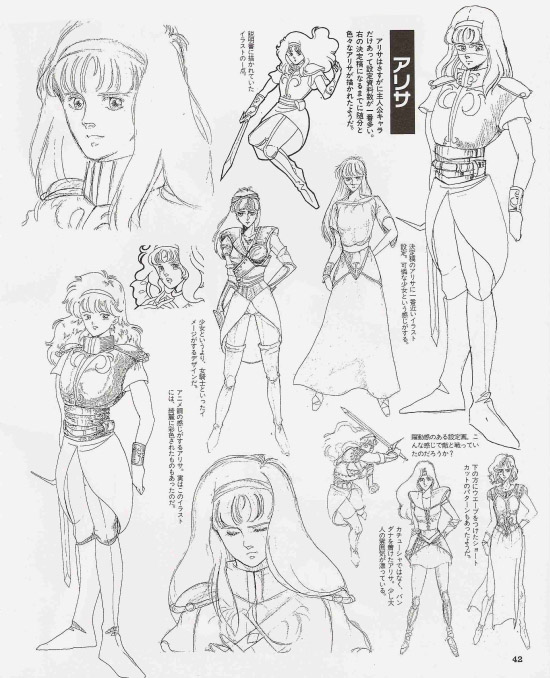
Concept art, manual illustrations and portraits drawn for some of the game’s cutscenes featuring Alisa/Alis.
The rest of the development team could have disagreed with Aoki and decided that it was too risky a gamble not to opt for a male lead character, but for their first original RPG, the members are driven by a desire to stand out from the competition. This could be seen as a form of unintentional feminism, but Kodama’s heroine’s appearance is in stark contrast to the genre’s canons. Numerous games, animated series and OVAs featuring young women were already on the market at the time, but they often made the woman an object of desire for a male audience, sexualizing her with bikini armor and mini-skirts (Valis, Athena, The Wing of Madoola, etc.). It’s interesting to compare the cast of Phantasy Star with that of the novel series The Weathering Continent (1990), written by Sei Takekawa and illustrated by Mutsumi Inomata, again a female duo. In this series, adapted as an OVA in 1992, there’s a similar trio of human characters, except that the appearance of the female character seems to respond, consciously or not, to a more commercial logic.
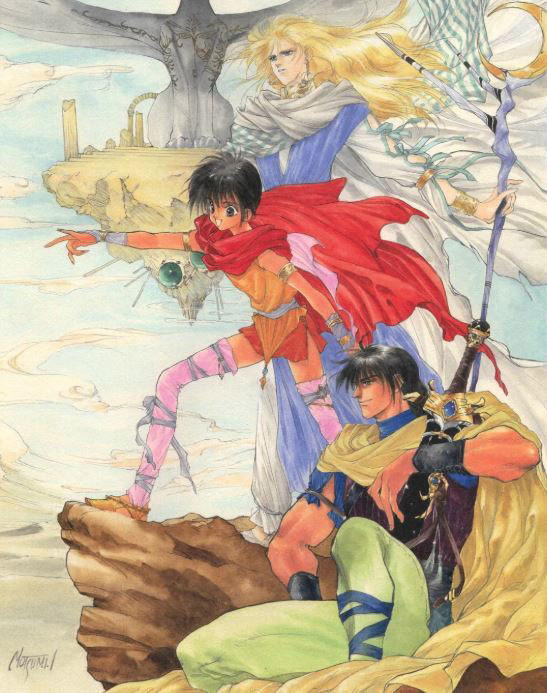
A muscular character, an androgynous character and a young woman with lighter clothing than her comrades.
Aoki also laid the foundations for one of Alisa’s companions, called Lutz in the Japanese version and Noah in the West. Thought to be a hermaphrodite in one of the first versions of the script, Aoki and Kodama agreed to make them a physically weak androgynous person, whose gender remains deliberately undetermined. They conceived of them as the opposite of Tyron / Odin, who fits perfectly into the archetype popularised by Sylvester Stallone and Arnold Schwarzenegger, and whose first characteristic must be to exude a sense of physical power.
‘I designed Noah with intelligence as his best feature, and Odin, with power as his. I tried to create Noah as a mysterious character, while portraying Odin in the image of a typical leading man in heroic fantasies. Though their personalities are different, I imagined the contrast of their visual designs to be like Raistlin Majere and Caramon Majere in Dragonlance, a series of novels from Advanced Dungeons & Dragons.“
In terms of their characteristics, Lutz is more akin to a shōjo manga character who shines more on their intelligence than their strength, and meets certain beauty criteria (of which apparent fragility may be a part). However, Kodama said she did not set out to target one audience over another, but rather to place her characters on an equal footing, whatever their gender.
‘I usually don’t think to make games strictly for a female audience, myself, but I think my RPGs attract a larger female audience.’
‘I believe that a story or world cannot revolve around male power alone, you can not neglect the great amount of female power beside it.’
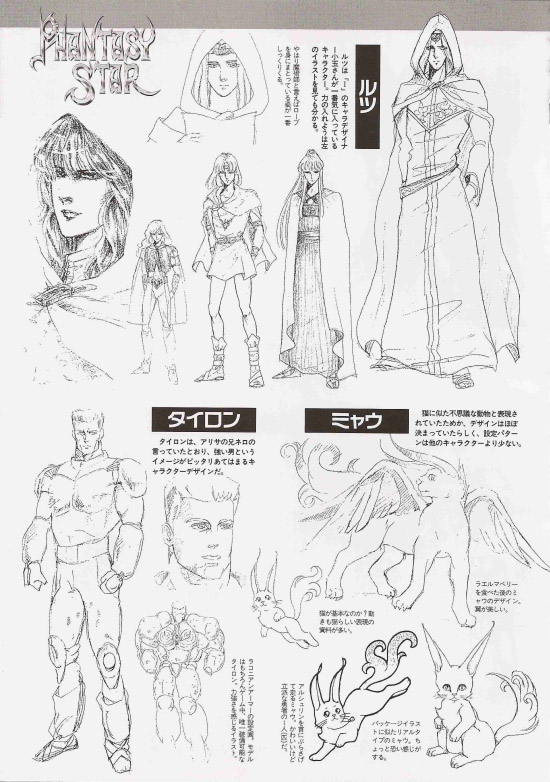
Concept art, manual illustrations and portraits drawn for some of the game’s cutscenes featuring Lutz / Noah (top), Tyron / Odin (bottom left) and Myau (bottom right).
Not feeling confident about designing or animating certain types of character, Kodama enlisted the help of several of her colleagues. This was notably the case for graphic designer Takako Kawaguchi, who designed Myau, an animal with feline features, while Kazuyuki Shibata, who had just been hired by Sega, took charge of the monsters.
As for Tyron, we owe it to an employee with only a little more seniority. After working briefly in advertising, Naoto Ohshima decided to change careers and joined Sega in the hope that his creativity would be put to greater use. Quickly spotted by Naka, who saw him draw Superman on a Digitizer System as a test, Ohshima quickly earned a reputation for being good at drawing muscular men, which is probably why he worked on a Mark III adaptation of Rocky shortly after being hired. So it came as no surprise when he joined the Phantasy Star project in mid-development to design Tyron and draw the illustrations featuring him in the game.
Influences
The design of the game’s characters is based on an art direction inspired by various Western fantasy films, unsurprisingly with the most famous saga of the genre as one of the main influences:
‘I was influenced by a lot of things: the movies I watched when I was a teenager like Star Wars and Alien fantasy fiction, table-top RPGs like Dungeons & Dragons and even Norse mythology, as well as other stories.’
‘I wanted to create a universe like Star Wars where I could think about various cultures and customs when making planets.’
‘Much of my design work in the game was influenced by (George Lucas’ film), which is one of my favourite movies. Aspects of Star Wars, such as the costumes, were designed with a strong Asian flair.’
‘It’s an SF movie, but Luke’s outfit looks like a judo uniform, and the light sabers are used a lot like samurai swords…’
‘In designing the world of Phantasy Star world, I wanted to use what I learned in Star Wars about borrowing something from a completely different universe. So that’s why I thought that it’d be neat if the people in this world wore medieval clothes, even though it’s an SF story and there are robots running around.’
‘I decided to experiment by giving the costumes and designs a more Western motif.’
‘At the time, we had no intention of releasing the game in Western markets, so these designs were purely to pique the curiosity of Japanese gamers.’
Phantasy Star borrows a formula from Star Wars that is reflected in its very title, with a mix of fantasy and science fiction that sets it apart from the competition, which at the time was more focused on heroic fantasy. Once again, the choice was not made by chance:
‘At that time, nearly everyone in the [console] industry was making their first stab at making an RPG, so we were all groping around for ideas. However, all of us at Sega were really challenging ourselves with this game, so we veered away from the main road as much as possible during development.’
Graphics
One of the problems faced almost systematically by developers in the 80s was the amount of memory available, and this affected graphic designers in particular. Every detail, every extra color counted, and Kodama even recounted how one of her colleagues was asked by a programmer to choose certain colors rather than others in a particular game because they were easier to compress into the cartridge.
For Phantasy Star, the developers took inspiration from computer games to include in-game portraits and illustrations, which are very memory-hungry and which the graphic designers had previously drawn on paper.
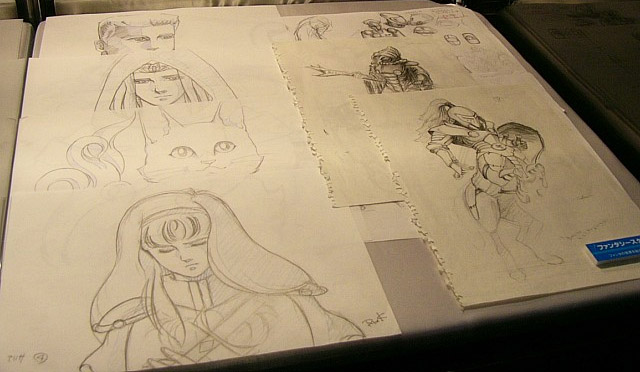
Original artworks exhibited in 2003. Rieko Kodama’s signature can be seen at bottom right of the Alisa drawing.
‘As a designer, I’d always get asked by the planner to make some background or another within 150 tiles… then once I finished it, he’d go up and say ‘Sorry, but can you cut out 20 tiles?’”
The game had to fit into a 4 megabit cartridge, although it seems that its initial size was smaller according to Kodama’s recollections. The adaptation of After Burner, produced in parallel with Phantasy Star, was itself made using a 4-megabit cartridge. This was a point of which the RPG developers were presumably aware of, and which helped them convince their management to use a cartridge of the same size.
Kodama was responsible for drawing the various 2D areas where the player moves around, the backgrounds of the battle scenes, the villagers, the cinematics featuring Alisa and Lutz and the title screen. Of all the elements to be drawn, it was perhaps the dungeons that gave her the most trouble.
‘Regarding the 3D dungeons, if you want to make them run as smoothly as possible, it’s not that difficult: all you have to do is draw all the frames of the scrolling walls. But if we’d done that, we wouldn’t have been able to fit them all into the ROM, and it wouldn’t have rendered as well if we’d just removed some frames…’
‘Movement throughout the 3D dungeons had to be drawn by hand, but it was difficult to know if you were moving in our first version. So Naka created wireframes for the dungeons and printed them out for me. I then used them as a reference to draw new designs. It really helped me figure out how to represent the walls when you’re moving.’
This whole part of the game was done by trial and error over a relatively long period and many elements were left on the workbench.
‘I remember working on the graphics for a stone dungeon.
We even integrated it into the game, but apparently it wasn’t possible to keep it because of the size of the cartridge.’
The graphic designers and programmers worked hand in hand to squeeze every last byte and fit as many elements as possible onto the cartridge.
‘Naka found a way to make sure there was just enough room for me to draw one or two extra monsters! He really helped me out.
At the time, RPGs didn’t really have enemy animations. He first told me that he wanted to include some, but that it wasn’t possible because of memory constraints. And yet he managed to make the impossible possible! I’ll never forget that.’
‘I wasn’t trained in programming, so I would tell him what I wanted to do in terms of graphics and make all sorts of unreasonable requests. He always did his best to code what I asked him to.’
With two or three days to go before the game was due to be released, it was decided to add a final illustration featuring the 4 protagonists, although it was not clear whether the request came from Naka, Kodama or another member of the team (the version of events changed from one interview to another). The cartridge was already bursting at the seams, but Naka found a way to rearrange some of the graphics in the ROM and free up enough space to draw 120 more tiles. Despite her already full schedule, Kodama had no choice but to draw the illustration in question.
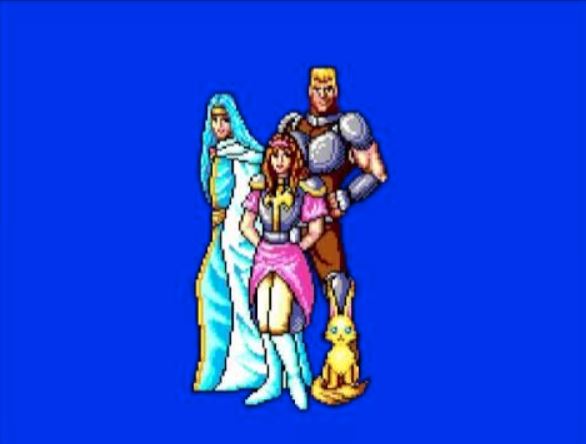
Ending illustration drawn by Kodama
In addition to her contribution to the creation of the characters and the game’s graphics, Kodama signed the manual illustrations, both for the characters and the world map, and designed the Luveno ship, one of her rare forays into the field of mecha-design. As for the game’s logo, although Ohshima drew several sketches, it was Kodama who designed the final version.
The development of Phantasy Star was completed after a period of just under 5 months, which may seem short for an RPG, but was considered a relatively comfortable length of time by some of its developers, who had previously been used to 3-month development cycles.
While Kodama has repeatedly stated that the team consisted of between 5 and 7 people depending on the development period – a normal size for the time – the end credits list 18 different people. Among these 18 people are developers who came to lend a hand for a short time, whether in character design, graphics, balancing or programming. Even though Yuji Naka claims to have been the only programmer on the game, 2 other names are listed as having worked on the game in addition to his own, although it is not clear exactly what role they played.
Phantasy Star was released on Mark III on December 20, 1987, just a few days after Final Fantasy and one of the main representatives of the dungeon crawler genre – Dungeon Master -, underlining the extent to which Sega’s title was able to capture the zeitgeist while asserting its own identity. Like films such as Night of the Living Dead (1968) or Alien (1979), respectively featuring an Afro-descendant and a woman as the main character, the progressivism shown by the Phantasy Star team seems to have been more an internalized element by all or part of the team than the result of a conscious decision on their part (or rather: the creators of these various works have all denied this). In the years that followed its release, its importance grew and grew, giving this first episode a special place both within the series it initiated and in the RPG field, and more generally in the video game industry.
For Kodama, Phantasy Star wasn’t the first major title in her ludography, but it was one of the ones she had been most involved with up to that point, and while it wouldn’t achieve the popularity of Sonic, it is still perhaps the most representative of her career.
What’s more, this first episode also illustrates the fact that, while parity was far from being achieved in the video game industry and there is still work to be done on the representation of women, Sega was perhaps a little less narrow-minded than some of its competitors on these issues at the time, as the following title tends to attest.
Page 1 2 3 4 5 6 7 8 9 10 11 12 13 14 15 Sources
———-Support me———-
VGDensetsu is the equivalent of a full-time job for me – I spend an average of 30 to 40 hours a week on it. You can help me continue my work by supporting me financially via Patreon (monthly payment with the possibility of a one-off payment by unsubscribing after an initial payment) or via Ko-fi (one-off payment), or simply by talking about my work to those around you.