



Rieko Kodama – Part VIII: The two Phantasy Star II
Table of contents:
Part I: Tokyo, 1984
Part II: Champion Boxing
Part III: From arcade to console (and vice versa)
Part IV: Alex Kidd in Miracle World or the birth of a Master System icon
Part V: Breaking out of the canon to go beyond it: the making of Phantasy Star
Part VI: The status of women in the Japanese video games industry
Part VII: Change and new responsibilities
Part VIII: The two Phantasy Star II
Part IX: Working conditions at Sega and in the Japanese video game industry
Part X: A mascot in the making
Part XI: On both sides of the Pacific
Part XII: Final Phantasy
Part XIII: The last Saturn games
Part XIV: Arcadia of my youth
Part XV: Entering History
Games
To be confirmed
Other video game related works
Chronology
Gallery
Sources
General sources (Interviews, liner notes, comments, etc.)
Article aussi disponible en VF
A Mark III game
When the first Phantasy Star was released in December 1987, it didn’t take long for Sega to decide that this would be just the first episode in a series, and set in motion a long-term marketing campaign for its sequel. As was done at the same time with series such as The Black Onyx and Mega Man, the company organized a scenario and game design contest in the pages of Beep! magazine, as well as in one of the guide books dedicated to the first episode. As early as March 1988, even though work on the game itself had not yet begun, over 2,000 people took part in this contest, presented as a prelude by Sega’s marketing department. Some of the Phantasy Star developers met some of the winners at a round table discussion, including a very young Masahiro Sakurai, then aged 17.
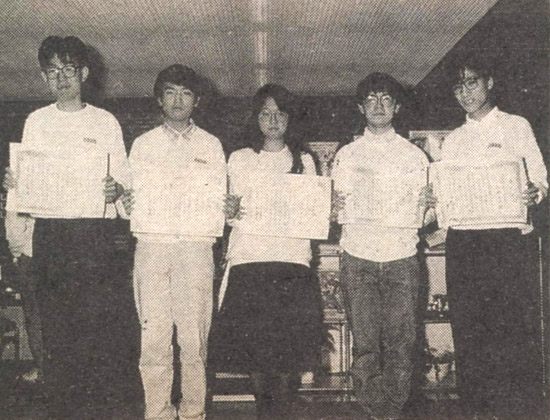
The contest winners, with Masahiro Sakurai (second from the left)
In April, Chieko Aoki began work on the script, although it’s not clear whether she incorporated any of the ideas submitted in the contest. She chose to set the action 1000 years after the first episode, and to make Lutz / Noah the main character. As their companions had since passed away, new characters had to be created, and this task fell to Kodama. The graphic designer also drew a number of image boards to give an overview of the setting of the game, as was already common practice in the animation industry in the 1980s.
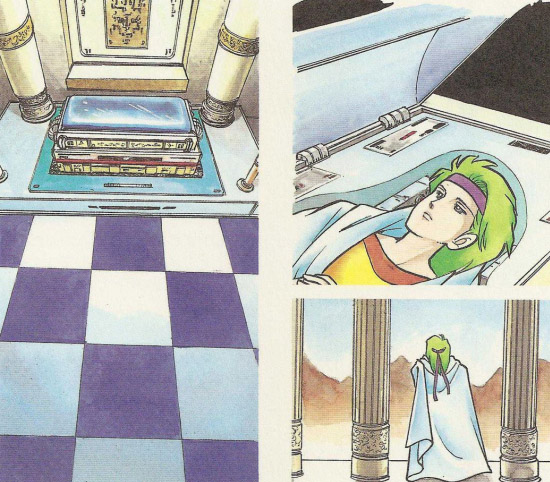
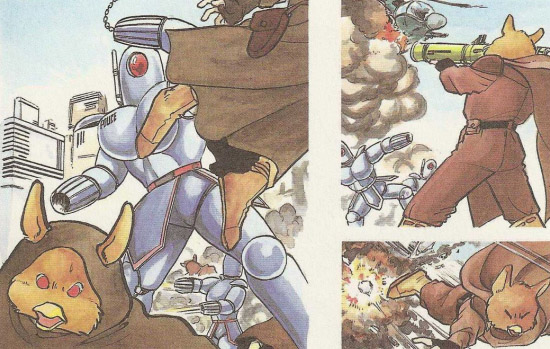
Some of the image boards drawn by Kodama
While Aoki refined her script, Kodama worked in parallel on Altered Beast and Alex Kidd in the Enchanted Castle until she left for a business trip to the United States around June. According to the Summer 1988 catalog published by Sega at the same time, Phantasy Star II was scheduled for release on the Master System in December of that year. However, on her return to Japan some 2 months later, Kodama discovered that the project had little in common with what she had been working on.
A Mega Drive game
After 2 months spent programming Super Thunder Blade, during which time Aoki urged him to finish it as quickly as possible, Yuji Naka finally joined the development of Phantasy Star II. On discovering the script, he was the first to express his displeasure at making Lutz the main character, an opinion shared by other colleagues. Another point in the script that displeased some of the team was the idea of including time travel during which Lutz would be reunited with Alisa, which some perceived as a rewriting of the story. Faced with these comments, and rather than make any changes to her script, Aoki decided to write a new scenario that retained only a few elements of the original.
Over the summer, the development team gradually came together and began work on this sequel. Alongside Aoki, who directed the project, we find a good part of the staff from the first episode, but with one major change: the design of the characters was entrusted to Toru Yoshida. Having made his debut on Super Thunder Blade, he was asked to join the Phantasy Star II team towards the end of the latter’s development. While waiting to finish work on his first game, he borrowed a Mark III to try his hand at Phantasy Star I and cancelled the leave he was supposed to take over the summer. Despite his lack of seniority, he was given the job that Kodama had held on this game, and she only found out about it when she got back from her trip.
This was not the only change made in her absence, as the game was now planned for release on the Mega Drive. Several reasons and hypotheses can be put forward for this: firstly, the Mark III was at the end of its life, with its last commercial game – Bomber Raid – coming out in January 1989 (it was originally due for release in 1988). Secondly, Sega desperately needed games for its new console, which initially suffered from the same problem as the Mark III, namely a lack of support from third-party developers. Most of these developers were already working on Famicom, PC Engine or computers and, either because of exclusivity clauses or because of financial risks, they did not necessarily want to invest in a console whose commercial success was uncertain.
The graphics team consisted mainly of 3 people: Toru Yoshida, who designed the main characters, certain enemies, portraits, dungeons and cinematics; Yasushi Yamaguchi, who was in charge of mecha design; and Kazuyuki Shibata, who designed the monsters for the first episode and was appointed art director for its sequel. Although she’s listed first in the ‘graphic designers’ section of the game credits, Kodama didn’t actually do much work on this second version of Phantasy Star II, which also seems to be the case for the other people listed in this same section (Yoshida, Yamaguchi and Shibata are listed in specific positions and not in this section). She only drew two illustrations used in cinematics: one showing Alisa in a dream and the other featuring Lutz.
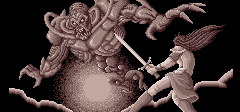
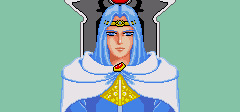
The two in-game illustrations drawn by Kodama
Despite the importance of the project, the game’s graphics were handled either by beginners or by people who had been working at Sega for a year or less. As Yoshida pointed out, Mega Drive games were usually designed by a pair of graphic designers made up of a veteran and a beginner. It’s likely that, in order not to further delay the release of a game whose marketing plan had already been set in motion, it was decided in a hurry to entrust the task of designing the characters to a young recruit.
When the developers began work on the graphics for Phantasy Star II, the console hardware was finally ready, even if it wasn’t yet commercially available. What’s more, most of them had already worked on the console beforehand, and the result on screen was notably more colorful and accomplished than on previous titles.
Despite all this, this second episode suffers from one major omission compared to its predecessor: the 3D dungeons. After development of the first episode came to an end, Yuji Naka worked with his colleague Mark Cerny on a project for a polygonal 3D game set in a dungeon on Mark III. Unfortunately, the project didn’t come to fruition, which is probably why Naka didn’t start working on Mega Drive at the same time as Kodama. The latter joined the team in charge of adapting Altered Beast around March or April 1988 (i.e. almost two months before the arcade version was released), while Naka began programming Super Thunder Blade around May or June of the same year. Apart from the fact that he didn’t have much time to study the hardware, which was still unfinished at the time of Super Thunder Blade, he also had to deal with a very tight schedule that didn’t leave him much time to experiment with 3D on the Mega Drive.
The development team did, however, get a concession from its management. Sega had originally planned to release the game on a 4 meg cartridge, the same size as the first episode. Naka negotiated a 6 meg cartridge in exchange for a promise that the game would be finished on time. A promise he would be unable to keep.
The Mega Drive version was initially announced for January 1989, a very tight production schedule, to which was added a great deal of pressure from management. To meet the deadline, development would have had to be completed in October 1988. Naka stated that he only had two and a half months to code the game between September and December, while Yoshida began work around August. Kotaro Hayashida claims that development took 6 months once the project was rebooted, which seems to be a bit of an overestimate on his part. The master was delivered in December 1988 and the game hit the shelves in March 1989, after the usual 3-month delay for cartridge production.
These days, Phantasy Star II doesn’t enjoy the same popularity as its predecessor, even though it democratised the idea of having one of its main characters die, years before Final Fantasy VII. Nevertheless, this first Mega Drive episode was generally well received and was the first RPG on the console, at a time when the genre was occupying an important place in the Japanese video game market. What’s more, one of its female characters—Nei, who is closer to the standards of the time than Alisa (and likely inspired by a character of the same name appearing in the manga ‘Bastard!’)—remains one of Sega’s most popular characters to this day.
However, the way Phantasy Star II and other titles developed before the launch of the Mega Drive were developed raises a significant issue, namely that of working conditions at Sega.
Page 1 2 3 4 5 6 7 8 9 10 11 12 13 14 15 Sources
———-Support me———-
VGDensetsu is the equivalent of a full-time job for me – I spend an average of 30 to 40 hours a week on it. You can help me continue my work by supporting me financially via Patreon (monthly payment with the possibility of a one-off payment by unsubscribing after an initial payment) or via Ko-fi (one-off payment), or simply by talking about my work to those around you.