



Rieko Kodama – Part III: From arcade to console (and vice versa)
Table of contents:
Part I: Tokyo, 1984
Part II: Champion Boxing
Part III: From arcade to console (and vice versa)
Part IV: Alex Kidd in Miracle World or the birth of a Master System icon
Part V: Breaking out of the canon to go beyond it: the making of Phantasy Star
Part VI: The status of women in the Japanese video games industry
Part VII: Change and new responsibilities
Part VIII: The two Phantasy Star II
Part IX: Working conditions at Sega and in the Japanese video game industry
Part X: A mascot in the making
Part XI: On both sides of the Pacific
Part XII: Final Phantasy
Part XIII: The last Saturn games
Part XIV: Arcadia of my youth
Part XV: Entering History
Games
To be confirmed
Other video game related works
Chronology
Gallery
Sources
General sources (Interviews, liner notes, comments, etc.)
Article aussi disponible en VF
Flicky
At the end of the Space Invaders boom, Sega had between 1,600 and 1,800 game centers, which had to be constantly supplied with new titles. Judging that it would be more profitable to exploit in-house titles than games produced by third-party companies, the company’s sales department regularly asked its developers to create an equivalent to one of the competition’s hits. Examples include Fantasy Zone, originally designed as a reaction to Gradius, and Flicky, Sega’s response to Namco’s Mappy. Initially released in the arcade in May 1984 and directed by Yoji Ishii, Flicky borrowed part of its gameplay from its rival – both were object-collecting platformers – as well as the idea of featuring cute animals. What sets it apart, however, is the way it scrolls, adopting a mechanic typical of platformers of the time and requiring the player to move around a background that loops endlessly (an element that would later feature in other games Ishi supervised, notably Teddy Boy Blues and Fantasy Zone).
Although Yoshiki Kawasaki designed the graphics for the arcade version, he admitted that he was not involved in adapting it for the SG-1000, leaving Kodama to transcribe his work. Visually much more modest than Champion Boxing, this version, released in December 1984, illustrates the console’s limitations quite well, with sprites flickering relatively frequently because there are too many of them to display simultaneously on screen.
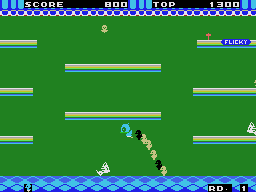
The SG-1000 version of Flicky
Like Teddy Boy Blues, released as an arcade game in 1985, Flicky was later adapted for Sega consoles, including a Mega Drive version available via its Sega Game Toshokan download service in 1991, then as a cartridge in the West on the same console. Its main character was immortalised the same year in Sonic the Hedgehog and then in some of its sequels, as one of the animals that the blue blur releases at the end of each level.
Girl’s Garden
In April 1984, a programmer named Yuji Naka, then only 19 years old, joined Sega. For his debut, he worked on an SC-3000 version of Lode Runner using its external floppy disk drive – the SF-7000. This version of Doug Smith’s hit game was to include new stages designed by Naka, in addition to the stages already included in the SG-1000 version. Unfortunately, this disk never hit the shelves and only 10 copies were distributed internally. The programmer then moved on to another game which, according to him, was not originally intended to be released commercially:
‘Back then, the [SG-1000] hardware wasn’t really selling to girls, so my boss at the time came up to me and said, “come up with a game that can relate to the female audience,” so I started making it. I thought it was just a little test for me, but my boss really liked it and was like, “OK, we’re going to make this into a product.” Altogether it took four months to make that game, but the first two months were just me nonchalantly putting it together, since I was still in that “test” phase. The next two months were really hectic, since I had to finish it all up. Looking back, I really don’t want anybody to go in there and look at the programming, because as a game, it looks like it’s working, but inside it’s just awful.’
For this project, called Girl’s Garden, the programmer who would later make a name for himself with Sonic and Phantasy Star collaborated with two new recruits, including Hiroshi Kawaguchi, a musician hired as a programmer:
‘When I joined Sega, I wanted to work on game music,’ recalls Kawaguchi, ’but when I mentioned during the interview that I could also write in machine language, I was told that I would be a programmer. So I became a programmer (laughs).
About a week after I joined the company, Yuji Naka, Katsuhiro Hayashi and I were brought together and asked to create a game for girls. There was no planner or graphic designer, so I worked on the graphics myself.
Eventually, a designer joined the team, but in the meantime I drew the graphics on my own. So the project had four members and the music was composed by Hayashi.’
Katsuhiro Hayashi was the first Sega employee to be hired specifically to work on game sound. Prior to this, sound was handled by hardware engineers (for arcade games) or programmers (for console or computer games). As for Kawaguchi, he quickly moved away from graphics, alternating between programming and music from his next game onwards, before making the final switch to composer in 1985 after his work on the Hang-On soundtrack.
As for the other designer who was called in to help during development, it seems to be not one but two people. The first is known only by the first letter of their surname – S – and left on a trip to Africa before the end of development. The second is none other than Kodama in one of her lesser-known contributions. As a direct result of the lack of credits in the game, her contribution to Girl’s Garden is largely ignored and she herself rarely, if ever, mentioned it in public. It was via a conversation reported on Twitter by her colleague Yosuke Okunari that we learned of this work, during which she said that she had done very little work on the game. Despite the large number of interviews she has given throughout her career, it is likely that she only took part in this communication exercise because of her job. As a result, she has almost never mentioned the work she has done on a particular game without being asked about it.
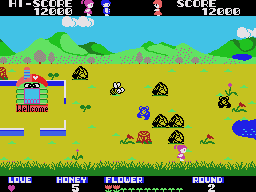
Girl’s Garden
Apart from the various names of key figures in the industry that should have featured in the game’s credits, Girl’s Garden is famous for being one of the first titles openly marketed to a young female audience, or at least thought of as such. In this game, we take on the role of a young girl who has to collect flowers and jump over bears in order to win the love of young Minto (who probably doesn’t deserve that much effort). It’s worth noting that, almost 3 years before Phantasy Star, Kodama and Naka had already collaborated on a title not aimed at the usual male audience of the time.
The game was completed around October 1984 and released between December and January 1985, to great success according to Naka (in proportion to the number of consoles and computers in Sega’s installed base). It was quickly followed by another title featuring a female protagonist.
Ninja Princess
In the mid-1980s, there was still no clear separation between the arcade and console/computer divisions within Sega. Some of the development tools, such as those used to create graphics, were common to both branches, even though the resolution and number of colors that could be displayed on screen varied greatly from one medium to another. As a result, despite the reluctance of some developers to work on console games, it was not uncommon to see them working alternately on titles produced for one market or the other. Kodama herself witnessed the creation of some of Sega’s arcade classics.
‘I distinctly remember that during the development of the arcade version [of Space Harrier], a prototype of the cabinet was placed at the far end of the development room, opposite my seat.’
‘But the first thing that really impressed me was Hang-On. This cabinet appeared with a bang on the development site and I was asked to sit in it for a minute.’ (laughs)
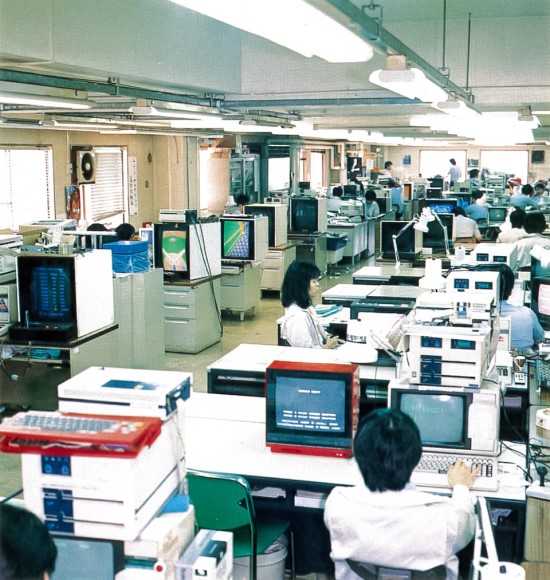
Sega’s development department in 1985. In the foreground is a red SC-3000. On the left are several screens displaying the arcade game Major League, while on the far right is a Hang-On cabinet.
As well as watching her colleagues work on arcade games, Kodama was also responsible for developing some of them. This was the case with Ninja Princess, a title on which she was assisted one last time by Yoshiki Kawasaki, who completed her training – he joined the public relations department once the game was finished.
‘When I was working on Ninja Princess, I learned how to create tiles (ed. note: patterns made up of blocks of pixels and used for backgrounds) thanks to Mr Kawasaki’.
She learned how to design backgrounds – which would become her speciality, as graphic designers gradually began to specialise either in objects (characters and other sprites) or in backgrounds – while taking charge of various elements, from character animation to the title screen and its logo, not forgetting the cinematic in which the princess transforms into a ninja.
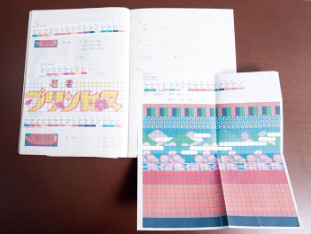
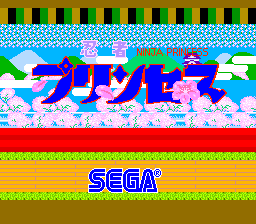
Logo and background drawn by Rieko Kodama for the title screen of the game
Like many of Sega’s arcade games of that era, Ninja Princess was also released on one of the company’s home machines a few months after the original version. This was an opportunity for Kodama to adapt her own work for the SG-1000.
This version was released in February 1986, 11 months after the arcade version, and in the intervening period Kodama worked on a number of titles for different machines. In particular, she took part in the development of Great Baseball (December 1985), a new collaboration with Yuji Naka, and her first known Mark III game – the console, which would become the Master System in the West, had been released two months earlier in Japan. Other contributions, however, are more uncertain, and Kodama herself could not remember some of them when asked about them decades later. On the occasion of the release of a music album celebrating the 30th anniversary of the SG-1000 in 2013, she indicated that she had probably worked on Dragon Wang, a title released in July 1985 and riding the beat’em up wave initiated by Irem’s Kung-Fu Master.
Up until the early 90s, she made numerous contributions to games without necessarily remaining attached to their development team for the duration of their creation. What’s more, at the time of the Mark III, while production times had lengthened compared with the SG-1000 era, most titles were developed in 2-3 months and it was not uncommon for certain developers, whether graphic designers or composers, to work on several games at the same time at a fast pace.
‘There weren’t many graphic designers and production deadlines were short, so I sometimes took on 5 or 6 titles a year.’
Composer Tokuhiko Uwabo, known for his work on Phantasy Star, reported in 1993 that he sometimes worked on as many as 16 games simultaneously (this probably corresponds to the number of games he worked on during the same year). As for Kodama, between two Mark III or SG-1000 games, she was given the task of designing the backgrounds for another arcade game, this time set in a science fiction universe.
Quartet
In the second half of the ‘80s, Sega was experimenting with arcade games, offering motorbike, car and jet simulations running on dedicated cabinets that reacted to what was happening in the game. These were games that could often only be played by one person, while other more traditional games allowed two or even more players. Then came the year 1985 and the release of Gauntlet, a title halfway between hack’n slash and shoot’em up that had the rare particularity of being playable by 4 players simultaneously.
Atari’s game did not go unnoticed by Sega’s management, who asked their developers to produce a title inspired by it. They swapped the top view for a side view and opted for a shoot’em up, one of the most popular genres of the time. The title of their game – Quartet – was a clue as to how many players could play simultaneously.
Released in April 1986, it came out just 4 months after Space Harrier and a few weeks after Fantasy Zone, two of Sega’s best-known shoot ‘em ups of the decade. Yet far from being cannibalised by their success, Quartet managed to carve out a good place for itself in arcades. Despite this, it also marked the end of an era for Kodama.
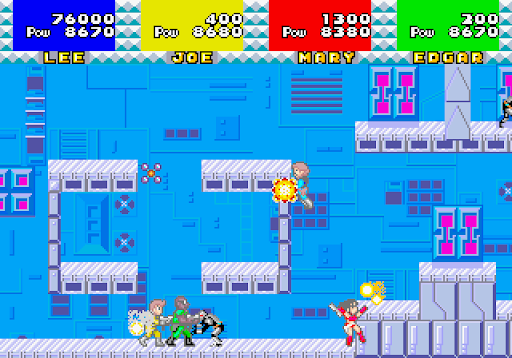
Quartet
Sega had two development divisions since 1984: R&D1 for arcade games and R&D2 for the consumer market, a term that encompasses both consoles and computers. However, there was no strict separation between them, and each member could move from one to the other as required. But towards the end of 1986, Sega, with its ever-growing number of employees, carried out a minor reorganisation and placed each of its R&D divisions on a separate floor. For Kodama, a member of R&D2, Quartet thus became her last arcade game, even though she was later invited, like many other employees, to try her hand at certain titles directed by Yu Suzuki two floors above hers, notably After Burner (1987) and the R360 version of G-Loc (1990). What’s more, these two divisions remained intrinsically linked by virtue of the main function that R&D2 was given:
‘At the time, our mission was to bring popular titles like After Burner to the consumer market. This continued with the Mark III, the Mega Drive and the Saturn, which came out later.’
In Japan, Sega was then much better known for its arcade games than its consoles, and relied on the former to sell the latter. These adaptations were often made without waiting for a whole year to pass; it is even highly likely that some of them were started before the arcade games from which they were adapted were put into service (the Mark III version of Hang-On was released just 3 months after the arcade version, which was the same length of time required to produce the cartridges).
As if to demonstrate that R&D2 was not confined to producing adaptations of arcade games, shortly before Sega reorganised, Kodama joined the team responsible for developing one of the most famous titles created specifically for the Mark III: Alex Kidd in Miracle World.
Page 1 2 3 4 5 6 7 8 9 10 11 12 13 14 15 Sources
———-Support me———-
VGDensetsu is the equivalent of a full-time job for me – I spend an average of 30 to 40 hours a week on it. You can help me continue my work by supporting me financially via Patreon (monthly payment with the possibility of a one-off payment by unsubscribing after an initial payment) or via Ko-fi (one-off payment), or simply by talking about my work to those around you.