






The Aicom shmup trilogy (Viewpoint, Pulstar, Blazing Star)
This page is a summary of the tweets posted by the developer Wildran on Twitter.
Viewpoint (1992)
The first game developed by Wildran at Aicom was A.B.Cop, an arcade game produced by Sega, on which he worked as a programmer. He then joined the development team for Gun-Dec / Vice: Project Doom (Famicom, 1991) as a sub-planner – he designed the car chase stage, a level in which you encounter an enemy that would reappear years later in stage 5 of Blazing Star.
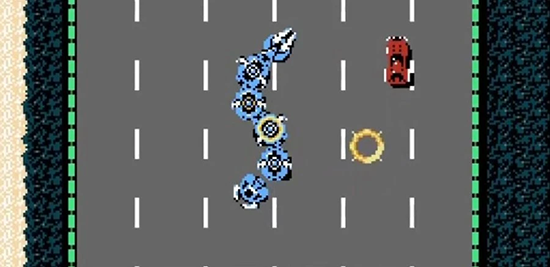
Gun-Dec
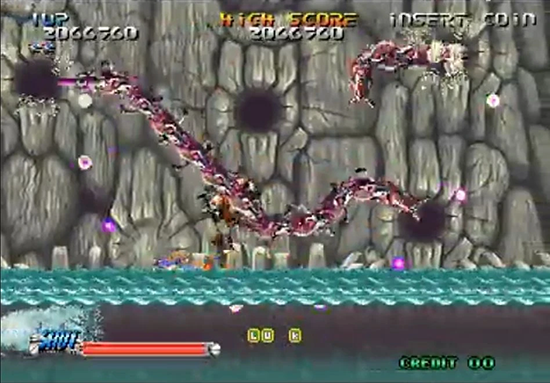
Blazing Star
Viewpoint began under the working title ‘Naname Shoot’ (Diagonal Shoot) and, although the concept of an isometric 3D shmup was already in place, the creation of the graphics began before the game design was finalised (Viewpoint was initially created with graphics as the primary focus). To create these graphics, wireframe models were designed on a computer, then printed and used as layers under which 2D sprites were drawn (a method sometimes called wrap scan, which was used to recreate illustrations or photos in pixel art). The process of creating the graphics for Viewpoint was so time-consuming that Gun-Dec was developed in parallel with part of the same team (including its producer, Toshiyuki Nishimura, who worked as director on Gun-Dec).
Wildran joined the Viewpoint team as a sort of co-director and created a more detailed design document than the original one.
He wanted to create an opening featuring a female character, but it didn’t fit with the music or the game’s setting, so he abandoned the idea (but would reuse it in Blazing Star).
The chosen camera angle raised several questions, including that of the controls: should the joystick be pushed to the right or upwards to move forward?
Some attacks were designed to take advantage of the 3D effect, such as the wall of flames, while the wave of homing missiles was inspired by Macross.
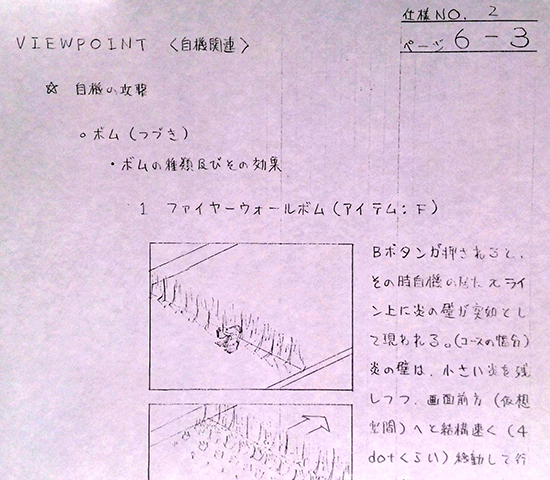
As for the enemies, at first they were all large, but Wildran felt it necessary to add smaller ones. The isometric view posed difficulties for the graphic designers, who found it hard to judge the size of the enemies or certain elements of the background. Once again, Wildran resorted to placing a sheet of graph paper on the screen for the graphic designers to use as a reference.
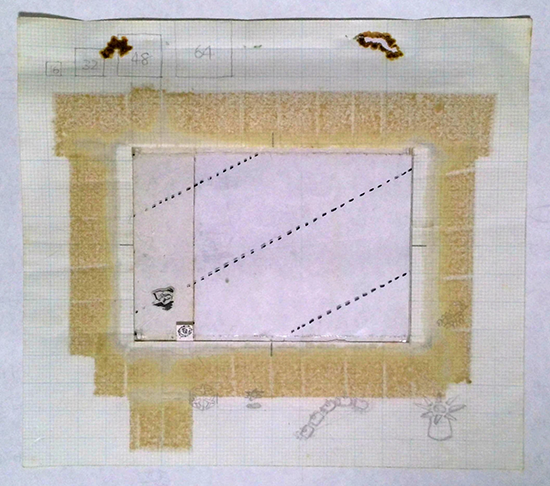
This view also posed problems for players, and although Wildran wanted to adjust the game’s difficulty and some other details, he left Aicom some time before the game’s development was completed for family reasons. He was credited as Run in the game.
Pulstar (1995)
Regarding the relationship between Pulstar (Aicom) and R-Type (Irem), Wildran explained that, to their knowledge, there were no former Irem employees on the game’s development team. The idea was to show that it was possible to create a game on NeoGeo on par with R-Type without necessarily having it developed by Irem.
Regarding the composition of the team, Wildran noted that the lead programmer for Pulstar and Blazing Star had previously worked on the Mega Drive version of Air Buster as well as Super Star Soldier (PC Engine). The game’s producer, Toshiyuki Nishimura, was a former Taito employee who had worked on Kikikaikai and Rastan Saga.
Speaking of staff, the development team for Aicom previous shmup, Viewpoint, included the planner for Namco’s arcade game Märchen Maze.
Blazing Star (1998)
According to Wildran, Pulstar 2 and Blazing Star were two different projects. He added that the message left by one of the Pulstar programmers in the NeoGeo CD version of the game announcing a second instalment was probably more of a wish than an announcement at that stage. Although the Pulstar developers quickly discussed making a sequel and did some graphics for it, their project never Saw the light of day as it was rejected by SNK (Pulstar was not a commercial success).

Early Blazing Star logo, when the game was called Pulstar Blast
It wasn’t until 1996, shortly before Aicom became (?) Yumekobo, that Wildran rejoined the company, nearly four years after leaving shortly before the end of Viewpoint’s development. He submitted a proposal for a shmup called Garumaito / ガルマイト dated June 14, 1996 (the name Aicom can still be seen in katakana in the proposal, as Yumekobo was formed on August 2, 1996 according to GDRI).
Garumaito was originally conceived as a game unrelated to Pulstar, but in order to avoid starting from scratch and without using the name Pulstar, it was decided to use the graphics created for Pulstar 2 and name the game Blazing Star.
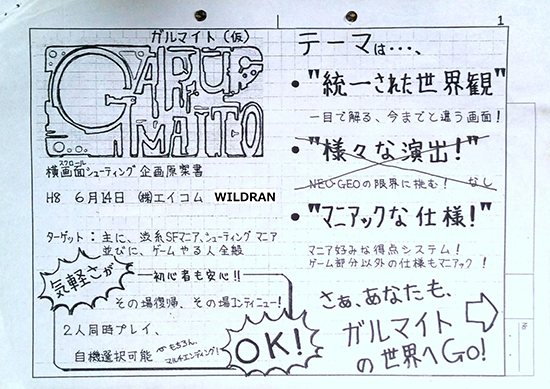
Pulstar character designer Daikichi, along with another designer, created new characters unrelated to Pulstar, while the basic concepts for some of the bosses and levels that would become Blazing Star had already been set out in the design document. However, for economic reasons, it was decided to reuse the graphic assets already created for Pulstar 2, which meant shelving the story written for Garumaito and its characters, even though there are some similarities in the new cast, particularly among the female characters.
Furthermore, as the NeoGeo was (apparently) more suited to horizontal than vertical scrolling, the level design of the Macross stage was revised accordingly.
To create each boss, Wildran wrote a note summarising what he wanted and then worked with the designer. Once the appearance was defined, Wildran refined or modified the various attacks and characteristics of the boss. Finally, the graphic designer and programmer brought the concept to life.
The graphics team was quite large for a shoot ’em up, with no fewer than 10 designers plus support staff (for smaller tasks or shorter periods). Mr. CD was the lead designer, and of these 10 members, 3 were newcomers. CD designed the backgrounds for stages 1 and 5 as well as several enemies, 3D elements, and even the final boss, which was initially assigned to someone else. He also named some of these enemies.
Due to the need to create many enemies, it was decided to halve the number of color palettes allocated to them (it is not possible to display as many colors as one would like on the screen, so color palettes must be predefined and colors drawn from them to design the graphics). This freed up memory and allowed more enemies to be created.
The idea of displaying comments in real time was proposed in the design document as a way for the game to generate more revenue. The idea of a simultaneous two-player mode was one of the mandatory objectives.
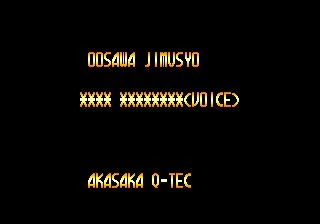
As a big fan of Tokimeki Memorial, Wildran got voice actress Mami Kingetsu (who plays Shiori Fujisaki in the Konami game) to lend her voice for the comments. A character from TokiMemo also served as the model for one of the characters in Blazing Star. However, due to Mami Kingetsu’s popularity, management felt that mentioning her in the credits would drive up the fee (??). Her name was therefore censored.
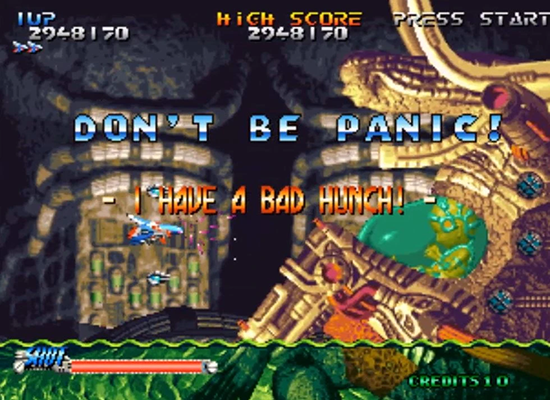
Regarding the point that everyone is waiting for: no, it wasn’t a professional translator who wrote the English text in Blazing Star, but one of the graphic designers, responsible for several enemies, who claimed to be ‘great at English’.
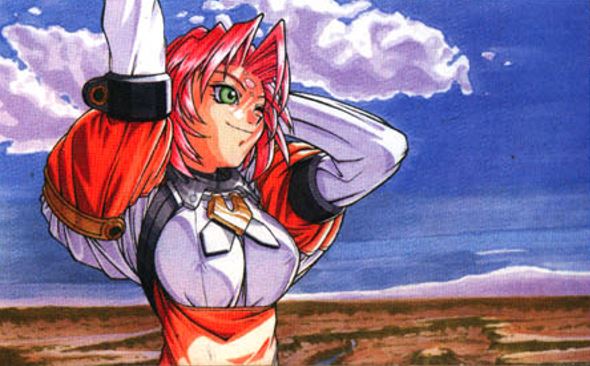
The end of development was apparently rushed by SNK with a rather sudden location test held at NeoGeo Land in Osaka. The Blazing Star team was reassigned to debugging the Saturn version of The King of Fighters (Wildran said ‘96’, but it’s more likely to be ‘97’, released in March 1998) before they could implement the ending sequence. A mid-game cutscene, designed for a hypothetical NeoGeo CD version, was also abandoned. All that remains are illustrations published in NeoGeo Freak.
The game was released in arcades on January 19, 1998 with what appears to have been very limited success and no release on the consoles of the time (NeoGeo, Neo CD, Saturn, PS1).
Love Hina Pocket (2000)
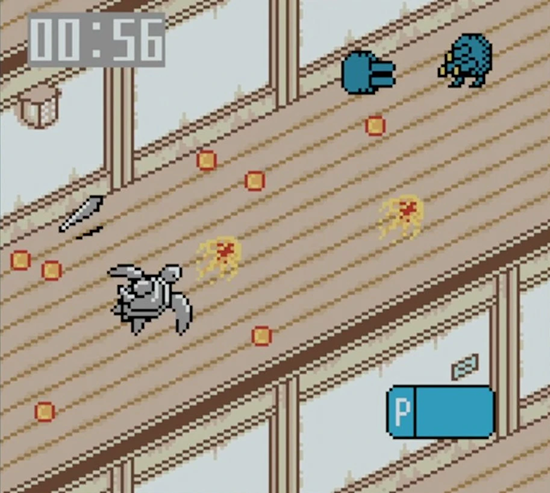
A GBC game that includes a mini shmup with an isometric 3D view.
Games Wildran worked on:
A・B Cop (Arcade – 1990) Programmer
Gundeck / Vice: Project Doom (Famicom – 1991) sub-planner
Viewpoint (NeoGeo – 1992) co-director
Foresight Dolly (PC-98 – 1994) sub-planner, scenario
Blazing Star (NeoGeo – 1998) Director
Fatal Fury First Contact (NGPC – 1999) Director
Love Hina Pocket (GBC – 2000)
Super Real Mahjong Dōsōkai (GBA – 2004) scenario
Mario Party Advance (GBA – 2005) Planning
Walk It Out! (Wii – 2010) Director
Fairy Tail : Gekitotsu ! Kardia Daiseidou (DS – 2011)
Kokoro Connect: Yochi Random (PSP – 2012)
Hello Kitty no DokiDoki Fruit Petanque (G-Cluster – 2013)